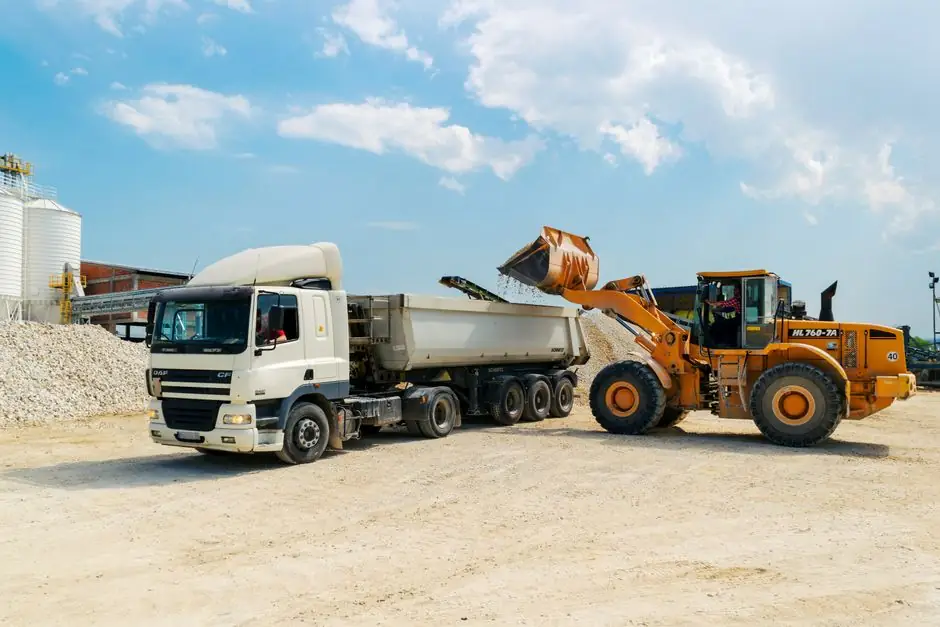
A backhoe loader combines three functions in one chassis: a center tractor, a front loader bucket, and a rear backhoe arm, with all work delivered through a shared diesel-driven hydraulic system rather than cables or mechanical linkages [S1][S2].
Most production backhoe loaders carry a turbocharged diesel engine in the 70-100 hp band, an operating weight between 4,000 and 24,000 lbs (1.8-10.9 t), and a rear dig depth of 8-20 ft, which is why they dominate small construction, utility, and agricultural jobs [S1][S4].
Three-in-One Chassis: Tractor, Loader, Backhoe
The chassis is a tractor, with large rugged tires, an enclosed cab or open canopy, and a swivel seat so the operator can face the rear hoe controls when digging [S1][S2]. The front attachment is a loader bucket used mainly to scoop, carry, and push loose material, not to dig, while the rear backhoe is the actual excavator, with three articulated segments: boom, stick, and bucket, joined at shoulder, elbow, and wrist equivalents [S1].
On a Caterpillar backhoe, the boom is bent upward so the bucket can swing past obstacles in the trench, a layout that mirrors the geometry of a human arm and gives the operator finer control in confined digs [S1]. The backhoe is usually mounted on a side-shift frame with vertical stabilizers, especially on European units, so the dig axis can be offset from the tractor centerline [S2].
Hydraulic Power Pack: Pump, Valves, Actuators
Working fluid is pressurized by an engine-driven hydraulic pump, then routed through control valves to double-acting cylinders at each joint and to the boom, stick, bucket, stabilizer, and steering functions [S1][S5]. The loader uses lift and tilt cylinders on the front arms, while the backhoe uses independent boom, stick, and bucket cylinders so the operator can curl the bucket while swinging the stick at the same time [S1].
Because the hydraulic circuit is closed-center with parallel valve sections, the operator gets simultaneous, proportional movement of multiple functions with low physical effort, which is why a single person can trench, load, and place a sewer box in one cycle [S1][S5]. The same pump also powers the rear auxiliary circuit, so attachments like hydraulic hammers, augers, compactors, and brooms run off the machine's own hydraulic flow without a separate power pack [S4].
Dig Cycle, Stabilizers, and Swing
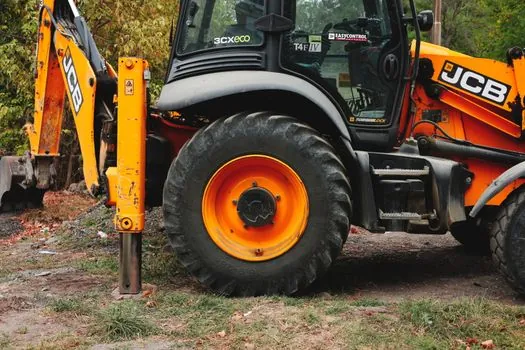
Before any dig, the two rear stabilizers and the front loader bucket are lowered to the ground to lift the tires off the surface and lock the chassis level, so all machine weight becomes reaction mass against the bucket [S1][S5]. The operator then extends the boom outward, drops the stick, curls the bucket into the soil, and retracts the stick to break the cut, repeating the motion to step down the trench face [S5].
Most production backhoes offer roughly 180-degree of rear swing, with swing motion delivered by a hydraulic motor driving a ring gear at the kingpost, which is the same architecture used on a compact excavator but scaled to the tractor chassis [S1][S2]. Material is lifted, swung, and dumped to the side of the trench or directly into a dump truck, with no need to reposition the tractor for each pass [S5].
Loader Cycle: Lift, Carry, Grade
The front loader is run while the machine is rolling, so the operator picks up a load of loose material, reverses off the pile, drives to the dump point, and rakes the bucket forward to spread or doze [S1]. Lift capacities for the loader bucket generally run from 1,500 lbs to about 13,000 lbs at pivot heights between roughly 8 ft and just over 12 ft, depending on the model and counterweight package [S4].
Because the loader doubles as the front stabilizer during backhoe work, the operator learns to sequence motions: lower the loader, deploy the rear stabilizers, then dig, then stow the stabilizers and lift the loader before driving off [S1][S5]. This is one of the reasons a backhoe loader is compared with a wheel loader for site logistics: it can self-load, self-carry, and self-grade in a single machine on tight sites [S1].
Spec Bands and Engine Class
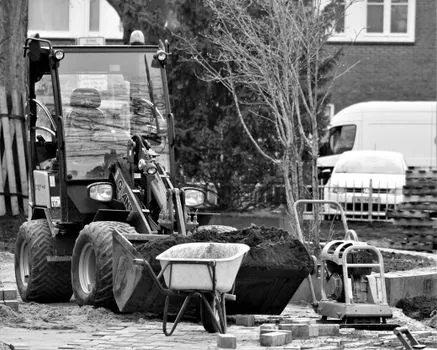
Backhoe loaders cluster into three weight classes: compact 4,000-8,000 lbs (1.8-3.6 t) units with 2WD and 55-70 hp engines, mid-size 15,000-19,000 lb (6.8-8.6 t) 4WD rental units in the 70-100 hp band, and heavy 19,000-24,000 lb (8.6-10.9 t) machines with 100-148 hp engines for deep trenching and loader work [S4]. The CAT 450 sits at 131 hp with a CAT C4.4 ACERT engine, while the John Deere 710L reaches 148 hp at 2,240 rpm and a maximum operating weight of 25,588 lbs (11,607 kg) [S4].
On the small end, the John Deere 310L EP delivers 69 hp at an operating weight of 13,882 lbs, yet still digs to 13 ft 8 in, which is a useful reference point for fleets that need a truck-trailer-legal machine [S4]. The vast majority of rental fleets sit in the 70 hp or 90 hp tier with 15,000-25,000 lbs operating weight, because that band fits the most common dig depth, lift height, and trailer-load envelope on urban projects [S4].
Comparison: Backhoe Loader vs Skid Steer vs Mini Excavator
Versus a skid-steer loader, the backhoe loader trades ground speed and zero-radius turning for dig depth, swing range, and on-board hydraulic flow for hammers and augers, so it wins on trenching and utility work but loses on grading productivity in open yards [S4]. Against a mini excavator, the backhoe loader adds a front loader and road speed, but it has a smaller digging envelope, less swing torque, and a shorter stick, so fleets that run steady deep trenching usually prefer a mini excavator plus a small wheel loader instead [S4].
Attachments and Hydraulic Auxiliary Use
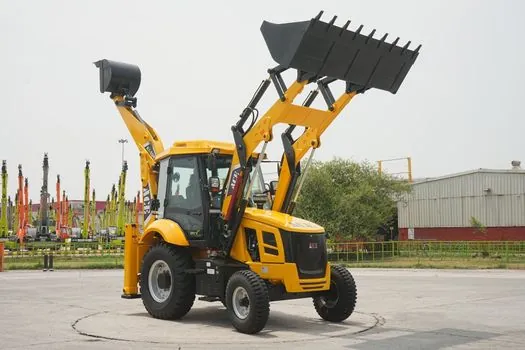
Common rear backhoe attachments include buckets with thumbs, hydraulic hammers, couplers, compactors, rippers, brooms, snowplows, augers, and the so-called tiger tooth for frost and hard soil, all of which tap the machine's standard auxiliary hydraulic circuit [S4]. On the loader side, the same chassis accepts rakes, snowplows, angle blades, asphalt cutters, and material-handler buckets, which turns the unit into a year-round utility machine, not just a digger [S4].
JCB, the largest backhoe manufacturer globally, sells the 3CX and 3DX platforms widely across India, the UK, and emerging markets, and these models are commonly specified with both 2WD and 4WD drivelines, plus factory-fitted hammers and augers for utility crews [S2][S3].
Operating Limits and Safety Constraints
Stabilizers must be down and the front loader lowered before any dig cycle begins; if the operator trenches on the tires, the chassis will rock and the bucket cannot break out the cut to full depth [S1][S5]. The machine must be parked on level ground, with the operator trained on the swing path, because the rear arc covers both sides of the chassis and strikes anything within about 180 degrees of the kingpost [S5].
Underground utility strike is the dominant backhoe-loader incident class, so the safe operating rule is hand-dig or vacuum-expose within 0.5 m of any marked utility before the bucket enters the soil, and the cab ROPS plus a seatbelt is non-negotiable on any sloped surface [S5].
Standards and Sourcing
Backhoe loaders are not governed by a single dedicated ISO or SAE product standard for hydraulic performance; they fall under general machinery safety directives such as the EU Machinery Directive 2006/42/EC for CE-marked units and OSHA 29 CFR 1926.602 for motor vehicle equipment on US construction sites, while operator competence is typically validated against local programs such as OSHA 10/30 or NPORS in the UK [S2].
Key sources for the working-principle and spec detail in this piece are the HowStuffWorks Caterpillar backhoe walkthrough, the Wikipedia backhoe loader entry, DOZR's 2022 spec and attachment guide, and DesiMachines' 2025 working-principle explainer, all of which use turbocharged diesel hydraulic systems as the common architecture [S1][S2][S3][S4]. For buyers cross-checking flow and pressure on a specific model, the manufacturer's service manual is the authoritative source, and most OEMs publish hydraulic pump flow in the 70-100 L/min range at rated engine speed for mid-size units [S4][S5].
Trackable signals to watch next: telematics integration on mid-size rental backhoes, factory-fit electric and hybrid backhoe loader platforms from JCB and CASE entering volume production, and updated ISO 20474 earth-moving machinery safety revisions for ride-control and operator-presence logic on loader arms. For related heavy-equipment context, see this disc coupling selection for packaging lines spec map.