
Rotary ball bearing and linear ball bearing are not substitutes. One resolves radial and axial loads on a rotating shaft; the other resolves a unidirectional force along a straight stroke. The two product families sit in different OEM catalogs, use different cage geometries, and fail by different mechanisms [S1][S2][S6].
As of mid-2026, standard LMK-series flange linear bearings are listed in 3D-printer and packaging-machine accessory catalogs [S3], and bearing manufacturers in Zhejiang continue to ship linear shafts, slide units, and closed/open/adjustable linear bushings as matched systems, not as substitutes for rotary bearings. Picking the wrong family burns a week of debugging on a machine that will not index or, worse, will not align.
What each bearing actually is and which motion it serves
A radial deep-groove ball bearing supports a rotating shaft; load capacity is rated perpendicular to the bore, and the inner ring rotates with the shaft while the outer ring is fixed in the housing. Angular-contact and thrust variants handle combined or pure axial loads on rotating members [S6].
A linear bearing supports a carriage or shaft moving along one axis only. The rolling element recirculates inside a closed or open bushing, and the load capacity is rated perpendicular to the shaft axis. Self-aligning versions from Minitec and HepcoMotion tolerate moderate parallelism error between shaft and bearing bore [S1][S2]. Closed, open, and adjustable styles are sold as separate products with different stiffness and contamination behaviour [S2].
Load direction, stroke, and misalignment: the three hard gates
Rotary ball bearings are rated for combined radial and axial load on a fixed centre line, with misalignment limits typically held under a few arc-minutes. Deep-groove types take radial load with light axial; angular-contact types take axial load in one direction only and are commonly paired in DB or DF stacks [S6].
Linear bearings are rated for a load applied perpendicular to the stroke axis, with no rated capacity for moments about the carriage. A single linear bushing can resist moderate moment loads only when the stroke is short and the load is centred; production designs pair two parallel shafts and four bushings to share moment and overturning loads [S2]. The self-aligning geometry common in Minitec and HepcoMotion products tolerates a small parallel misalignment between the two bearing axes and the supported shaft, which is why single-shaft linear slides are usually dimensioned for short strokes where induced moment is small [S1][S2].
Stroke is the second hard gate. A rotary bearing runs continuously through 360°; a linear bearing has a finite travel defined by the shaft length. If the application requires reciprocation past the practical stroke of a linear bushing, designers either extend the shaft or switch to a recirculating ball screw or ball spline [S6].
Stiffness, life, and the comparison that decides the spec
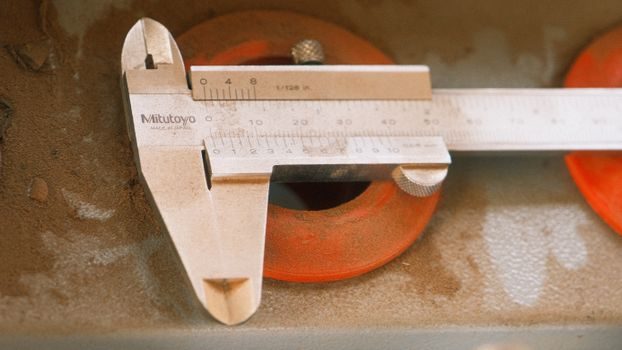
Stiffness behaviour is where the two families diverge sharply. A preloaded angular-contact rotary bearing can hold sub-micrometre radial runout when mounted in a precision spindle housing. A linear ball bushing has measurable compliance along the load direction, and its contact geometry is point-contact between ball and race, the same Hertzian regime as a rotary deep-groove bearing but with the load vector always perpendicular to the motion [S6].
On the four criteria that drive a buy decision, the comparison reads as follows. <strong>Motion type:</strong> rotary = 360° continuous, linear = finite straight stroke. <strong>Load vector:</strong> rotary = radial plus controlled axial via contact angle, linear = perpendicular to stroke axis only. <strong>Misalignment tolerance:</strong> rotary = a few arc-minutes unless explicitly specified, linear = self-aligning bushings tolerate a few tenths of a millimetre parallel offset. <strong>Typical lubrication and sealing:</strong> both families use grease or oil with 2RS or ZZ shields, but linear bushings are more often shipped as open or adjustable types for relubrication in dirty environments [S1][S2].
Materials, ceramics, and contamination behaviour
Standard 52100 chrome steel remains the default for both rotary and linear ball bearings, with 440C stainless selected for medical, food, and cleanroom duty. Ceramic-hybrid bearings, silicon-nitride balls on steel races, are sold as a custom solution for harsh chemical, high-speed, or electrical-isolation applications, and BearingWorks continues to list hybrid and full-ceramic options alongside conventional steel types in its 2026 catalog [S4].
Linear bearings inherit the same steel and ceramic options. The contamination story differs, however, because the linear bushing runs in an open or shielded track where swarf and grit collect. Open and adjustable linear bushings exist specifically so the user can wipe the shaft and re-grease; closed linear bushings are sealed at both ends and used on clean, short-stroke assemblies such as the 13 mm TSM13 ball-bearing linear stages shipped by Zolix, where 3 µm sensitivity is published as a positioning spec [S5].
Where rotary wins, where linear wins, and the failure modes to plan for
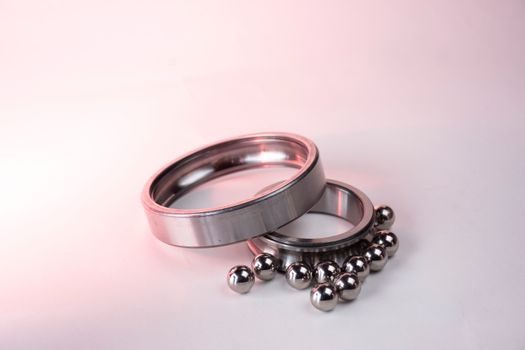
Rotary ball bearings are the correct answer for shafts, spindles, gearboxes, pumps, electric motors, and wheel hubs — any rotating member carrying combined load. The dominant failure modes are false brinelling from static vibration, grease degradation above the rated temperature, and fatigue spalling on the inner or outer race after rated L10 life [S6].
Linear bearings are the correct answer for pick-and-place slides, XY tables, 3D-printer carriages, packaging-machine cross-slides, and optical stages. The dominant failure modes are brinelling from point loading on a stopped shaft, edge-loading when the carriage runs off the end of the shaft, and contamination-induced wear on the ball track. Super-ball and self-aligning linear bushings are designed to reduce edge-loading and parallelism-sensitivity, which is why the same family is sold in closed, open, and adjustable variants.
For metrology stages, ball-bearing linear stages in the 13 mm travel class with 3 µm sensitivity, such as the Zolix TSM13 series, are stacked into manual or motorised positioners when micrometre-class repeatability is enough and a full crossed-roller stage would be overspec [S5]. This is also the crossover point where a ball screw or ball spline starts to look attractive if the stroke grows past a few hundred millimetres or if the load is being driven rather than carried.
Sourcing, standards, and what to verify before you order
Both families ship under the same ABEC tolerance grades for rotary bearings and the same ISO fits for linear bushings, but the published life equations differ. Rotary L10 life uses the Weibull exponent on rotating inner-race speed; linear L10 uses stroke length, stroke frequency, and load magnitude with its own exponent. Specifying one family against the other's life equation is the most common engineering error in this category. [S1]
Sourcing-side signals from mid-2026 show continued Chinese dominance in commodity LM-series linear bushings and standard deep-groove rotary bearings, with Jinan Rockway, Ningbo Hengli, and BSPD among the active exporters carrying ABEC-1 to ABEC-5 inventory and interchange data in their catalogs [S6]. Zhejiang-based shaft and slide-unit specialists continue to ship linear-motion kits as matched systems, so the carriage, shaft, and end-supports are usually ordered together. For harsh-environment applications, hybrid-ceramic and full-ceramic options remain a custom-build conversation with bearing makers like BearingWorks, not a catalog line item [S4].
The next trackable signal: monitor whether the LMK and LME flange-linear-bushing part numbers continue to appear as 3D-printer and packaging-machine accessories in the 2026 H2 wholesale catalogs, which would confirm continued volume production in that price band [S3]. A second node to watch is the spread of self-aligning linear-bushing geometry, currently a Minitec and HepcoMotion specialty, into general industrial distribution [S1][S2].
For related coverage, see Alloy Steel Buying Guide 2026: Grade, Form, Mill Source and MTC.