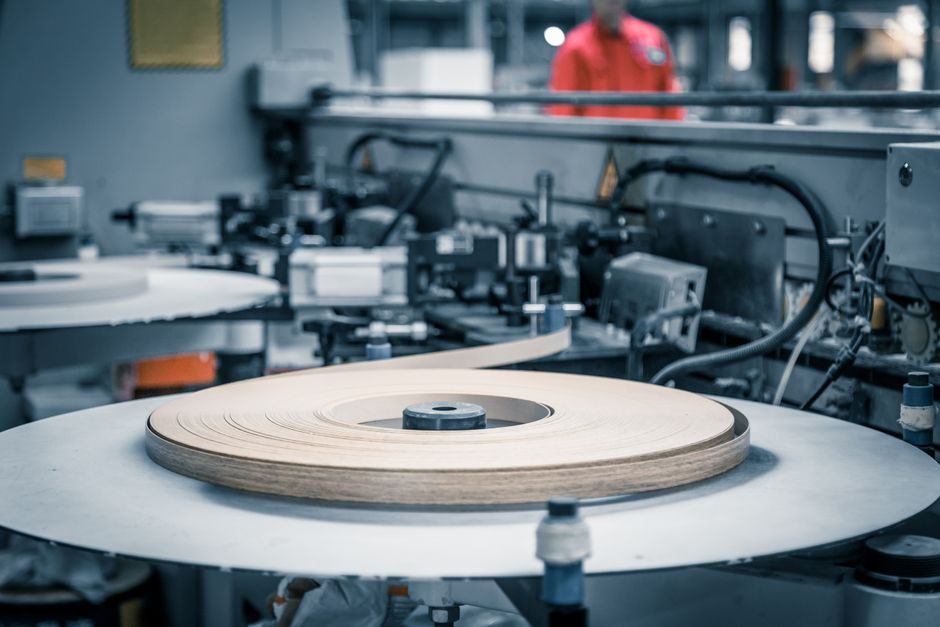
Flat belt drive sizing is a four-input problem: design power (kW), small-pulley speed (rpm), minimum pulley diameter and required belt width — solved against manufacturer tables for the chosen tension member (polyester, polyamide, aramid or steel) [S1][S2].
Forbo Siegling's Extremultus flat-belt line is published at ≥ 98% drive efficiency with rated power transmission up to 1850 kW and a thermoplastic traction layer, while Walther Flender's polyurethane flat belts are stocked in widths of 25, 50, 75, 100 and 150 mm and rated up to 30 t of lifting force with steel or aramid tensile members [S1][S2]. Two different design philosophies (elastomeric polyurethane vs. thermoplastic-coated fabric) meet the same mechanical problem from opposite ends of the catalogue.
What a flat belt actually is, and where it wins over V-belts or chain
Flat belts are continuous strip drives running on flat-faced pulleys, distinguished from V-belts by their rectangular cross-section and from timing belts by the absence of tooth engagement — the drive force is pure friction [S1]. Forbo Siegling markets the construction as truly endless (polyester line, aramide line) or spliced roll, with a thermoplastic traction layer over the fabric, marketed at ≥ 98% mechanical efficiency versus typical V-belt losses [S1].
Flat belts sit in the design space where the user needs high speed synchronicity, low vibration and short take-up travel. Siegling's product copy specifies "short take-up ranges, little creep, good damping" and credits the construction with the ability to handle bevel and cone drives where the belt rotates on its longitudinal axis [S1]. For OEM machine builders comparing flat belt drives to roller chain for low-speed, high-load conveyor service, the trade-off is clear: flat belts run quieter and need no lubrication, but cannot transmit torque across large speed ratios the way chain does.
Selection inputs: power, speed, pulley diameter, arc of contact
Step one is the design power P_d = P_nom × service factor, with the service factor read off the driven machine's load profile (uniform, light shock, heavy shock). Step two is the small-pulley rotational speed n_1 in rpm, which combined with P_d gives the linear belt velocity v = π × d_1 × n_1 / 60 000 in m/s. Forbo Siegling publishes a 1850 kW upper limit and an extremely wide speed range for the Extremultus line, so the practical constraint at the high-power end is belt width and the arc of contact on the small pulley [S1].
Step three is minimum pulley diameter, set by the belt's permitted bending strain. Walther Flender explicitly states that its polyurethane flat belts allow "considerably smaller pulley diameters compared to conventional drive mechanisms," which is the key reason flat drives are retrofittable into tight machine frames [S2]. Step four is the arc of contact on the small pulley, ideally ≥ 120° for friction drives, which fixes the centre distance and the required belt tensioner travel if a take-up is needed. A flat belt that slips almost always traces back to one of these four inputs being mis-sized, not to a belt-quality problem.
Tension member choice: polyester, polyamide, aramid or steel
The tension member decides the belt's stretch behaviour, allowable working load and minimum pulley diameter. Siegling publishes three lines: a polyester traction layer (standard applications), an aramid warp blended into a thermoplastic traction layer (high-modulus, low-elongation), and a polyamide traction layer for highly oriented film constructions [S1]. Walther Flender takes the elastomer route: extruded polyurethane body with either steel cord (highest strength) or aramid (high strength, low stretch) tensile members, with FDA/EU food-grade versions available on request [S2].
Decision logic that holds across both manufacturers: specify aramid or steel when low elongation is non-negotiable (printing, paper feed, precision conveyors); specify polyester when cost dominates and 1–2% creep is tolerable; specify polyamide or polyurethane-only for food-contact or low-pulley-diameter machines where the higher friction coefficient of the elastomer helps. The aramid line is the closest direct cross between the two suppliers and is the most common default for OEM machine builders.
Width and rated capacity: 25 mm to 150 mm and beyond
Walther Flender publishes a fixed width ladder — 25, 50, 75, 100 and 150 mm — and ties rated lifting force directly to belt width, topping out at 30 t [S2]. Siegling's Extremultus line is sold in roll form or pre-fabricated endless, so the width is cut to the calculated value and not constrained to a stock step [S1]. For spec-driven procurement, the Walther Flender width ladder simplifies part numbering; for custom OEM drives, Siegling's cut-to-width approach reduces over-design.
A flat-belt rating table is essentially a matrix of belt width × number of fabric plies × tension-member type, read against the design power and small-pulley speed. Doubling belt width roughly doubles the tractive force at a given tension level — the geometry of a flat belt is simpler than a V-belt because there is no wedge angle to recalculate. Engineers migrating from V-belt designs can use the ribbed belt reference for cross-checking, but the design equations (Eytelwein, belt length formula) are not interchangeable with the flat-belt tables.
Joining, installation and the FIX-FLAT clamping system
Endless belts are mechanically and dimensionally superior but require either factory splicing or on-site welding. Siegling supplies the Extremultus line in three formats: roll stock (spliced on site), prepared for splicing, or already fabricated endless [S1]. Walther Flender's flat belts are explicitly "finite, extruded" — supplied as open-length belts that are joined at installation, with the FIX-FLAT clamping plate system offered as the standard fixing method at both ends [S2].
For a given drive, the choice between endless and open-end is a cost-versus-performance decision. Endless belts run more quietly and have no joint weak point, but cannot be installed without disassembling the drive shaft. Open-end belts with FIX-FLAT plates can be fitted in minutes and re-tensioned, which is the reason Walther Flender can credibly market the line as "maintenance-free, no service or repair costs" — there is no splice to fail [S2]. This is a real-world trade-off that the catalog tables do not capture, and it dominates retrofit work on existing belt conveyor lines.
Criteria comparison: Siegling Extremultus vs Walther Flender polyurethane
Both products occupy the flat-belt drive space but solve different sub-problems. Siegling Extremultus targets high-power industrial drives with rated capacity up to 1850 kW and an efficiency figure of ≥ 98%, supplied in three tension-member lines (polyester, aramid, polyamide) and as truly endless belts or roll stock [S1]. Walther Flender targets lifting and conveying with finite polyurethane belts in a fixed width ladder (25–150 mm), lifting-force ratings up to 30 t, FDA/EU food approvals on request, and a patented FIX-FLAT clamping system for fast on-site joining [S2].
On three decision criteria, the picture is sharp. (1) Maximum published capacity: Siegling 1850 kW [S1] vs Walther Flender 30 t lifting force [S2] — they are rated in different units, which itself signals the application split. (2) Joining method: Siegling offers factory-endless and on-site splicing [S1]; Walther Flender sells open-end belts with FIX-FLAT clamping plates only [S2]. (3) Tension-member options: Siegling = polyester, aramid, polyamide [S1]; Walther Flender = steel, aramid [S2]. The common ground is aramid, the only tension member both manufacturers publish.
Failure modes and what the catalog does not tell you

Three flat-belt failure modes recur in field service: edge wear from pulley misalignment, slip from under-spec tension, and tensile rupture from shock loads. Siegling's Extremultus line is published with an aramid warp blended into the traction layer to resist stretch-induced slip, but the manufacturer does not publish a minimum pulley-diameter table for each belt code in the public catalog [S1]. Walther Flender's polyurethane construction resists edge wear better than fabric belts, but the open-end joint with FIX-FLAT clamping plates is the structural weak point at the rated 30 t lifting load [S2].
The catalog-level data also does not address creep versus elastic stretch, two different phenomena that are commonly conflated. Creep is the small per-revolution slip between belt and pulley and is roughly constant with load; elastic stretch is recoverable and proportional to tension. Polyester and aramid tension members hold creep to a few tenths of a percent over the belt's service life; polyurethane-only constructions show more creep and need periodic re-tensioning. For drives where creep would change product positioning — printing, packaging, cut-to-length — specify aramid or steel and pay for it; for general conveying, the cost saving of polyester is real.
Standards, sourcing and the 2026 supplier map
No single ISO or EN standard governs flat-belt dimensioning at the level that ISO 5293 does for V-belts, so OEM sizing falls back on manufacturer rating tables and on ISO 9001 quality systems at the supplier. EN 12882 is the closest generic reference for conveyor belts on belt conveyors, covering electrical conductivity and flammability requirements that also apply to flat drive belts in classified areas [S1][S2]. For food-contact drives, FDA 21 CFR and EU Regulation 1935/2004 compliance are the relevant gates — Walther Flender publishes the FDA and EU food-approval option for its polyurethane line [S2].
On the supply side, the German tier (Forbo Siegling, Walther Flender) sets the catalog reference, while Chinese trading suppliers cover the lifting-sling and webbing-sling end of the flat-belt market — different product class, different duty cycle, but the same flat-strip geometry. Lifting-sling manufacturers such as those indexed on China.cn publish polyester, nylon and duplex webbing slings from 1 kg MOQ, used for overhead lifting rather than drive transmission [S3]. For OEM buyers cross-checking a drive-belt quote against a lifting-sling quote, the engineering basis is different and the two should not be substituted. For belt-drive spec work, the immediate next step is to pull the small-pulley minimum-diameter table from the chosen manufacturer — Siegling's 2026 product page or Walther Flender's full catalog — and to verify that the design centre distance allows a take-up travel of at least 1.5% of the belt length. Trackable signals to watch: any 2026 catalog revision from Forbo Siegling updating the 1850 kW Extremultus ceiling, and any new FIX-FLAT plate sizing release from Walther Flender beyond the 150 mm width point. See also the conveyor chain sizing and selection guide for cross-checking flat-belt conveyors against chain-driven equivalents on the same duty profile.