Standard ball screws and linear guides ordered through dedicated stock programmes such as NSK Quick Ship shipped in 3-5 days from order to dock as of January 2025, a window the programme continued to advertise through 2026 [S3].
Outside that stock tier, lead times diverge sharply by precision class, length and modification scope: Rollon warned on 16 September 2026 that the highest-precision linear guide classes carry dramatically longer delivery times, especially at rail lengths above 1240 mm [S6], while customised ball-screw repairs through Rockford Ball Screw's service channel have been quoted at one of the fastest turnaround times in the industry, recovering up to 70% of the cost of a new assembly [S1].
Two-tier market: stock programmes vs high-precision custom
NSK's in-house manufactured ball screw and linear guide portfolio under the Quick Ship programme quotes 3-5 day shipment for standard sizes, 5-7 days for components needing minor modifications, and four-week shipment for the MCM Monocarrier integrated actuator family in specific model sizes, with the programme capped at fifteen units per purchase to serve prototyping and pre-production runs [S3].
The opposite extreme lives in the high-precision profile rail and ground ball-screw segment, where Rollon's engineering guidance dated 16 September 2026 states that the highest-precision classes of linear guides usually have dramatically longer lead times, especially at lengths beyond 1240 mm, and the cost of those delays compounds when a single axis cannot be released until every component in the build chain is in house [S6]. The same article frames the decision as a routine engineering trade-off rather than a supply crisis, with accuracy class, length and quantity all driving the calendar.
What is actually driving the 2026 delivery window
Three variables explain most of the spread seen on quote sheets in 2026: precision grade, length, and whether the screw is rolled or ground. Ground ball screws carry tighter lead-error tolerances than rolled screws, and the accuracy designation system (T for travel, P for position) sits behind longer factory lead times for tighter grades [S5].
Length is the second lever. Rollon specifically calls out 1240 mm as the threshold beyond which the highest-precision linear guide classes stretch out [S6], which lines up with the practical reality that long shafts need straightening, end machining and dynamic balancing steps that shorter parts skip. Modification scope is the third: a one-off custom nut, special wiper package, or preloaded assembly on a non-standard diameter moves a part out of the Quick Ship stock pool and back into engineered delivery. For reference, the standard-versus-custom split inside a single vendor's portfolio is visible at ball screw sourcing, where catalogue items and engineered specials share a sales channel but follow different production routes.
Selection criteria that determine which tier you land in

Engineers picking components in 2026 should match the screw class to the duty cycle before chasing the shortest calendar. A ground C7 or C5 class ball screw on a long-stroke semiconductor handler is in a different queue than a rolled C10 unit on a packaging indexer, and conflating them on one purchase order is the most common cause of stalled builds [S5].
The drive-train pairing matters just as much. Ball screws convert rotary to linear motion through recirculating ball bearings in matching helical grooves, with efficiency high enough that smaller motors and drives can be used, but they typically need a holding brake on vertical axes because they are not inherently self-locking [S2]. Lead screws, by contrast, slide on the thread flanks, are usually lower cost, run quieter, and self-lock without a brake, but they cannot match the high-speed, high-load envelope of a ball screw [S2]. The selection table in PBC Linear's reference article marks ball screws as the option for high speeds, high loads, high accuracy and high efficiency, while lead screws win on low cost, quiet motion, self-lubrication and anti-backlash nut availability [S2].
Comparison: stock ball screw, custom ground ball screw, and lead screw pairings
For a process engineer weighing sourcing options against a delivery deadline, the three dominant routes through 2026 stack up roughly as follows. (1) Stock ball screw + profile rail from a Quick Ship programme: 3-5 day shipment, catalogue diameters and lengths only, no preload options outside the standard menu, accuracy class fixed by the part number [S3]. (2) Custom ground ball screw + matched high-precision linear guide: precision class selectable down to C5 or better, length up to and beyond 1240 mm available, but delivery stretches into multi-month territory at the top of the accuracy range [S5][S6]. (3) Lead screw + linear guide pairing: lowest cost, self-locking on vertical axes without a brake, quieter in operation, but limited to lower speeds and loads and not suitable for high-duty-cycle precision axes [S2].
The pairing question is not just a screw decision. A linear guide selected to ride with a ground ball screw should share the same accuracy class envelope, otherwise the screw's positioning repeatability is wasted on a looser rail. For axes where the screw must hold position without power, a lead screw with a self-locking thread form removes the brake from the bill of materials and from the failure-mode list, which is why the two technologies continue to coexist inside the same vendor catalogues. On shorter, lighter axes that still need rigidity, a crossed-roller guide is a frequent alternative to a profile rail when moment loading dominates the duty cycle.
Use cases that justify the longer queue
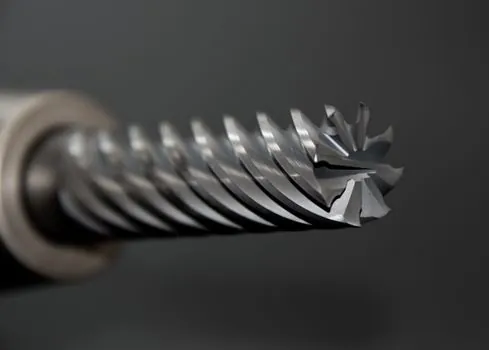
High-precision ground ball screws paired with high-accuracy profile rails are not a luxury choice; they are the only option when the application class demands it. Semiconductor wafer handlers, machine tool spindle tilt axes, optical inspection stages and large-format gantry systems all sit in this segment, and the 1240 mm length threshold that Rollon flags is exactly the territory those machines live in [S6].
For these builds, the engineering question is rarely whether to wait, it is how to de-risk the wait. Specifying two qualified vendors for the same part, freezing the drawing before release, and confirming the accuracy class in writing up front are all standard moves. HepcoMotion's 2023 launch of its short-lead-time ball screw range was framed as a direct response to the same market pressure, with the product family covering driven track systems, ball screw linear actuators, and screw jack integrations across the same sales channel [S4]. A related engineering signal worth tracking is the wider OEE gap discussion in cell-level assembly, where module-line OEE benchmarks and downtime causes put a number on how much a single stalled axis can cost a facility per shift.
Failure modes and limits buyers underestimate
Three failure modes show up repeatedly when lead time is treated as the only constraint. First, mismatched accuracy classes between a ground screw and a rolled rail: the rail becomes the positioning bottleneck and the screw's tighter tolerance is paid for but not used [S5]. Second, omitted brake sizing on a vertical ball-screw axis: a self-locking lead screw would have held, a ball screw will back-drive the moment power is removed, with the load then free to fall [S2]. Third, underspecified end-bearing arrangement: a long screw's critical speed and buckling load both depend on how the ends are supported, and a fixed-free arrangement is rated very differently from a fixed-supported arrangement on the same diameter and length [S5].
On the support side, a ball screw that is not paired with a properly sized bearing support will not reach its rated life regardless of how fast it arrived. Rockford Ball Screw catalogues bearing supports as a separate line, sized to absorb radial and axial force components at the screw ends [S1], and this is consistent with the bearing-load-capacity and buckling equations that any serious ball-screw sizing routine has to include [S5].
Standards, sourcing signals and what to track next
Accuracy grades for ball screws are commonly quoted under the JIS B1192 class system (C0 through C10) for travel and position tolerance, and the T and P designations in the JIS framework correspond to compensated travel and position variation respectively; sourcing specifications should name the class explicitly rather than the marketing adjective [S5]. For length, the 1240 mm threshold is a vendor-defined engineering limit, not a standard, and any quote that does not state the rail length and the precision class together should be treated as incomplete [S6].
Two trackable signals through the rest of 2026: whether Quick Ship programmes such as NSK's keep their 3-5 day standard window under any further supply-chain pressure, and whether the higher-precision end of the market publishes concrete lead-time bands rather than the "dramatically longer" framing still used in 2026 engineering guidance [S3][S6]. For new design work, the safe move is to lock the part number early, dual-source the screw and the rail, and budget the build calendar around the slowest component rather than the average one.