Aluminum riser and gate stock on a foundry cutoff line typically falls between 3/4 inch and 6 inch solid section, which puts it inside the 3 to 10 TPI working band according to Dakin-Flathers' metal-cutting TPI chart [S2], with DoALL's April 2026 aluminum-blade guide placing everyday 1/4 to 2 inch stock in the 4 to 6 TPI or 5 to 8 TPI variable-pitch range [S5].
The decision is not about the alloy label, it is about the thinnest wall and the largest cross-section the blade will see in one shift, because TPI is a chip-clearance problem as much as a tooth-count problem when aluminum is gummy and soft [S5].
Why TPI, Not Tooth Pitch Alone, Drives the Cut
TPI is the count of teeth in a 1 inch span, while tooth pitch is the gullet-to-gullet spacing, and the two scale inversely: 10 TPI gives a 0.100 inch pitch, 14 TPI gives roughly 0.071 inch, 6 TPI gives 0.167 inch [S4]. Dakin-Flathers' rule of thumb holds 6 to 24 teeth in the workpiece for metals and harder materials and 3 to 6 for wood or soft stock, with too few teeth risking tooth straddle breakage and too many causing gullet overload and stripped teeth [S2].
Sawblade University's reference table lines up as 14 to 18 TPI for thin metal tubing and sheet, 10 to 14 TPI for general pipe and profile work, and 6 to 10 TPI for solid bar [S4]. The Practical Machinist thread on portaband TPI confirms the same Ellis Saw recommendation of a 10 to 14 variable-pitch bi-metal blade for stock generally under 1/2 inch, with the same blade still usable on rectangular section up to 6 inch by 6 inch at the cost of slower feed [S3].
Matching TPI to Riser and Gate Section Sizes
Foundry risers are usually hot-topped cylindrical or rectangular feeders above 1 inch diameter, and sprue gates are often thinner channels feeding into the casting cavity, so a single blade rarely covers both in one pass. DoALL's aluminum-specific guidance puts under 1/4 inch walls in the 10 to 14 TPI band, the 1/4 to 2 inch everyday range in 4 to 6 or 5 to 8 TPI variable pitch, and thick solids above that in 3 to 4 TPI coarse blades [S5]. The Chief Delphi metal-cutting thread anchored the same envelope at 14 to 24 TPI as a "relatively high TPI" for most metals, dropping to 18 TPI as a practical favorite when wall thickness varies between 0.040 inch and 1/2 inch [S1].
For a horizontal band saw running mostly 1 inch to 4 inch riser rounds, a 6/10 variable-pitch bi-metal blade is the workhorse, 1/2 inch wide, 0.025 inch thick, M42 HSS tooth tips on a spring-steel back [S6]. A shop cutting thin 0.040 inch to 0.125 inch gates for sand-cast aluminum should keep a dedicated 14 to 18 TPI blade on hand, because a 10 to 14 pitch blade "strips right off" thin stock after a few dozen cuts on a portable machine, according to the same Practical Machinist comparison [S3].
Material, Tooth Form, and Chip Clearance for Gummy Aluminum
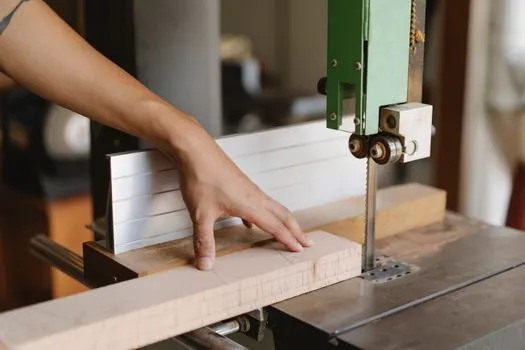
TPI is only one third of the aluminum-cutting problem; blade material and tooth geometry carry equal weight. Bi-metal M42-tooth blades on a spring-steel body are the default for general aluminum work, while tungsten-carbide-tipped blades are reserved for high-volume production and abrasive aluminum alloys that wear HSS teeth [S5]. The teeth need a positive rake angle so the cutting edge shears rather than scrapes, plus a deep gullet so the long, stringy aluminum chips evacuate before they weld back onto the tooth face, the failure mode DoALL calls "gumming" or "galling" [S5].
Variable-pitch blades (10/14, 6/10, 4/6, 5/8) spread the cutting load across different gullet spacings on the same loop, which dampens the harmonic chatter that otherwise shows up when one tooth pitch hits a resonant frequency in a long riser cut. Dakin-Flathers lists TPI options from 1 to 32 across its product range, with Vari-Pitch available for harmonic control on uniform cross-sections like the round or square risers common in iron and aluminum foundries [S2].
Side-by-Side Comparison of Common TPI Choices for Aluminum
Four blade configurations cover roughly 90 percent of riser and gate cutoff work, each tied to a different stock-thickness band: [S2]
- 14 to 18 TPI bi-metal: thin gates and sheet under 1/4 inch, smoothest finish, slowest on thick stock, fits the 6 to 24 teeth-in-workpiece rule for hard materials [S1][S2].<br>- 10 to 14 TPI variable bi-metal: the all-rounder for 1/4 to 3/4 inch wall and small-diameter sprue, holds up on rectangular section up to 6 inch by 6 inch at reduced feed [S3].<br>- 5 to 8 TPI or 6 to 10 TPI variable bi-metal (M42, 1/2 inch wide): the production default for 1/4 to 2 inch riser rounds and gates, pairs with deep-gullet positive-rake tooth form for chip evacuation [S5][S6].<br>- 3 to 4 TPI coarse bi-metal or carbide-tipped: solid riser columns above 2 inch, fastest chip removal, demands a saw with rigidity and enough horsepower to push the coarse tooth [S4][S5].
When a Standard TPI Window Is the Wrong Answer
Variable stock thickness is the failure case where a single TPI blade cannot do the job. The Chief Delphi discussion captured this directly: "in FRC you'll probably be cutting stuff with wall thickness as thin as 0.040 inch and bars 1/2 inch or larger, so there is no perfect tooth count unless you change blades all the time" [S1]. The Practical Machinist commenter running 14/18 TPI bi-metal portable blades on under-1/8 inch steel and up to 1/2 inch aluminum settled on a slow feed for occasional 1-1/2 inch cuts rather than buying a second blade [S3].
The benchmark used by both industry and trade references is 2 to 3 teeth in the workpiece at all times as the minimum engagement, which is what makes a 6/10 variable blade tolerable on a 2 inch riser (the coarse teeth still leave a tooth in the cut) but disqualifies a 14 TPI blade on the same section (every tooth is buried, gullets cannot clear aluminum chips) [S4]. DoALL frames the same limit as a chip-volume problem: a fine pitch on thick stock overloads each gullet and the aluminum welds to the tooth face, while a coarse pitch on thin walls grabs the material because too few teeth are engaged [S5].
Standards and Sourcing Notes for Shop Buyers
There is no ISO or ASME blade-specification standard governing TPI for a given aluminum thickness; selection rests on manufacturer application charts and the 2-to-3 teeth-in-workpiece rule of thumb repeated across Dakin-Flathers, Sawblade University, DoALL, and Ellis Saw guidance [S2][S3][S4][S5]. The Practical Machinist thread cites Ellis Saw's "Band Saw Blade Tooth Selection" chart as the reference table, which tops out at 10 to 14 variable pitch for the finest stationary-machine recommendation and leaves coarser pitches to the operator's stock [S3].
Blade format matters for sourcing: horizontal band saws typically take 64-1/2 inch by 1/2 inch coils (the format of the Imachinist 6/10 TPI M42 reference blade [S6]), while vertical bandsaws and portable Portaband units take shorter, narrower coils. The Chief Delphi thread flagged Starrett, Lennox, and Morse as the durable bi-metal brands operators trust, with Lennox 18 TPI blades showing at least four times the cut count of a 10 to 14 blade on thin steel in the same hands [S1][S3]. A foundry cutting abrasive aluminum-silicon alloys at volume should step up to tungsten-carbide-tipped blades rather than running bi-metal M42 to destruction, per the DoALL material guidance [S5].
Track the next procurement decision against two signals: the thinnest gating section on the cut list, which sets the upper TPI limit, and the largest riser column diameter, which sets the lower TPI limit, then pick the variable-pitch blade whose coarse-end tooth count covers the thick section and whose fine-end count keeps at least three teeth engaged in the thinnest wall [S2][S4]. For most aluminum casting operations that window collapses to a 6/10 variable-pitch 1/2 inch M42 bi-metal blade as the default, with a 14 to 18 TPI blade held in reserve for thin gates and sheet [S5][S6].
For the relevant spec sheets and selection criteria, see riser cutting machine, circular saw, and strapping band.
Related analysis: Chemical Anchor Selection for School Building Projects.