A modeled 16,000 m³ battery-manufacturing dry room had an energy demand of approximately 400 kW in its defined base case [S1].
Across battery plants, conventional clean and dry rooms can represent 26%–53% of total energy consumption, depending on use case and production conditions [S7].
400 kW for a 16,000 m³ Battery Dry Room
The 400 kW figure is a plant-specific result rather than a universal benchmark for every dry room. The underlying process model covered a room with a volume of 16,000 m³ and examined humidity control for the air entering and leaving the space [S1].
For battery manufacturing, the controlled environment must keep moisture below 100 parts per million during relevant processing steps [S1].
The model studied humidity management for air entering and leaving a 16,000 m³ dry room and examined how design and operating parameters affect energy demand and cost contribution to battery manufacturing [S1]. Those design choices can materially change both electrical demand and operating cost because dehumidification must handle incoming moisture continuously.
Dry-Room Share of Factory Energy
Conventional clean and dry rooms account for 26%–53% of overall energy consumption in lithium-ion battery cell production, depending on the use case and production conditions [S7].
Fraunhofer FFB places clean and dry room demand within a broader range beginning at 25%, with the upper value dependent on cell chemistry [S6]. Conventional clean and dry rooms account for 26%–53% of overall energy consumption depending on the use case and production conditions [S7].
The percentages are not contradictory because they use different boundaries. A figure tied to dry-room HVAC, a figure tied to all clean and dry room equipment, and a factory-wide total will produce different shares. Capacity utilization, production conditions, chemistry, leakage load, room volume, dehumidification architecture, and outdoor humidity all affect the result [S5][S6][S8].
Dew Point Sets the Dehumidification Load

The operating target directly determines the amount of water that must be removed.
There is no single energy-consumption figure that applies to every dry room; energy demand depends on factors such as the target dew point and outdoor humidity [S8]. Lower dew points require more effective dehumidification, while humid outdoor air raises the incoming moisture load.
An engineer must define the process dew point, outside design conditions, air-change rate, internal moisture sources, equipment heat gains, operating schedule, and whether the space is continuously occupied [S1][S5][S8].
Dehumidifier Choice: Criterion-Based Comparison
A 16,000 m³ room consuming approximately 400 kW illustrates the scale of the HVAC and moisture-control load, but it does not identify the most efficient equipment for another plant [S1]. The comparison must instead be made against four project criteria: achieved dew point, outdoor design humidity, energy consumption, and recovery or reuse capability.
The comparison is a selection framework, not a claim that one technology fits every plant. Conventional clean and dry rooms still account for 26%–53% of energy use in lithium-ion cell production, while mini-environments can reduce the volume that must be conditioned [S7].
Where Dry Rooms Fit in Cell Production
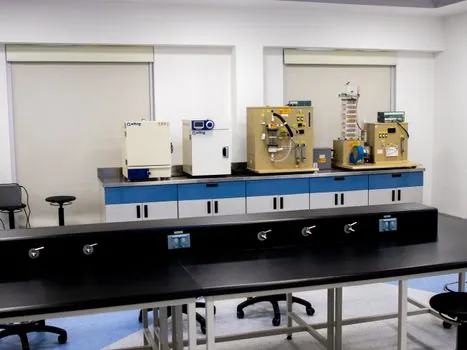
Dry rooms are needed for electrode-related operations and cell assembly. Lithium-ion battery manufacturing entails several steps, including manufacture of the anode, cathode, electrolyte, and separator [S5]. Electrode manufacturing and cell assembly are performed in controlled clean and dry environments [S5].
Dry rooms are extremely important to high-quality cell manufacturing [S4].
That chemistry explains why dry rooms belong in the production risk assessment rather than in the general facilities category. Dry rooms are important to high-quality cell manufacturing, and their design and operation contribute to battery manufacturing cost [S1][S4].
Limits of the Available Energy Benchmarks
The 400 kW base case covers one defined 16,000 m³ model, while the 25%, 29%–38%, 43%, and 26%–53% values represent different scopes and definitions [S1][S2][S5][S6][S7]. None should be applied to another plant without matching the denominator, operating assumptions, and boundary.
A facility engineer should therefore build a project-specific calculation using at least 4 inputs: dry-room volume in m³, target dew point in °C, outdoor humidity at design conditions, and operating hours per year. The model should then add internal moisture generation, fresh-air flow, equipment heat loads, dehumidifier electrical demand, and regeneration or heat-recovery effects [S1][S5][S8].
For a closer look at production-system integration, a digital twin of a battery cell production line can support line-level energy monitoring and process-data reconciliation, provided the dry-room HVAC boundary is measured rather than estimated.
The trackable operating indicators are measured dry-room electrical demand in kW, annual operating hours, dew-point deviation, outdoor humidity at the design condition, and dehumidifier or regeneration-stage consumption. Comparing these values with the 400 kW base case and the 26%–53% plant-energy range gives a defensible way to separate genuine efficiency gains from changes in production volume or space allocation [S1][S7].