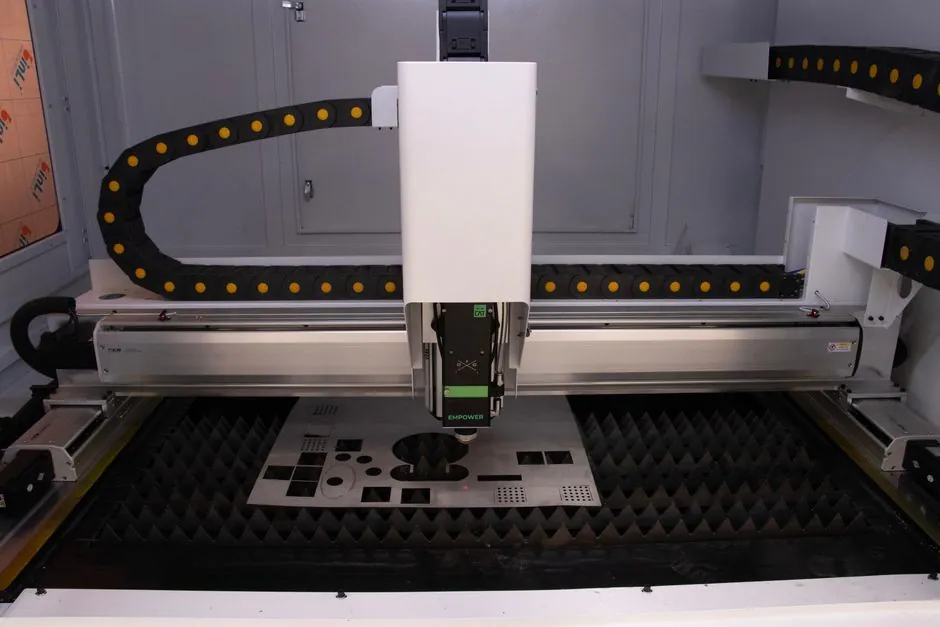
A 6-axis paper machine stretch from wet end to reel, often exceeding 80 meters in a single bay, pushes the limits of any portable metrology tool, and that is exactly the working envelope laser trackers were designed for [S1][S2].
Engineers specifying alignment equipment for paper machines, roll shops, and winder rebuilds in 2026 consistently narrow the field to three platforms: FARO Vantage series, Hexagon Leica Absolute Tracker AT930 and ATS600, and the compact API iLT, with software stacks (FARO CAM2 / BuildIT, Verisurf, Hexagon SpatialAnalyzer) completing the system [S2][S3][S4][S6][S8].
Why Paper Machines Are a Tracker Application, Not a Theodolite Job
Paper machines combine rotating rolls, long dryer sections, and precision bearings that must align within fractions of a millimeter over a 60–100 m footprint, and laser trackers measuring 3D coordinates of a reflector through laser distance, angular encoders, and absolute distance measurement cover the volume in one setup [S2]. Oasis Alignment documents direct paper-machine applications including dryer section frame flatness, press roll parallelism, and reel drum concentricity, all of which benefit from sub-millimeter traceability across the full machine length [S1]. A tracker’s 80 m to 160 m reach and ability to hand off the reflector between stations without re-locking makes it operationally faster than total stations for these geometries [S2].
Practical specification points in a mill environment include IP-rated housings for steamy hood areas, battery operation for moving between wet end and reel, and wireless communication so a single operator can drive the measurement from a tablet [S3]. A laser tracker also functions as a mobile CMM on the machine deck, capturing thousands of points per second during a single inspection pass and comparing them directly to the OEM CAD model for the rebuild [S2][S3].
The Three Platforms That Dominate Mill Floors
Among the three vendor families cited in 2026 sourcing, the FARO Vantage series is the most widely deployed in mill rebuild work, with measurement ranges up to 80 meters, integrated absolute distance measurement (iADM), 6DoF probing for hidden features such as bearing housings behind guards, and wireless portable operation [S2]. The compact form factor and the broad CAM2 / BuildIT software ecosystem make it a default choice for service contractors who move from one paper machine rebuild to the next [S3].
Hexagon’s Leica Absolute Tracker AT930 emphasizes high-speed dynamic measurement, with the wider Leica ATS line including the ATS600, which adds direct non-contact scanning from long stand-off distances for surface work on calender rolls and Yankee dryer shells [S2][S4]. A typical AT-class accuracy envelope sits at sub-micron level for static distance and integrates temperature compensation for hot machine halls where ambient swings distort measurement frames [S2].
API’s iLT positions itself as the most compact and portable tracker in this comparison, engineered for ease of use and rapid redeployment between work sites, which suits a mill maintenance team that needs to share one instrument between paper machines, converting lines, and the winder shop [S8]. For a full comparison of volume, accuracy, and workflow fit, the buying matrix in How to Choose a Laser Tracker: Specs, Volume, and Workflow Fit breaks down the same three families against decision criteria relevant to a paper-mill engineering buyer.
Head-to-Head Comparison on the Criteria a Mill Engineer Cares About
On the four decision criteria that show up in every paper-machine spec, the three platforms line up as follows. Working volume: FARO Vantage up to 80 m, Leica AT-class up to 160 m class envelope, API iLT compact with the same absolute-distance architecture as larger units [S2][S4][S8]. Dynamic accuracy: the published Vantage figure is down to 75 µm at full reach, and the AT930/ATS600 family targets sub-micron distance and high-speed dynamic measurement for moving targets such as rotating rolls [S2][S5]. Hidden-feature access: FARO 6DoF probing and the Leica T-Probe both reach inside dryer section frames and behind press roll housings without disassembling guards [S2][S7]. Portability: API iLT and FARO Vantage are designed as carry-on systems for a single operator, while the larger AT930/ATS600 rigs are typically moved on a cart or tripod between bays [S2][S8].
On software, FARO CAM2 2026 and BuildIT cover as-built, alignment, and projector workflows for both inspection and machine install; Hexagon SpatialAnalyzer and the Verisurf open platform integrate with the Leica AT family and OEM CAD packages used by paper machine builders such as Valmet, ANDRITZ, and Voith [S3][S4][S6]. Practical field data points include tracker-only setups on roll shops where a single operator completes parallelism checks on a calendar stack in a fraction of the time needed with dial indicators, and machine-deck builds where the tracker drives a laser projector for accurate drill and tap patterns on sole plates [S3][S6].
Mill-Specific Failure Modes and Selection Traps
Paper-machine halls impose conditions that a bench-top CMM spec sheet never sees: steam plumes, ambient temperature swings of 10–15°C between hood zones, paper dust, and continuous vibration from adjacent dryer sections, so the practical selection filter is environmental tolerance plus active temperature compensation, not headline accuracy alone [S2][S4]. A common trap is specifying the longest-range tracker in the catalog when the actual paper machine width is under 50 m, because the larger instrument is harder to redeploy between wet end, dryer section, and reel and usually sits on a cart for one operator [S2].
Another pitfall is treating the tracker as a one-person inspection tool without planning for a second technician to hold the reflector on rotating rolls, which is where the Leica T-Probe or a 6DoF handheld target becomes mandatory for any moving-component measurement [S2][S7]. A third mistake is buying on quoted static accuracy (MPE) without checking the full-volume 3D accuracy at the working distance, because paper-machine alignment is essentially a 3D coordinate problem, not a 1D distance problem [S2][S5].
Who Should Buy Which, and Who Should Rent
A multi-machine integrated mill with continuous rebuilds benefits from owning a Leica AT930 or ATS600 for its long reach and high dynamic accuracy, paired with SpatialAnalyzer for the engineering team that already runs Hexagon CMMs in the quality lab [S2][S4]. A converter or single-machine rebuild contractor that moves between sites is better served by a FARO Vantage for its compact carry-on form factor and the broad contractor ecosystem using CAM2 and BuildIT for both inspection and projector-based machine install [S2][S3]. A small mill maintenance department that needs to share one instrument across paper machines, winders, and the roll shop should evaluate the API iLT on portability and ease of use first, then verify accuracy envelope against the longest machine in the plant [S8].
Renting or contracting a service provider is the right call for a mill that needs laser tracker metrology once per major outage, because the FARO/Leica/API platforms all support service-based delivery through OEM-trained alignment specialists, and the ROI math only works for ownership above a threshold of several full machine alignments per year [S1][S2][S6]. For broader shop-floor context on rigging and commissioning equipment used alongside trackers during a rebuild, the forklift installation guide for tracker, rough-terrain rigging, and electric commissioning covers the material-handling side of the same outage window.
Trackable Signals for the Next Outage Cycle
Watch for three verifiable signals before the next planned paper-machine rebuild: vendor-published firmware and software releases in the FARO CAM2 2026 line that add new paper-machine alignment templates [S3]; updates to the Leica ATS600 / AT930 spec sheets that change working volume or 6DoF probing characteristics relevant to dryer-section frame work [S4]; and API iLT accuracy or accessory disclosures that would shift the compact-class comparison for mills weighing a second shared instrument [S8].
For component-level specifications, see construction machinery and equipment, and lamps and light fittings.