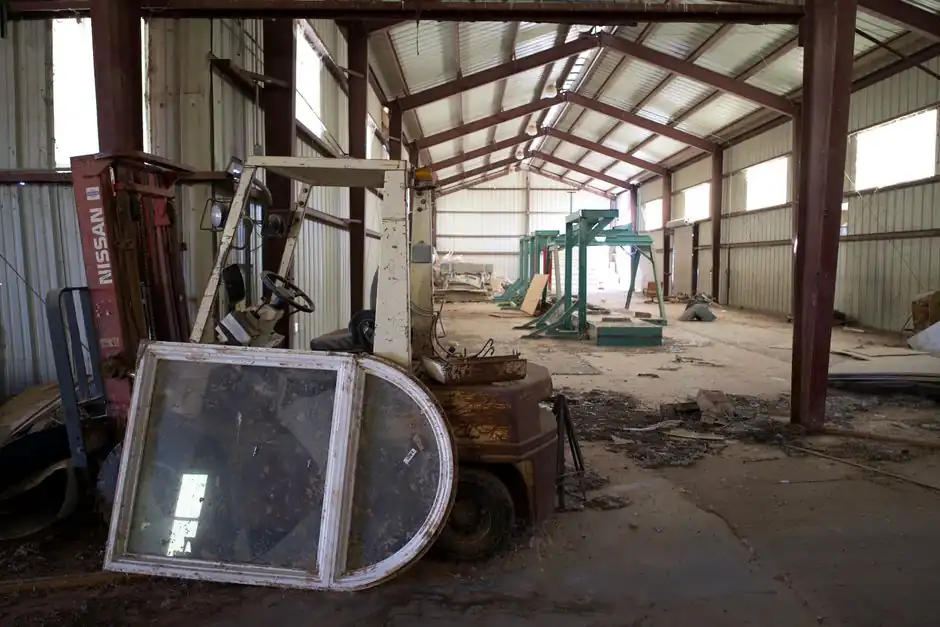
Installation work for forklifts splits into three distinct jobs with very different time budgets: an asset-tracker retrofit on a Raymond or Toyota runs 30-90 minutes per unit across 11 model categories [S1]; a rough-terrain machine going from semi-assembled to first lift takes 4-8 hours per unit on a level hardstand [S2]; an electric counterbalance or reach truck commissioning run adds dedicated circuit, ventilation, and battery-lift steps that can stretch across a full shift [S3].
Common to all three is the same failure pattern: a clearance, hardstand, or wiring detail missed at install becomes a tipover, controller fault, or asset-loss event in the first month. This guide walks the three workflows in order of cost-of-error, then closes with the cross-cutting rules that apply to any forklift handover, including ROPS drilling restrictions, voltage-class limits, and chain-tension acceptance windows.
Asset-tracker retrofit: 30-90 minute job, 11 truck categories
Asset-tracker installation on a forklift is rated at 30-90 minutes per unit by the OEM installation guide, and is scoped for an installer who can identify ignition, alternator, and starter circuits and use pull-up/pull-down resistors, relays, and diodes [S1]. The job covers 11 truck categories spanning Raymond 425-C30TT, 425-C35TT, 960-CSR30T, 750-R45TT, 560-OPC30TT, C4750-C40, C4750-C50, 8400 and 8410; Toyota 8BNCU18, 8BNCU20, 6BPU15, 6BRU23, 8BRU18, 9BRU23, 8BPU15, 8HBE30, 8FGCU25; Nissan UniCarrier MCP1F1A15LV; and Crown RMD6025-32 [S1].
Two hard rules govern every category: do not drill into any OSHA-required certified ROPS structure without written permission, and when in doubt mount the device with at least two 1-inch wide VHB tape strips along the longest side rather than mechanical fasteners [S1]. On 36 V or higher electrical systems, two DC-to-DC step-down converters and fused input and output are mandatory because the tracker cannot accept truck battery voltage directly [S1]. Do not splice or poke-and-wrap at the terminal block; use terminal rings and verify with a multimeter, and on Category 1 trucks add a 36 V fused relay at the deadman input to flip polarity as required [S1].
Rough-terrain rigging: 4-8 hours, six-stage sequence, 4 m × 6 m hardstand
Rough-terrain installation is dominated by a six-stage sequence that runs site hardstand, mast pinning, fork and carriage fit, cabin and tyre reinflation, hydraulic bleed, and first-load acceptance [S2]. For 1.5-3.5 t class machines the Hangcha XF Series covers 2700-6500 mm lift heights at 1500-3500 kg capacity, and the 5.0-10.0 t XF variant extends to 3000-7000 mm at 5000-10000 kg [S2]. Site acceptance starts with a level, compacted hardstand pad of at least 4 m × 6 m rated for the loaded axle weight and an approach ramp under 10% gradient; operating on uncompacted fill above 15% slope is the dominant tipover cause on commissioning day [S2].
Ground pressure under a 3.5 t 4×4 rough-terrain unit with load on the mast runs 80-110 kPa per tyre at recommended inflation, and tyre pattern is a configurable item, not a single option: agricultural-pattern pneumatic for muddy yards, industrial block-pattern for mixed paved and broken ground [S2]. Mast pinning is the second failure point: remove the transport lock pin only after the lift cylinders are pressurised, or the mast can drop under residual pressure and bend the tilt rams, and chain pre-tension must be checked at full free-lift with a 200 kg test load, with each chain deflecting within 5 mm at mid-span [S2]. Rough-terrain forks are de-rated by 10% versus smooth-floor forks of the same size due to dynamic loading on uneven ground, which puts a 3.5 t machine's per-fork pair at roughly 1575 kg each at 600 mm load centre [S2]. A related reference for rough-terrain spec'ing on urban infrastructure work, including ground clearance and 4WD trade-offs, is in this rough-terrain selection spec map.
Electric unit commissioning: 24V/48V/80V supply, 1.5 m clearance, ≤40°C ambient
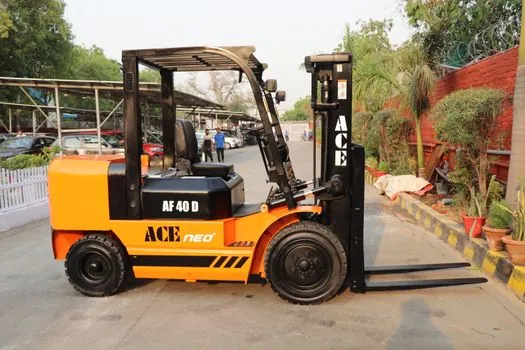
Electric forklift installation is gated by three preconditions: voltage compatibility on a dedicated breaker-protected circuit (24V, 48V, or 80V classes), a minimum 1.5 m clearance around the machine, and a floor rated for the forklift's total weight including maximum load [S3]. Ambient limits are 0-40°C and below 85% relative humidity unless the truck is explicitly rated for harsher conditions, and the battery charging area must have forced ventilation to disperse hydrogen off-gassing plus an ABC dry-chemical extinguisher within reach [S3].
Battery handling is the highest-risk step: lower the battery with a dedicated battery hoist (never a general crane), align terminals against the wiring schematic to avoid reverse polarity, and fasten with the manufacturer's locking bolts or straps so the pack cannot shift under load [S3]. Operators must hold a valid electric forklift certificate and electricians must be licensed for the truck's voltage class; both groups require a documented safety briefing covering battery acid, moving parts, and emergency protocols before first energisation [S3]. A broader selection walkthrough for port and terminal work, where 80V battery electrics are common, is in this port and terminal forklift capacity and duty-cycle guide. Also relevant for outdoor cold-store and yard work is this forklift snow plow and pusher sizing and host-machine match, which covers attachment fitment that often runs in parallel with the install handover.
Cross-cutting rules: ROPS, mast pinning, and chain-tension acceptance
Three rules apply regardless of truck class. First, never drill into a manufacturer-defined ROPS structure without written permission; the asset-tracker guide lists this as the single mandatory pre-drill check, and the same logic applies to any overhead guard or cab pillar [S1]. Second, mast pinning and chain pre-tension are acceptance-gated, not best-effort: chains must show equal deflection within 5 mm at mid-span under a 200 kg test load, and the equaliser pulley must sit centred in its bracket before the first production lift [S2]. Third, hardstand and clearance dimensions are not negotiable: 4 m × 6 m for a 3.5 t rough-terrain unit, 1.5 m radial clearance for an electric counterbalance, and approach gradients under 10% for rough terrain [S2][S3].
When the install cannot meet those gates, do not improvise. A weak floor, a missing breaker, or a non-ROPS-safe mounting point is a stop-work condition: reschedule, repour the pad, or reroute the tracker mount rather than sign off a marginal unit. For demolition and other high-shock duty cycles where spec'ing precedes install, the 4WD, clearance, and load-center math for demolition forklifts article covers the upstream sizing decisions that determine which installation envelope you are working in.
Trackable signals for the next commissioning cycle: (1) fleet-wide tracker install completion rate across the 11 categories versus the 30-90 minute per-unit budget; (2) first-month tipover and chain-tension rework rate as a proxy for hardstand and mast-pin compliance on rough-terrain deliveries; (3) battery-hoist versus general-crane near-miss reports as a leading indicator of electric-install procedural drift. For context on the broader forklift selection decisions that feed these install envelopes, the agricultural and forestry selection spec maps cover low-speed yard use and uneven-terrain loading that sit adjacent to the rough-terrain install path.
Spec-level background on the components involved: linear guide, and crossed roller guide.