
Industrial stainless-steel bimetal thermometers from Chinese OEM channels list between US$3.58 and US$10.00 per unit FOB at 100-piece MOQs in the April–June 2026 Made-in-China windows [S3][S6].
Branded US-market equivalents — Ashcroft 3" and 5" industrial dials — surface on the secondary channel at US$49.95 and US$215.00 respectively [S5]. That 5×–50× spread on functionally similar instruments defines the real procurement problem: how to read OEM price lists without under-specifying for a process line.
What "bimetal thermometer" actually covers in the 2026 price lists
The Made-in-China category "Bimetal Thermometers" groups three distinct product families under one search: 2.5"/3"/4" stainless back-mount industrial dials, adjustable-angle 1/2"NPT process gauges, and decorative V-shape panel units [S3][S4]. A peer process reference covering the working principle is the bimetal-thermometer entry — useful when explaining the helix/coil mechanism to procurement.
At the low end, household and medical-grade bimetal sticks (axillary, nursery, BBQ probe) list at US$0.50–1.50 per piece at 1,000–10,000-piece MOQs, mostly under ISO 9001:2015 factories in Anhui and Ningbo [S1][S2]. These are not interchangeable with process instrumentation: the case pressure rating, stem length, and dial accuracy class differ by an order of magnitude.
Decision criteria that move the unit price
Four variables drive the spread between US$3.58 and US$215.00 on otherwise similar 3"–5" dials: case material, stem length and connection, liquid filling, and brand/origin [S3][S5][S6].
Case material is the first splitter. 304 stainless industrial cases from Yuyao Gongchuang and similar OEM lines sit at US$4.00–10.00 [S3]; decorative "luxurious gold finish" V-Shape dials from Changzhou KB Instruments run US$6.90–19.90 at 1,000-piece MOQ [S4]. Branded OEM dials from US manufacturers carry the material cost plus calibration paperwork.
Stem length and process connection form the second axis. A 1/2"NPT adjustable-angle 5" dial is a different tool from a back-mount 3" panel gauge, and the price reflects the thermowell interface machining, not the bimetal element [S3].
Liquid fillable cases (silicone or glycerin) for vibration service add roughly 20–40% to the case cost on Chinese OEM channels and are listed as a separately negotiable option on the TM Sensor manometer family [S4].
Brand and documentation are the largest non-material premium. An Ashcroft 50-EI42-E-060 5" dial, 5-3/8" stem, 30–130 °F range, lists at US$215.00 on the open-box secondary channel — roughly 30× the Chinese OEM equivalent dial of the same nominal size. A new-in-box Ashcroft 30-EI-60-E-090 3" dial sits at US$49.95, closer to a 6–10× multiplier on the Chinese 3" stainless [S5].
Price comparison across the main options
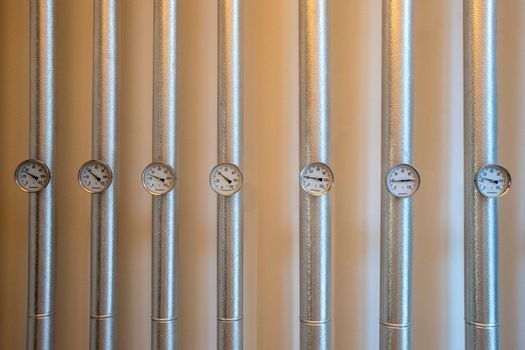
The table below lines the four main sourcing options against four decision criteria, drawn only from the 2026 price snapshots [S1]–[S6].
Household stick (Anhui/Ningbo OEM, 10,000 MOQ): US$0.50–0.62 per piece, no industrial certification, not for process lines [S1].
BBQ/household stainless case (Ningbo Boro, 1,000 MOQ): US$1.05–1.16 per piece, IP rating not stated, not for hazardous-area service [S2].
Industrial 2.5"–4" back-mount stainless (Yuyao Gongchuang, 100 MOQ): US$4.00–10.00 per piece, plain 304 case, OEM custom labelling available [S3].
Branded US 3"–5" industrial (Ashcroft, secondary channel, single-unit): US$49.95–215.00 per piece, factory calibration traceability included [S5].
Where a US$4 dial fails and a US$215 dial earns its place
A US$4–10 Chinese OEM dial is appropriate for non-hazardous utility service: HVAC water loops, compressor interstage, tank skin, bearing-house local indication [S3]. They are also the right pick for OEM skid builders who need large quantities of identical 3" back-mount gauges at predictable cost.
A US$49.95–215.00 branded unit earns its place where the dial is the primary safety indicator: fired-heater skin thermocouple backup, refinery column overhead, or any loop where the gauge is read for safety-critical confirmation and the calibration paper trail is auditable [S5]. A related comparison for non-contact service — and where infrared wins on moving or energised targets — is covered in the infrared-thermometer reference and in the 2026 spec-match piece infrared vs bimetal process jobs.
Hidden cost lines that change the per-unit economics

MOQ-driven cash flow is the first non-obvious line. A US$3.58 dial at 100-piece MOQ ties up ~US$358 per SKU; a US$215 Ashcroft at single-unit MOQ frees that capital but loses the per-unit discount [S3][S6]. For a maintenance stockroom running 40 SKUs, that is a working-capital question as much as a unit-price question.
Calibration and traceability is the second. Branded units ship with factory certs traceable to NIST or equivalent; Chinese OEM dials list calibration as negotiable, and several 2026 listings do not state any cert at all [S3][S4]. For a regulated plant, recalibration cost at an external lab can erase the OEM unit-price saving inside one cycle.
Thermowell and stem interface is the third. Industrial installations specify a thermowell between the dial stem and the process; a US$4 dial in a US$120 thermowell is normal, but the dial-thermowell-interface machining must match — and that is where cheap OEM dials sometimes fail, with NPT threads that do not seat cleanly on a US-supplied thermowell [S3][S4].
Standards, certification, and what to verify before ordering
For hazardous-area service, the relevant framework is ATEX 2014/34/EU for European sites and IECEx for global EPC projects; the dial itself is normally part of a larger certified assembly rather than independently certified [S3].
For sour service, NACE MR0175 governs the materials of the wetted stem and the thermowell, not the dial mechanism — verify with the thermowell supplier rather than the dial OEM [S3].
Dial accuracy classes follow manufacturer convention (typically ±1% or ±2% of full span); the 2026 OEM listings do not publish a class, so request it on the datasheet before signing a PO [S3][S4].
Sourcing signals worth tracking after June 2026

Two signals are trackable on a 60–90 day cadence: (1) whether the Made-in-China industrial-bimetal category tightens the MOQ floor from 100 pieces to 50 pieces as smaller Western distributors enter, which would compress the US$4–10 tier toward US$3.58 [S3][S6]; (2) whether the Ashcroft secondary-channel listings in the US$49.95–215.00 band start appearing with new-in-box rather than open-box condition more frequently, which would suggest channel inventory build rather than liquidation [S5]. For process engineers comparing a bimetal dial against an electronic alternative on the same loop, the infrared-thermometer reference and the pt100 rtd response time vs thermocouples and thermistors piece are the natural next reads.
Related: linear guide.