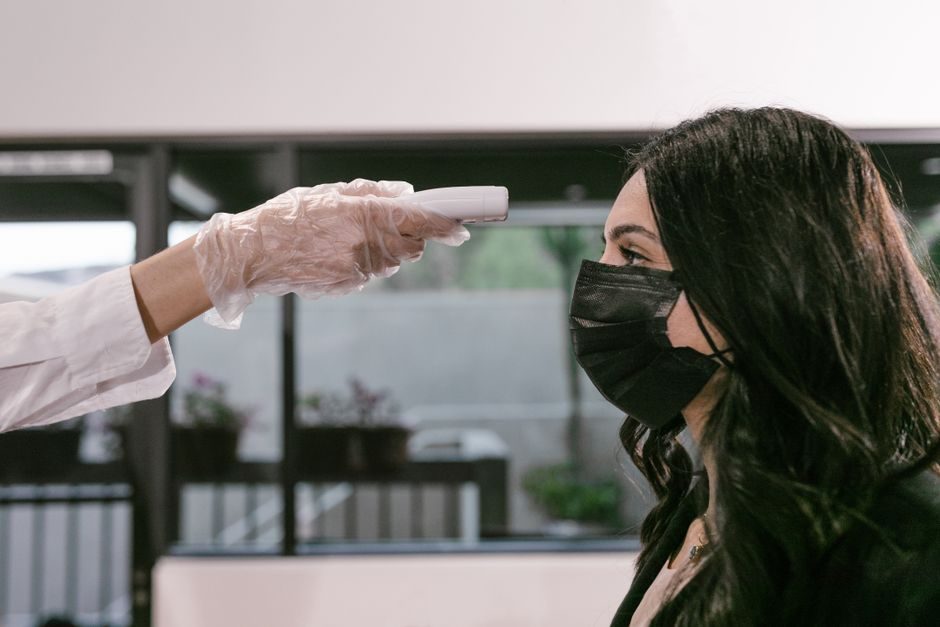
An infrared thermometer such as the OMEGA OS-VIR50 measures surface temperature from -50 °C to 2,200 °C with 0.1 °C resolution using double-laser aiming, USB data link, and onboard video — a non-contact instrument designed for moving, energized, or hard-to-reach targets [S1]. A bimetal thermometer such as the Ashcroft C-600B-05-BS is a 4-1/4 in dial, 18 in stem, 0-120 °C local-indication instrument built around a coiled bimetallic strip, intended for threaded thermowells on static piping and vessels [S4]. The two are not substitutes; they answer different questions about the same process.
This article lines up the two technologies against the criteria that actually drive a spec: sensing principle, accuracy class, response, environment, certification, installed cost, and maintenance model. For deeper procurement detail on the IR side, see the Infrared Thermometer Buying Guide 2026: Specs, Optics, Calibration and the Industrial Infrared Thermometer Selection: D:S, Spectral Band, Emissivity primers, and for context on how thermometers sit inside a loop see Temperature Transmitter vs RTD Pt100: Element, Transmitter, Loop.
Sensing principle and what each one actually measures
Infrared thermometers infer temperature from the thermal radiation emitted by a surface in a specific spectral band, using an optical head to define a measurement spot at a defined distance-to-spot ratio. Because the device never touches the target, it reads surface temperature only — any dust, oxide scale, oil film, or polished finish shifts emissivity and therefore the reading [S1]. The OS-VIR50 lists a 2,200 °C upper limit, double-laser sighting, and 0.1 °C resolution, with relative humidity and contact-mode options bundled into a single handheld [S1].
A bimetal thermometer, by contrast, relies on the differential thermal expansion of two bonded metal strips coiled into a helix; one end is fixed inside the thermowell, the free end drives a pointer, and the reading is the local bulk temperature of whatever the well is immersed in. Industrial stainless-steel bimetals on Made-in-China listings cover 0-120 °C and similar process ranges with PT100/RTD options at roughly US $10-25 per piece in OEM quantities [S3]. The Ashcroft C-600B-05-BS is a 4-1/4 in dial, 18 in stem, 0-120 °C unit in the same local-indication class [S4]. Both are commonly built around stainless-steel wetted parts for chemical and utility service [S3].
Accuracy, response time, and surface vs bulk temperature
An IR unit can be specified with sub-second response because there is no thermal mass to heat up, and the OS-VIR50 quotes 0.1 °C resolution across a 2,250 °C span [S1]. The trade-off is emissivity dependence: the displayed temperature is only as trustworthy as the emissivity setting, the spectral band match to the target material, and the cleanliness of the optical path. Field use without a blackbody reference drifts unless the operator validates against a known source.
A bimetal thermometer responds in tens of seconds because the helix has to physically wind or unwind as the thermowell conducts heat. Accuracy is dominated by the geometry of the helix and the quality of the dial mechanism rather than by emissivity; a properly immersed bimetal in a well-greased thermowell reads the bulk fluid temperature of the process, not the wall. For most 0-120 °C service on water, glycol, or light oils, this is the measurement the operator actually wants. For comparison points on how this class of instrument fits in a broader instrumentation architecture, see the Pressure Transmitter Buying Guide 2026: Match Type, Output and Certification to Process and the Temperature Transmitter Selection Criteria: Sensor, Output, Safety, Diagnostics references.
Environment, safety, and hazardous-area fit

Infrared is the only practical option when the target is moving (rotating drums, conveyors, webs), electrically live (busbars, switchgear, transformer windings), behind a sight glass, or inside a vacuum/induction furnace where a physical probe would fail. The OS-VIR50 spec includes a video module and alarm outputs to support continuous monitoring roles [S1]. Where the IR device itself must sit in a hazardous area, the certification (ATEX 2014/34/EU, IECEx) is carried on the handheld body, not the target.
A bimetal thermometer with a stainless-steel stem and case is itself a passive mechanical device — no electronics in the head — so it sits naturally in flammable or dusty zones without intrinsic-safety constraints. Its weakness is the thermowell: a fixed, threaded or flanged penetration that has to be drained, chemically cleaned, or pressure-rated. Forged thermowells must be specified to ASME B16.34 / ASME PTC 19.3 TW for stress calculations; the bimetal itself is the simplest part of the assembly. Operators who need a 4-20 mA or HART output from the same point typically swap the bimetal for a pressure-transmitter-style temperature transmitter with an RTD element.
Criteria-based comparison: infrared vs bimetal on the dimensions that drive a PO
Side by side, the two instrument classes answer different questions. The OMEGA OS-VIR50 handheld spans -50 °C to 2,200 °C with 0.1 °C resolution and double-laser aiming at an indicative €860 ex-tax [S1]. The Ashcroft C-600B-05-BS is a fixed 0-120 °C, 4-1/4 in dial, 18 in stem bimetal at roughly US $151 on the secondary market [S4]. Bulk OEM bimetals from Chinese manufacturers cluster at US $10-25 per piece for stainless-steel, dial-type, PT100-compatible units in 100-piece MOQs [S3].
On the four decision criteria that usually pick the winner: (1) Target accessibility — IR wins whenever the target is moving, live, or sealed behind glass; bimetal wins for any threaded thermowell on a pipe or vessel. (2) Reading type — IR reads surface only, so emissivity and surface condition are first-order errors; bimetal reads bulk fluid via the well, which is what most process operators actually want. (3) Cost per point — bimetal is one to two orders of magnitude cheaper per installed point and needs no power or cabling; IR is a capital instrument with a single operator serving many points. (4) Hazardous-area fit — bimetal is intrinsically safe as a passive mechanical device; IR requires the handheld itself to be zone-rated, and the target dictates the optics and spectral band.
Installation, calibration, and lifecycle
Installing a bimetal is a thermowell-and-fitting job: a 1/2-NPT or flanged thermowell welded or screwed into the pipe, the bimetal inserted, and a visual check against a known reference. Calibration is a mechanical zero-and-span on the dial, and the failure mode is a sluggish or stuck pointer as the helix fatigues — usually a 10-to-20-year service life in clean service. The Ashcroft C-600B-05-BS is representative: a 4-1/4 in dial, 18 in stem, 0-120 °C unit sized for direct thermowell mounting [S4].
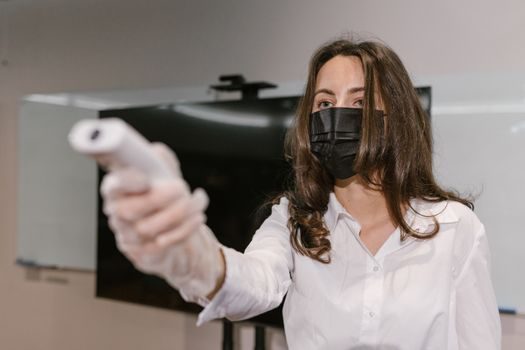
Installing an IR thermometer is an optical job: pick the spectral band (8-14 µm for general surfaces, 1.0-1.6 µm for metals, special bands for glass), set the D:S ratio to fit the spot size to the target, configure emissivity, and verify against a blackbody. The OS-VIR50 ships with USB, an LCD, double-laser aiming, and a video module to document aiming and reduce operator-induced error [S1]. Calibration drift is dominated by detector ageing and lens contamination, not by the target, and a yearly blackbody check is normal. For a deeper look at how infrared temperature compares with non-temperature inline measurement, the Rotameter vs Electromagnetic Flow Meter Selection Criteria and Conductivity meter selection criteria for chemical dosing skid design articles cover the same engineering-decision framework in adjacent instrument families. The underlying physical principles of non-contact temperature measurement are also detailed in the infrared-thermometer and bimetal-thermometer encyclopedia entries, which sit alongside related primary-sensing references such as the infrared-level page.
Who each instrument is for — and who it is not for
An IR thermometer is for the maintenance technician, the process engineer troubleshooting a hot spot on a furnace shell, the electrical team scanning a 10 kV bus duct, the quality lab checking incoming coil temperature, and the food plant auditing packaged goods on a conveyor. It is not for the control loop that needs a tight, repeatable, emissivity-independent reading on a process stream; that is a thermowell-and-transmitter job, not a handheld job. [S1]
A bimetal thermometer is for the local operator who needs to glance at a pipe and read 87 °C, for the skid builder who wants a cheap, rugged, certified indication on every heater and cooler, and for the hazardous-area process where a passive mechanical gauge is the simplest possible device. It is not for moving targets, not for non-contact scanning, and not for any point where the operator needs a logged, transmitted, or trended reading. For that last case, the right answer is an RTD or thermocouple in the same thermowell feeding a 4-20 mA or HART transmitter, with the bimetal retained as a mechanical backup [S3].
Selection rules of thumb and common spec errors

Five rules I tell junior engineers on a daily basis: (1) If you can put a thermowell in it, use a bimetal or a contact transmitter; do not waste an IR on a static pipe. (2) If you cannot touch it, you must use IR, and the first question is spectral band, not brand. (3) Never trust an IR reading on a shiny metal without painting a high-emissivity patch or using a short-wavelength band designed for metals. (4) Never install a bimetal in a vibrating line without a thermowell filled with heat-transfer compound; the reading will be 20 °C low and slow. (5) Treat the dial and the IR as complementary: bimetal for what is happening in the pipe, IR for what is happening on the outside or on a moving surface. [S2]
The Ashcroft C-600B-05-BS at 0-120 °C and 18 in stem is a textbook example of a correctly-sized bimetal for a hot-water or light-oil line; the OMEGA OS-VIR50 with a 2,200 °C ceiling and double-laser aiming is a textbook example of a process-grade handheld for furnace, electrical, and predictive-maintenance scanning [S1][S4]. A common spec error is to use the IR unit as a control-loop transmitter because the spec sheet is impressive; control loops need a contact sensor, a thermowell, and a loop-powered transmitter, not a handheld with a USB port. The other common error is to over-spec the bimetal — buying a 0-600 °C industrial unit for a 0-100 °C water line drives up stem length, response time, and cost for no accuracy gain. Match the range to the working temperature with a sensible safety margin, and keep one spare on the shelf.
Trackable signals for the next planning cycle: ashcroft-style industrial bimetals continue to ship in the US $10-25 OEM band from Chinese manufacturers with PT100/RTD options bundled in [S3], and high-end handhelds such as the OMEGA OS-VIR50 hold their indicative price point around €860 ex-tax with video and USB documentation features becoming standard rather than optional [S1]. For adjacent instrument decisions on the same skid, the pH Meter vs Online pH Analyzer: Range, Output, Selection and High voltage tester vs micro-ohmmeter: which one belongs on a traceable certificate references apply the same criteria-based selection logic to other measurement families.