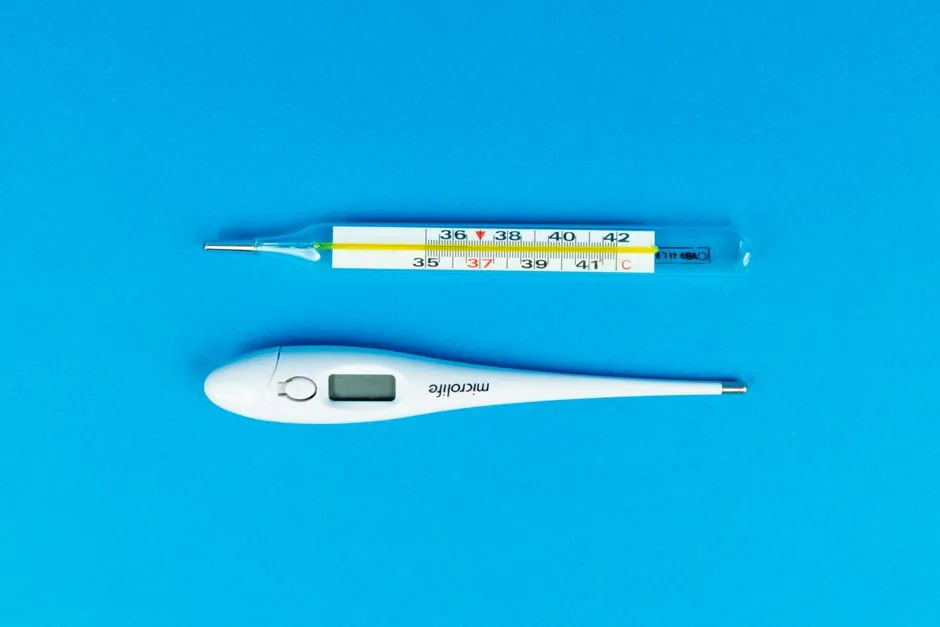
Industrial bimetal thermometers cover -80 to +500 °C with Class 1.0 to Class 1.5 accuracy per EN 13190, hermetically sealed 1 in to 6 in dials (25 to 150 mm), and 304 or 316SS cases [S1][S4][S6]. They require no external power, output no signal, and survive harsh field conditions where a wired pressure transmitter or remote infrared thermometer would be overkill or unsafe.
The selection problem is narrow but unforgiving: spec the wrong stem length, dial size, or wetted material, and the gauge reads off-scale, lags the process, or corrodes within months. This article maps the realistic choices a buyer faces, from pocket-size 25 mm indicators up to 150 mm process-class units, and lines them up against range, accuracy, ingress, and material criteria so the spec does not need a re-issue.
Operating Principle and the Variables That Actually Move the Spec
A bimetal strip is two metal sheets with different thermal expansion coefficients bonded together, then cut and coiled into a spiral or helix; temperature change winds or unwinds the coil, and a transmission shaft turns the pointer [S4]. That simple mechanism sets the operating envelope: a bimetal thermometer has zero power consumption, no electronics, and a linear pointer angle to temperature after calibration, which is why it is specified as the default local indicator for tanks, bearings, and HVAC headers where a bimetal thermometer reading must be visible at a glance [S5][S9].
Four variables drive almost every selection decision: the measuring range (-80 to +500 °C across the cited catalogs), accuracy class (1.0%, 1.5%, or EN 13190 Cl.1), stem geometry (axial, radial, 135°, universal), and the wetted material (304SS default, 316SS for chemical service, Hastelloy C-276 for acids) [S1][S4][S8][S9]. Once those four are fixed, the rest (dial size, window glass, bezel, recalibration screw) is mostly ergonomic.
Dial Size, Case Geometry, and Readability Gates
Dial size runs from 1 in (25 mm) pocket indicators through 2 in (50 mm), 2.5 in (63 mm), 3 in (75 mm), 4 in (100 mm), 5 in (125 mm), and 6 in (150 mm) process dials [S2][S5][S6]. A 25 mm to 50 mm dial is reasonable for OEM panels and indoor cabinets; 63 mm to 100 mm is the workhorse for eye-level field reading at 2-3 m; 125 mm to 150 mm is reserved for long sightlines on vessels, tank farms, or anywhere the operator reads from across a walkway [S2][S5][S6]. The same size envelope is reproduced in WSS industrial series units, where 100 mm and 150 mm dials are the dominant process sizes [S9].
Case and bezel choices follow the dial size. The dominant construction is SS304 weatherproof to IP55 or IP65 per IEC 60529, with drawn steel black powder-coated cases for non-corrosive indoor service and crimped or removable 304SS bezels for hermetic sealing [S3][S5][S6]. Working temperature inside the case is typically limited to 75% of full scale, a rule Tuckson prints in its standard-features table, because pointer error rises and coil fatigue accelerates past that point [S5].
Stem Diameter, Length, and Thermowell Decision
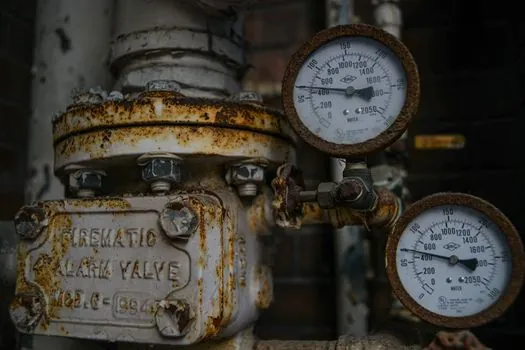
Stem diameter is offered in 6 mm, 8 mm, 9.5 mm, 10 mm, and 12 mm (0.25 in, 0.31 in, 0.35 in, 0.39 in, 0.47 in) for industrial units, and 6.35 mm (0.25 in) or 12.7 mm (0.5 in) for inch-spec stems [S1][S6][S8]. The thinner the stem, the faster the thermal response, but also the lower the mechanical strength under vibration and the more vulnerable to bending during installation. A 12 mm stem is the practical upper limit for thermowell insertion without step transitions; a 6 mm stem is reserved for low-mass, fast-response applications like bearing housings.
Stem length runs from 63 mm (2.5 in) up to 1000 mm on the cited EIPSA and Veksler catalogs, and QualityWell extends to 78 in (about 2000 mm) on its T-series [S1][S3][S6]. The selection rule is straightforward: immersion depth should reach roughly two-thirds of the stem into the measured medium for representative reading, and any direct-mounted (no thermowell) installation in a pressurized pipe must add a thermowell in 304SS, 316SS, or Hastelloy C-276, with the standard 1/2 in NPT or 1/2 in BSP process connection being the dominant fitting [S3][S6][S8][S9]. For process isolation, a thermowell also lets the gauge be removed for calibration without depressurizing the line, the same logic that drives separate pressure sensor installations in chemical service.
Temperature Range and Accuracy Class: Matching the Process
Standard published ranges span -80 to +500 °C (WSS series), -70 to +650 °C (Tuckson), and -50 to +600 °C (Instonnic Bi-Metal line), with accuracy at 1% FS, 1.5% FS, or Cl.1 per EN 13190 [S1][S5][S8][S9]. A practical reading window is also quoted at 75% of full scale to keep indicator error inside the accuracy class [S5]. Order codes for the most common ranges on a 1.0% unit include 0-100 °C, 0-200 °C, 0-300 °C, 0-500 °C, plus compound ranges for HVAC chilled-water and hot-water headers, listed as range codes C13 through C21 in the cited JY order table [S2].
Resolution and thermal response are the two numbers that often get ignored. Cited parameters give a resolution of 1 to 5 °C and a thermal response time of ≤40 s on a typical 8-12 mm stem [S4]. Buyers comparing a bimetal thermometer against a flow meter with RTD output, or against a remote industrial valve positioner with thermocouple feedback, should remember that a bimetal unit is an indicator, not a transmitter, so 40 s of lag is acceptable for tank-level or bearing-temperature service but disqualifies it from fast control loops.
Ingress, Explosion Protection, and Environmental Variants
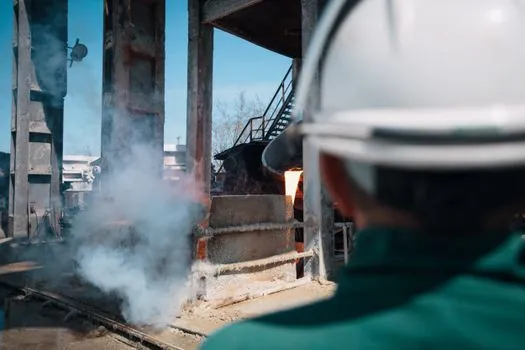
Ingress protection is overwhelmingly IP55 or IP65 across the cited catalogs, achieved by a hermetically sealed case, gasketed glass, and a crimped or removable 304SS bezel [S3][S4][S5][S6]. IP55 is the minimum for outdoor general service; IP65 is required for washdown, marine, or food-grade areas. The cited EIPSA nuclear and chemical build carries EN 13190 compliance and is offered for ATEX and IECEx explosive-atmosphere service, which is the relevant gating standard for any European hazardous-area deployment [S1].
Functional variants multiply when the environment is non-trivial: standard, shockproof, explosion-proof, and waterproof types are all catalog options, with electric-contact alarm and remote-transmission versions adding a switch output or a coupled capillary to a remote dial [S4]. EIPSA prints a capillary length up to 20,000 mm for the remote-dial configuration, which is the only way to read a 5 m tall reactor skin temperature from ground level without climbing [S1]. Silicone filling is also offered as an option on industrial units to dampen pointer vibration in compressor or pump rooms [S3].
Comparison: Main Bimetal Thermometer Variants Against Four Decision Criteria
Four realistic build variants line up against range, accuracy, stem/connection, and environment as follows. (1) Compact panel-mount (25-50 mm dial, 1.0% FS, 6 mm stem, 1/4 in NPT, IP55): fits OEM skids, indoor cabinets, and HVAC headers where space is tight and process temperature stays inside the 0-200 °C window [S2][S5]. (2) Standard process (63-100 mm dial, 1.0% FS, 8-10 mm stem, 1/2 in NPT/BSP, IP65): the workhorse for tanks, bearings, and pipework at 0-500 °C, the variant most often quoted in chemical and petrochemical datasheets [S1][S3][S6]. (3) Heavy-duty industrial (100-150 mm dial, Class 1.5, 10-12 mm stem, 1/2 in NPT, IP65, silicone-filled): the pick for compressor rooms, pump skids, and outdoor tank farms where vibration and 6 m sightlines dominate the spec [S3][S4][S5]. (4) Remote-dial or capillary-coupled (100 mm dial, 1.0% FS, capillary up to 20 m, 316SS wetted, EN 13190): the answer when the sensor sits inside an enclosure or at height and the operator needs a ground-level readout, also the standard build for nuclear, ATEX, and IECEx classified areas [S1][S4].
Who should NOT pick a standard 100 mm process bimetal thermometer: anyone who needs a 4-20 mA or digital signal for a control loop, anyone reading above 500 °C, and anyone whose process media attacks 304SS, since the standard wetted material is 304SS, not 316SS [S5][S6]. For those cases the realistic alternative is an RTD or thermocouple feeding a pressure transmitter or dedicated temperature transmitter, or a non-contact infrared thermometer for the high-temperature or moving-target case.
Standards, Calibration, and Sourcing Discipline
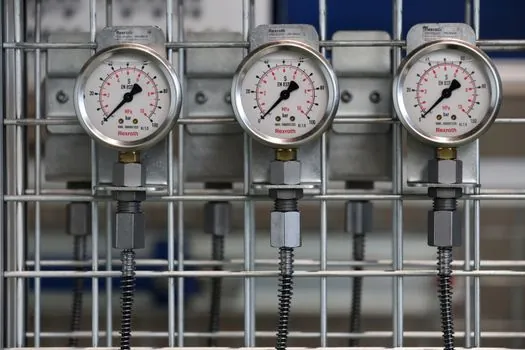
The governing design standard for industrial bimetal thermometers is EN 13190, with dial sizes and accuracy classes inside that framework, and IEC 60529 for the IP code on the case [S1][S3]. Chinese-market offerings reference JB/T 8803 and the verification regulation JJG 226, which is the local equivalent of the EN 13190 envelope for accuracy, hysteresis, and repeatability [S4]. Calibration in service is a re-zero screw on the back of the case: immerse the stem in a calibrated bath at full depth or at least 100 mm, then adjust the screw until the pointer sits on the reference temperature [S5].
A shortlist for the typical buyer runs in three lines. (1) For HVAC, skid OEM, and indoor tank headers, a 63 mm or 100 mm dial, 1.0% FS, 8 mm stem, 1/2 in NPT back connection, 304SS, IP65, in the 0-200 °C range. (2) For chemical and petrochemical outdoor service, the same dimensions but with 316SS wetted parts, 1/2 in NPT bottom or adjustable angle, and a thermowell, on a 1.0% FS Class 1 unit per EN 13190. (3) For high-vibration pump and compressor service, step up to 100-150 mm dial, 10-12 mm stem, silicone filling, and IP65 minimum. Two trackable signals for the next refresh: EN 13190 revision activity (none published in the cited material), and any move by Chinese vendors JB/T 8803 toward tighter hysteresis limits comparable to the current 1% full-scale benchmark.
This topic is covered further in Casting Mold Selection for Hardware Manufacturing: Process Family, SPI Class, and Alloy.