
The title identifies a blast-resistant design of a three-story glass curtain wall system at a federal research facility.
Blast-rated glazing must be selected as a tested assembly comprising laminated glass, framing, anchors, and substrate, because pressure rating alone does not define performance.
Pressure, Impulse and Duration Define the Rating
Blast-resistant curtain wall design requires three related inputs: peak reflected pressure, positive impulse, and load duration. A blast wave can impose a severe short-duration pulse that behaves differently from wind loading, so glazing, frame, connection, and substrate checks must use the same load basis [S4].
Incident pressure is measured at an unobstructed surface, while reflected pressure is amplified when the blast wave strikes a building facade. The reflected value therefore governs many curtain wall design checks [S3]. The supplied guide describes blast-resistant windows as specialized glazing systems engineered to withstand explosive forces and prevent dangerous glass fragmentation.
Simpson Gumpertz & Heger published an article titled “Blast-Resistant Design of a Three-Story Glass Curtain Wall System at a Federal Research Facility.” That pairing is relevant: a simple glazing calculator may assess pane response, but the mullion, connections, framing, and structural supports still require system-level verification.
Match the Threat Curve, Not a Generic PSI Value
The same example also shows why a pressure number without charge weight, standoff distance, and duration is incomplete.
Specification Section 08 44 13.16 directs designers to obtain peak pressure, impulse or duration, and hazard and protection criteria when blast resistance is required [S7]. A defensible design basis should therefore state at least: peak reflected pressure in kPa or psi, positive impulse in kPa.ms, positive-phase duration in ms, required hazard rating, panel dimensions, and frame or anchorage configuration.
Compare Glazing, Framing and Test Classification
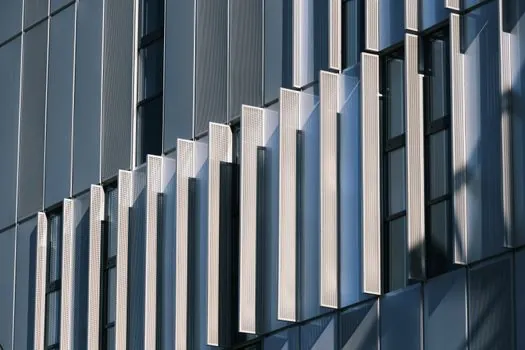
Blast performance belongs to the complete glazing assembly, not the pane alone. Laminated glass reduces hazardous fragmentation because the interlayer retains cracked glass, while the frame must transfer blast forces into the building and connections must remain secure [S2].
ISO 16933:2007 classifies tested blast-resistant curtain wall systems by blast loading and hazard rating. Reynaers ConceptWall 50-EP and 80-EP systems are listed up to EXV 33 and EXV 15, respectively, with hazard ratings of C and B/C, under defined test conditions [S5].
For wider technical context, the components are covered in the glass curtain wall and metal curtain wall panel references, but blast qualification must remain tied to the tested assembly.
Frame, Anchors and Controlled Deformation
Blast-mitigating curtain walls use reinforced framing, laminated glazing, and specialized anchors to absorb, deflect, or contain blast pressure. During loading, the system should deform in a controlled manner without catastrophic failure, while the laminated interlayer limits hazardous glass and debris projection [S2].
Frame capacity is not established by the blast designation of the glazing. Structural design must verify mullion and transom strength, deflection, connection strength, anchorage to the building, and load transfer into the substrate. Special frames may require deeper profiles, stronger alloys, or steel reinforcement, while installation must follow the engineered anchorage details [S2].
ConceptWall 50-EP has a minimum visible width of 50 mm and a 15 mm rebate height; ConceptWall 80-EP has an 80 mm minimum visible width and a 29.5 mm rebate height. The listed systems use dry EPDM glazing, with structural glue also available for the 80-EP configuration [S5]. These dimensions show that a blast-rated product may carry architectural trade-offs, including wider sightlines, deeper framing, and greater attachment demands.
Hazard Ratings Control Fragmentation
Blast performance has two separate dimensions: resistance to the applied pressure and the amount of glass allowed into the occupied space.
That requirement must still be reconciled with the applicable project criteria, because pressure resistance, fragment limits, and anchorage are separate acceptance conditions. A pane that survives the pressure pulse but releases hazardous fragments has not satisfied the occupant-protection objective.
The curtain wall specification therefore calls for both the load parameters and hazard or protection criteria, not a broad statement that the system is “blast resistant” [S7]. Project submittals should identify the tested assembly dimensions, glazing make-up, frame profile, fastener pattern, anchor spacing, substrate, and any conditions that differ from the published test configuration.
Applicable Test Methods and Project Scope
Blast-resistant curtain wall qualification may be supported by ASTM F1642 for glazing and glazing systems subject to airblast loading, ASTM F2248-19 for equivalent 3-second duration design loading, GSA TS01-2003 for glazing and window systems under dynamic overpressure, PDC-TR 10-02 for blast-resistant window methodology, and UFC 3-340-02 for structures resisting accidental explosions [S2].
These methods do not create a universal pressure rating. Each addresses a defined load basis, specimen, acceptance condition, or design procedure, while ISO 16933 provides a classification route used for the curtain wall systems described above [S2] [S5]. Specifiers should not transfer a hazard rating between standards unless the test conditions, assembly, and acceptance criteria have been reconciled by the responsible engineer.
Blast-resistant translucent wall systems provide an alternative for locations where transparent architectural glazing is not required. Kalwall states that its products meet DOD UFC 4-010-01 antiterrorism criteria and GSA Levels C and D without heavy laminated glass or glass shards, but those claims remain tied to the listed configuration and required assessment [S6].
Specify for the Building, Occupancy and Threat

This system is suitable for government, defense, diplomatic, industrial, and other facilities where occupant exposure to exterior blast loads justifies a tested or engineered blast-mitigating curtain wall. It is not suitable as a generic upgrade to a conventional curtain wall merely because the glass is laminated, and it does not replace site-specific threat assessment, structural design, or quality-controlled installation [S2] [S3].
For an existing aluminum window and door opening, retrofit feasibility depends on available edge distance, anchor capacity, head and sill conditions, opening dimensions, and compatibility with the blast-tested frame. These constraints can be more restrictive than adding glass thickness, because the weakest component may be the anchor, perimeter framing, or substrate rather than the glazing [S7].
Before procurement, record the governing reflected pressure, positive impulse, duration, hazard rating, maximum tested panel size, glazing make-up, frame profile, anchor layout, and substrate. Any change to a tested variable requires written review by the blast engineer, followed by qualification testing or an approved analysis where the test report no longer covers the field condition.
Two trackable signals should remain on the project record: confirmation that the specified hazard rating matches the governing occupancy criteria, and a submittal showing that field anchors and substrate details fall within the qualified assembly. Those two checks expose the usual failure points, which are loss of anchorage and unacceptable fragment dispersion rather than glass tensile strength alone.