
Stainless steel rebar is growing in popularity because of its corrosion-resistance and long-term performance advantages, while the best choice depends on project location, environmental conditions, expected service life, maintenance costs, and budget [S1].
Black rebar costs less and is easier to source, but seawater chloride, moisture, and de-icing salts can initiate corrosion, while stainless steel adds chromium-bearing alloy and typically requires a higher procurement budget [S1][S2].
Marine Decision by Exposure, Service Life, and Budget
Chloride ingress is the defining selection variable: chloride ions in seawater attack carbon steel reinforcement, and corrosion products can expand within the concrete, producing cracking, spalling, and repair demand [S1]. Stainless steel contains chromium and other alloying elements that support corrosion resistance through a protective oxide layer [S1][S5].
Stainless steel rebar is appropriate for coastal bridges, ports, harbors, sea walls, offshore platforms, tunnels, and water-treatment structures [S1]. Black rebar remains appropriate where the reinforcement is protected from chlorides and moisture, the exposure class is low, and the project cannot justify stainless steel’s higher initial cost [S2][S3].
Carbon steel rebar is widely available and easy to source, while carbon steel rebar is relatively inexpensive compared with other rebar types [S2].
Corrosion Resistance and Expected Service Life
Black rebar has moderate to low corrosion resistance in marine exposure, while stainless steel is described as highly resistant to chloride-induced corrosion [S1][S3]. The difference is not a small increase in maintenance frequency: carbon steel can lose cross-sectional area and bond capacity as corrosion develops, whereas stainless steel delays that deterioration mechanism [S1].
Treat these as comparative guidance, not a guaranteed design life, because exposure, concrete cover, crack control, cementitious composition, fabrication, placement, and maintenance all affect performance. The underlying stainless steel selection still requires project-specific durability design.
One reinforcing-product comparison reports stainless steel corrosion resistance at 800 to 1500 times that of black rebar and toughness at 15 to 24 times higher [S6]. These are comparative product claims rather than universal design factors, so they should not be inserted into a structural design calculation without test data and project approval.
Cost, Strength, Availability, and Lifecycle Integration
Carbon steel rebar is relatively inexpensive compared with other rebar types, while stainless steel rebar offers corrosion-resistance and long-term performance advantages [S1][S2]. Black rebar wins on initial cost and supply availability, especially for buildings and infrastructure with controlled exposure [S2].
These broad ranges do not establish equivalence between grades or bar diameters. Procurement must compare the specified grade, yield strength, tensile strength, elongation, bendability, weldability, and governing project requirements.
Stainless steel can be bent in the field according to the cited comparison, while corrosion-resistant alternatives such as epoxy-coated bar remain vulnerable at coating breaks [S4]. An intact epoxy coating prohibits the passage of chlorides and protects the steel from corrosion [S4]. That performance still depends on coating integrity and handling.
Black Rebar, Stainless Steel, Epoxy-Coated, and GFRP
Carbon steel offers the lowest initial cost and broad availability but has the lowest corrosion resistance in a continuously wet marine zone [S1][S2]. Stainless steel offers the strongest established balance for conventional metallic marine reinforcement, combining chloride resistance with field bendability, at a higher purchase cost and potentially longer lead time [S2][S4].
Epoxy coating can protect carbon steel from corrosion while intact, but coating damage can affect its performance and make installation quality important [S4].
For marine ports, sea walls, offshore platforms, and other chloride-saturated locations, specify stainless steel unless GFRP is justified by electrical, weight, or other specialist constraints. For less severe splash or atmospheric zones, compare stainless steel against epoxy-coated carbon steel on exposure class, cover, coating damage risk, schedule, and whole-life cost. For buried concrete isolated from seawater, black rebar may remain technically adequate.
Design, Fabrication, and Failure Modes
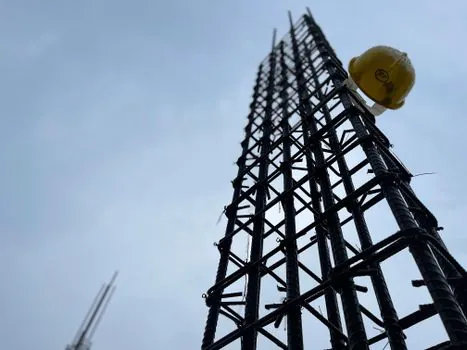
Carbon steel failure in marine concrete is a time-dependent corrosion process: chloride and moisture reach the steel, rust expands, cracking and spalling follow, and repair can become more expensive than the initial material saving [S1]. Stainless steel addresses that dominant mechanism but does not remove detailing, construction-quality, or load-design obligations [S4].
Stainless steel reinforcement can permit reduced concrete cover in suitable applications and can simplify a concrete mix where it was selected specifically to protect rebar rather than to compensate for reinforcement corrosion protection [S4]. Such reductions belong only in the approved structural and durability design; they cannot be transferred automatically from black rebar.
Common stainless grades include austenitic 316L and duplex grades, and 316L is reported to reach approximately 620 MPa in tensile strength within the broad material range [S5]. Grade selection must still address chloride exposure, fabrication, welding, galvanic interaction with attached metals, and the project specification. The broader alloy steel category does not make one stainless grade suitable for every marine exposure.
Procurement and Specification Checklist
Specify the grade, bar diameter, yield strength, tensile strength, elongation, bend test, surface condition, length, and certification requirement rather than ordering only “stainless rebar” or “black rebar.” Marine packages should also identify the exposure zone, estimated design life, concrete cover, crack-control limits, fabrication tolerances, and inspection hold points. [S4]
For a direct black-versus-stainless comparison, record at least four decision criteria: initial unit cost, chloride resistance, expected maintenance exposure, and procurement lead time. Carbon steel leads on initial cost and availability; stainless steel leads on corrosion resistance and service life; epoxy-coated carbon steel occupies the middle ground but carries coating-damage risk; GFRP is the specialist option for nonmetallic, lightweight, or electrically nonconductive reinforcement [S1][S2][S3][S4].
Before issuing the purchase specification, require mill certificates, verify that the named stainless grade and mechanical properties match the design, and include fabrication and coating requirements for any alternative proposed during bidding. For ductility or grade-selection context, B500B vs B500C rebar provides a useful companion comparison.
The next trackable decision is the project exposure map: zones continuously exposed to seawater, splash zones, buried zones, and sheltered concrete require different corrosion allowances, and the reinforcement schedule should follow that map rather than a site-wide stainless designation.