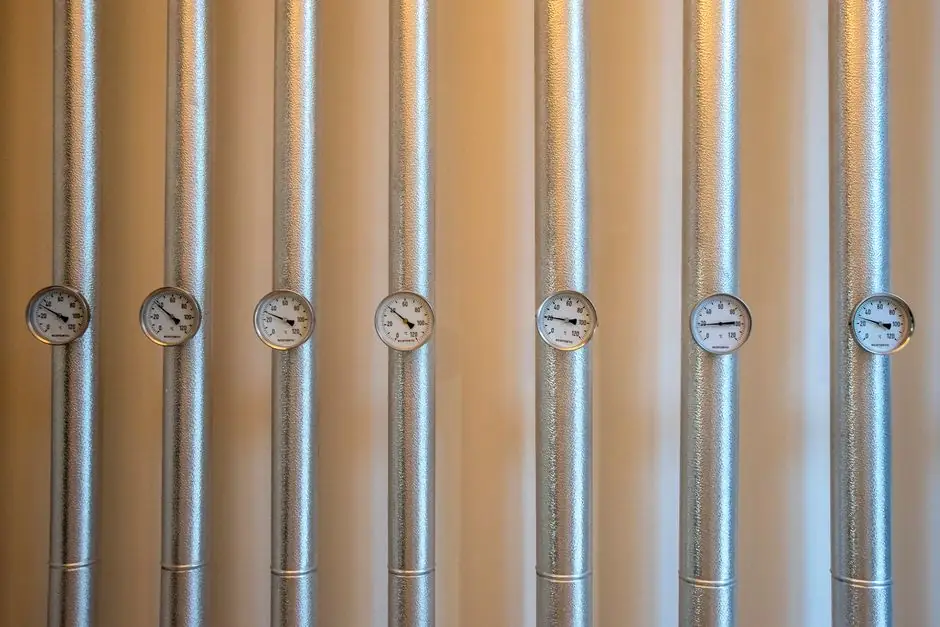
On a boiler, the bimetal thermometer dial size is selected from the reading distance outward, not from the process temperature inward: 63 mm and 80 mm suit local panel readouts, 100 mm is the common general-purpose size, and 150 mm (6 in) is specified when an operator needs a clear reading across a boiler hall [S3][S8].
Bimetal thermometers themselves cover a wide span, from roughly -70 °C to +600 °C depending on coil material, which is why dial geometry, not range, becomes the limiting spec for boiler-side reading [S1]. Stem length, process connection, thermowell, and case fill are decided after the dial size is locked in [S6].
Reading Distance and the 1 mm-per-metre Rule of Thumb
Bimetal dial readability is governed by the physical size of the scale graduations, which scale with the dial diameter; an operator standing 5 m from a 100 mm dial is still reading the same number of divisions an operator reads 1 m from a 50 mm dial [S3]. Larger dials also support larger, clearer scale markings, which directly lowers misread risk in noisy boiler environments where operators cannot always step close to the instrument [S3]. Boiler front panels, header readouts, and stack-temperature points are typical of 100 mm and 150 mm selections, while local branch-line gauges commonly use 63 mm and 80 mm cases [S8]. For reference on how a bimetal thermometer compares against other mechanical temperature instruments, the sensing principle is identical across sizes, so dial geometry is essentially a human-factors decision layered on top of the same coil mechanism.
Scale Density: How the Range Forces the Dial Diameter
Boiler dial ranges are typically narrow for working pressure and wider for flue gas. A 0-200 °C or 0-300 °C steam-line range on a 63 mm dial is cramped; the same range on a 100 mm or 150 mm dial shows readable 5 °C or 10 °C divisions [S3][S4]. Manufacturers generally recommend selecting the smallest temperature span that still covers the operating range so the dial scale is not wasted on unused travel, which means wider ranges (e.g. 0-500 °C for stack gas) effectively force a larger dial to preserve graduation size [S4]. Standard stem lengths run from about 50 mm up to 500 mm in industry, and longer stems are paired with larger cases because the same panel footprint has to host a readable scale [S5]. Industrial dial thermometer families offer 60 mm, 80 mm, 100 mm, 150 mm, and 200 mm cases, so a 100 mm case is rarely the only answer; 150 mm cases dominate higher-temperature boiler work where 5-10 °C readability across 0-500 °C is required [S8].
Boiler-Specific Selection Criteria
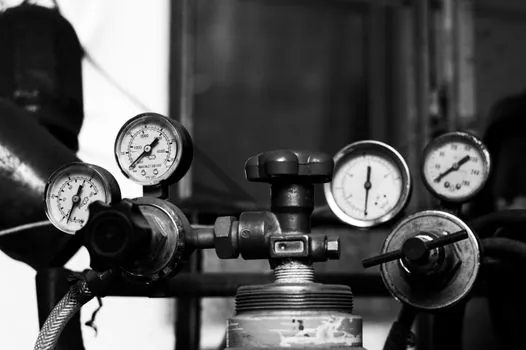
For boiler service, four criteria steer the dial size, and each one can independently push the spec upward. (1) Viewing distance: a 100 mm dial is comfortable to about 3 m; beyond that, 150 mm is the practical floor. (2) Ambient lighting: boiler houses with steam haze, low ceilings, and intermittent illumination favor the larger dial and a liquid-filled case for pointer damping, both of which are available across the common case sizes [S5]. (3) Vibration: liquid-filled cases (glycerin or silicone) are available in 63 mm through 150 mm bodies, so vibration alone does not force a size jump, but the fill option should be specified together with the case diameter [S5]. (4) Thermowell and stem length: a thermowell adds thermal lag, which makes the readable scale density more important, indirectly rewarding a larger dial on long-stem installations typical of boiler headers [S1][S6]. These four criteria interact; a 100 mm liquid-filled case on a 200 mm stem with a thermowell is a common balanced choice for saturated-steam headers. Where a local readout is the only goal, a dial indicator-style compact bimetal on a short thermowell will perform identically to a larger one in reading accuracy, since both meet the typical ±1% of full-scale accuracy class for industrial bimetal dials [S2].
Comparison of Common Dial Sizes for Boiler Service
The four standard sizes used on boilers line up against readability, panel footprint, and stem-length range as follows. 63 mm (2.5 in): smallest panel footprint, limited to short viewing distances, scale density degrades above ~250 °C span, typically paired with 50-100 mm stems. 80 mm (3 in): a step up in readability, still compact, common on local branch lines, 50-200 mm stem range. 100 mm (4 in): the general-purpose default for boiler headers, comfortable read at 2-3 m, scale holds 5 °C divisions on a 0-300 °C range, 50-500 mm stems. 150 mm (6 in): specified for across-room readouts and wide-range stack applications, readable at 5 m, supports narrow graduations on 0-500 °C ranges, 100-500 mm stems [S3][S4][S8]. Accuracy is independent of case size; ±1% of full scale is the typical industrial grade, so dial size is a usability trade-off, not a metrology trade-off [S2].
Installation and Materials That Affect the Final Choice

Material selection does not move the dial size decision, but it interacts with it because the case and stem must share a corrosion class. 304 stainless steel is the common default for boiler auxiliaries; 316 stainless is specified where chloride exposure, condensate chemistry, or chemical-plant tie-ins exist [S5]. The stem material and the thermowell material should be matched, since dissimilar metals in hot water loops accelerate galvanic attack and shorten service life [S1]. Adjustable-angle cases, which can be rotated up to about 90° for line-of-sight optimization, are available in 80 mm, 100 mm, and 150 mm bodies, and they let the operator correct a poor mounting position without re-tapping the thermowell [S7]. Liquid-filled cases (glycerin or silicone oil) damp pointer oscillation in high-vibration boiler-feed pump areas and are routinely ordered alongside 100 mm and 150 mm dials [S5]. The thermometer family also has to integrate with adjacent instruments; on a boiler front the pressure transmitter handles the 4-20 mA control signal, while the bimetal dial serves as the local mechanical confirmation, so the dial size is sized for the human reader, not the control loop.
Common Spec Mistakes and Limits
Three recurring spec errors drive most field complaints. First, ordering the largest available dial (often 150 mm or 200 mm) for a close-reading panel, which forces a needlessly large thermowell and reduces thermal response; the small-dial short-stem combination is faster and cheaper on a local readout [S3]. Second, specifying a wide temperature range to "cover everything", which spreads the graduations thin and forces an upward jump in case size to preserve readable scale; the correct move is to select the narrowest range that still brackets the operating point, not the largest range the case can host [S4]. Third, ignoring liquid fill in vibration zones, where a 100 mm dry case will show a wandering pointer; specifying silicone-oil fill on the same 100 mm case fixes the readability without changing the panel cutout [S5]. Bimetal thermometers are also slower than electronic sensors and require periodic re-zero at the back of the case, so for fast control loops an infrared thermometer or a dedicated RTD transmitter should be paired with, not replaced by, the dial readout [S1].
Track two signals going forward: (1) the published accuracy class on the model datasheet, which is the spec that ultimately limits how finely a chosen dial can be read, and (2) the thermowell insertion length, which should leave the bimetal tip centered in the pipe flow, not resting against the thermowell tip, to keep stem-conduction error inside the ±1% class [S2][S6].
See also our earlier report, Motor Protection Relay for Hazardous Area Motor Circuits: Settings, Coordination, and.