
Bottom pouring can reduce slag carryover because metal exits beneath the floating slag layer rather than being skimmed from the ladle lip.
Steel-foundry bottom-pour ladles from 500 kg to 40 tonnes support stopper-controlled casting, direct placement over the sprue cup and gas purging [S1].
How Bottom Pouring Keeps Slag Out of the Stream
A lip-pour ladle discharges metal from an open top, so the stream can cross the surface layer where oxide inclusions and other non-metallic material accumulate. A bottom-pour ladle draws metal from the bottom, leaving the surface layer in the vessel;
The practical claim is therefore reduced slag carryover, not guaranteed zero contamination. Vesuvius presents technical solutions for steel foundries using ladles between 0.5 and 40 tonnes that want to convert from lip pouring to bottom pouring, covering Monoblock stoppers, preheating, possible future automated pouring devices, and nozzle technology.
The distinction matters because a bottom outlet only remains clean if the refractory stoppers, nozzle and sealing system are maintained correctly. The benefits listed in S1 describe a controlled stopper-based system, not any vessel that happens to have a bottom outlet.
Lip Pour, Bottom Pour, and Teapot Selection
Steel applications provide a broader established range: bottom-pour ladles of 500 kg to 40 tonnes have been used for steel castings for more than 30 years [S1].
Bottom pouring is not the automatic choice for every casting. Large ladles above 40 t generally use slide gates because they are normally associated with single pours of very large castings, while ladles below 500 kg can be handled with simpler control and teapot solutions are often the first option for investment casters [S1].
Where Bottom Pouring Fits the Casting Job

Bottom pouring is suited to steel castings that require controlled, slag-resistant metal delivery, particularly where the vessel can be positioned directly above the sprue cup. Vesuvius identifies ladles from 0.5 t to 40 t for steel foundries and describes one-shot and multi-use Monoblock stopper configurations [S1].
Direct placement shortens the transfer path between outlet and mould, while a stopper provides controlled opening and closing of the metal path. The same system can support gas purging, an operation unavailable as a direct feature of ordinary open-lip pouring [S1].
Small-scale casters can also use teapot ladles, but their principal feature is controlled pouring from a covered vessel rather than the 500 kg to 40 t stopper systems evaluated in steel foundry practice [S1].
Stopper Choice Sets the Operating Limits
Vesuvius highlights the importance of preheating Monoblock stoppers.
S1 also identifies ladles above 40 t as a slide-gate case, ladles below 500 kg as a simple-control case and teapot systems as the first option for many investment-casting applications.
Failure Modes That Can Defeat Slag Control
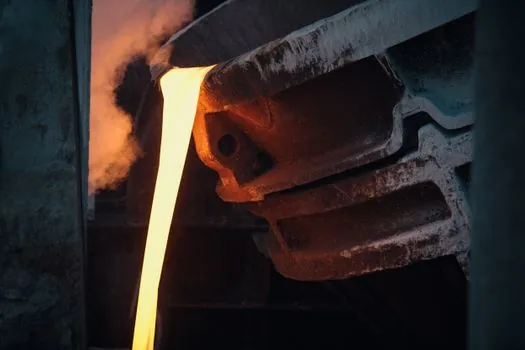
Bottom-pour performance depends on keeping the outlet and vent path unobstructed.
Refractory condition is equally practical. Vesuvius highlights the importance of preheating Monoblock stoppers.
Bottom pouring solves the exposure of surface slag during an open-lip transfer, but it does not remove every casting defect. In bullet-casting experience, small projectiles were handled effectively by bottom pour, while long, heavy projectiles performed more consistently with a ladle in some trials [S3]. Such casting reports concern geometry and filling behaviour rather than a controlled slag carryover measurement, so they should not be treated as a universal performance comparison.
Who Should Convert and What to Verify
Bottom-pour conversion makes the strongest engineering case when slag-sensitive steel castings justify the added stopper infrastructure, the ladle can sit directly over the sprue cup, and pouring can be automated or performed with less manual handling. A lip-pour ladle remains the simpler option for foundries that cannot support preheating, stopper replacement and vent maintenance [S1].
For a foundry already managing molten-metal chemistry, the relevant sequence is to control inclusions in the furnace and ladle, preserve the surface separation during transfer, and verify the outlet condition. The separate guide to set degassing time by ladle size and process is relevant because gas purging is listed as a bottom-pour benefit, although purging time must follow the alloy and ladle process rather than the pouring method alone.
The closest distinction is not bottom pour versus lip pour alone, but protected bottom delivery versus open-top delivery. The casting ladle design determines whether the surface layer can remain undisturbed, while the stopper or nozzle system determines whether that advantage survives repeated heats and pours [S1][S4].
A valid trial should compare slag carryover, inclusions, fill consistency and total casting time over matched heats. The defensible conclusion is that bottom pouring materially reduces the opportunity for surface slag to enter the stream, while “zero slag casting” remains a process target dependent on clean outlets, maintained vents, correct preheating and disciplined handling [S1][S4].