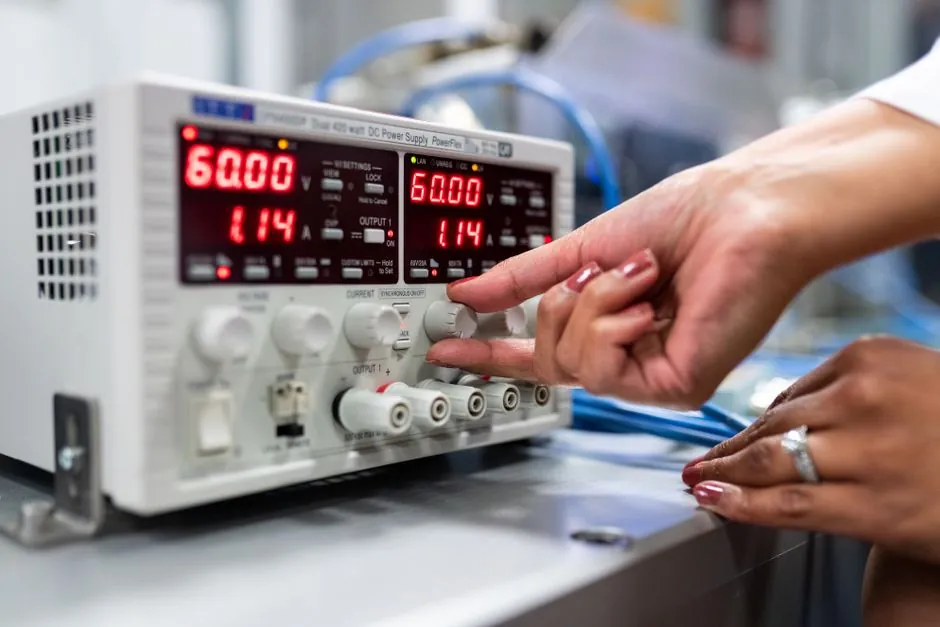
A bump test confirms a portable gas monitor's sensor and alarm chain still fires when exposed to challenge gas, while a full calibration is the quantitative adjustment of that sensor's output to match a known traceable gas concentration, per OSHA SHIB 11-26-2024 and ISEA definitions [S1][S2].
The two procedures are not interchangeable: a bump test passes when the instrument triggers its lower alarm setpoint, typically with the sensor reading at least 80% of the applied gas concentration; a full calibration re-zeroes the sensor and re-maps its span to the certified gas value, and only qualified personnel should perform it [S2][S3].
Definitions and Scope per ISEA / OSHA
ISEA's 2010 statement, incorporated into OSHA SHIB 11-26-2024, separates the three procedures explicitly. A bump test is a "qualitative function check where a challenge gas is passed over the sensor(s) at a concentration and exposure time sufficient to activate all alarm indicators to present at least their lower alarm setting," with success typically defined as the sensor reaching at least 80% of the applied gas concentration [S1][S2].
A calibration check is a "quantitative test utilizing a known traceable concentration of test gas to demonstrate that the sensor(s) and alarms respond to the gas within manufacturer's acceptable limits," with the acceptable band "typically ±10-20% of the test gas concentration applied unless otherwise specified by the manufacturer, internal company policy, or a regulatory agency" [S2]. A full calibration goes one step further and actually adjusts the sensor's response to the desired value versus a known traceable gas standard; only specially trained, qualified personnel are permitted to perform it [S2]. The same definitions and the broader instrument-test workflow are catalogued on the test and measurement reference page.
When Each Procedure Applies
OSHA's bulletin states that "the ISEA recommends, at a minimum, verifying the operational capability of these instruments before each day's use, with additional testing conducted as necessary" and ties that recommendation to existing OSHA rule references at 29 CFR 1910.146(c)(5)(ii)(C), 29 CFR 1910.120(c)(6), and 29 CFR 1910.272 Appendix A section 5 [S1]. That daily verification is, in practice, a bump test; the full calibration sits on a separate, longer interval driven by the manufacturer.
Industrial Scientific's published minimum frequency is a daily bump test on any gas monitor not running on DualSense technology, including a Tango TX1 operating with a single working sensor, with calibration and sensor replacement on the manufacturer's stated schedule [S3]. Critical Environment's field guidance, written for the same instrument class, recommends a bump test prior to each use for handhelds, a bump test every 30 days on continuous monitors after a 10-day accuracy trial, and a full calibration every 6 months regardless of bump-test result or sensor type, plus an immediate full calibration after any failed bump test [S4]. MSA's own engineering blog repeats the same logic: a bump test "determines whether a DRPGM can detect if a possibly hazardous gas is present, while calibration checks that equipment is accurate" [S2].
Decision Matrix: Bump Test vs Calibration Check vs Full Calibration

Across the three ISEA-defined procedures, the decision hinges on what the user needs to prove on a given day. A bump test answers "will this instrument fire its alarms if gas is present?" in roughly 30-40 seconds at about 0.5 L/min test-gas flow, with pass criteria of all alarms activating and the sensor reaching at least 80% of the applied gas [S2][S5]. A calibration check answers "is the sensor still reading inside the manufacturer's accepted accuracy window, typically ±10-20% of the test gas concentration?" without any adjustment to the instrument [S2]. A full calibration answers "the sensor has now been re-zeroed and its span re-mapped to the certified gas value," which is the only procedure that physically changes the instrument's stored response curve [S2][S3].
Cost and time scale with that depth. A bump test uses a short burst of the same calibration gas cylinder, so the consumable cost is similar to a calibration check, but the elapsed time is shorter because no zero/span adjustment cycle is run [S3][S4]. Critical Environment points out that if a calibration check fails, the operator must perform a full calibration anyway, "so you might as well do it the first time and get the guaranteed result" when accuracy is the requirement [S4]. This trade-off is the same one operators face on any process calibration decision: a quick functional screen versus an NIST-traceable re-map. For laboratories running multi-gas monitors, the same electronic test discipline (known stimulus, recorded response, signed-off log) governs both procedures.
Procedure-Level Specs and Acceptance Criteria
ISEA-aligned pass criteria and procedure parameters appear in the public sources as follows. Bump test: challenge gas above the low-alarm setpoint, exposure long enough for the sensor to reach at least 80% of the applied concentration, all alarm indicators (audible, visual, vibration) must trigger; no adjustment to the instrument is made [S2][S3]. Calibration check: zero the sensor in clean air or a zero-air cylinder, apply a certified traceable gas, sensor reading must fall within ±10-20% of the cylinder value (or a tighter band set by the manufacturer, internal policy, or a regulator) [S2]. Full calibration: adjust the sensor's zero and span to the certified gas value, performed only by trained personnel; if the sensor cannot be adjusted into spec, it has reached end-of-life and must be replaced [S2][S3].
Test-gas handling is part of the spec, not an afterthought: calibration gas must be within its expiration date on every use, the cylinder must be traceable, and the regulator flow should be set to the value the manufacturer lists (commonly around 0.5 L/min for diffusion monitors) [S1][S5]. Peak readings stored in the instrument are independent of the data log; the data log survives power cycling, but peak readings only clear when the operator clears them, and the recommended practice is to clear peak after every calibration and after every alarm event [S3].
Limitations, Failure Modes, and Common Pitfalls
A bump test that passes is not proof of accuracy. ISEA's wording is explicit that the bump test "checks whether sensors and alarms are working as intended, and failure might indicate that a blockage is present. In sum, bump testing assesses function, not accuracy" [S2]. A sensor can pass a bump test (alarm fires, sensor reads above 80% of gas) and still be 20% off the true concentration, which is the entire reason the ±10-20% calibration-check band exists [S2]. Self-tests on instruments such as the Industrial Scientific Tango TX1 verify memory, battery, and alarm indicators only; they do not verify sensor functionality or instrument accuracy, so a self-test cannot substitute for a bump test or a calibration [S3].
The most common field failure modes are predictable: expired calibration gas, an ambient-air zero performed in a contaminated atmosphere (which silently masks the contamination as "zero"), sensor end-of-life that no amount of bump-testing will catch because the sensor still responds to gas, and inconsistent test cadence on intermittently used portable units [S3][S4][S5]. MSA's portable-gas-monitor guidance specifically warns that bump testing "will only check that the sensors are working and reading the introduced gas within the acceptable range," not that the reading is correct in absolute terms [S6]. Newer instruments mitigate some of this with automated bump-test stations and remote monitoring, but those features are still functional checks, not calibrations, and the same documentation rules apply [S5].
Selection Criteria: Which Procedure to Run, and When
For daily pre-use verification on a portable four-gas monitor in a confined-space program, the answer is a bump test: OSHA SHIB 11-26-2024, the ISEA position incorporated into it, and manufacturer guidance all converge on at-minimum-daily functional verification before use [S1][S3][S4]. For a sensor whose bump test has just failed, for any instrument coming out of suspected impact or water exposure, or for any monitor that has never been through an initial-accuracy trial, the next action is a full calibration, not a calibration check [S2][S4]. For continuous (fixed) monitors already past a documented 10-day daily-accuracy trial, the published cadence is a bump test every 30 days plus a full calibration every 6 months regardless of result [S4].
Recordkeeping is part of the selection, not separate from it: every bump test, calibration check, and full calibration should be entered in a logbook with the cylinder lot, expiration date, applied concentration, observed reading, and pass/fail status, because most malfunctions "are discovered at the time of calibration or bump testing, meaning at some point between calibrations the gas monitor manifested a problem" [S4]. When in doubt about which procedure to write into a site safety procedure, the conservative read of the public guidance is to do the full calibration and keep the documented evidence, because "the only way to ensure the gas detector will accurately respond to the gases it is designed to detect is to calibrate the sensor against a known gas standard" [S4]. The same principle of recorded, traceable verification governs temperature calibration bath work and any measurement test on a critical safety chain.
Trackable next signals to watch: any update to the ISEA position statement referenced in OSHA SHIB 11-26-2024, manufacturer-published shifts from "daily bump test" to "on-Demand bump test" tied to redundant sensor architectures such as DualSense, and any new NFPA / IEC 60079- series wording that changes the pass band from the current typical ±10-20% of applied test gas concentration [S1][S2][S3].
Background reading: Electric vs Diesel Aerial Work Platforms: 2026 Spec-Driven Decision Guide.