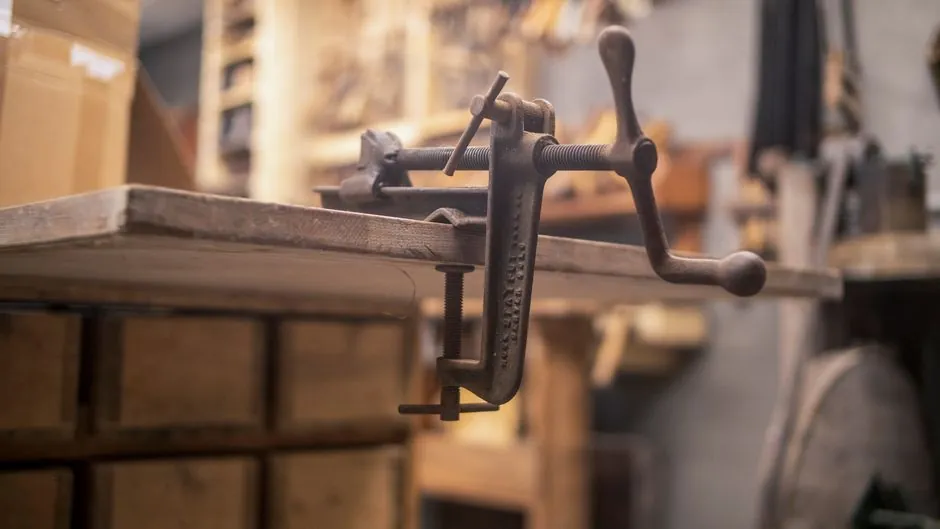
For most woodworking decisions, use a C-clamp when controlled pressure and a compact footprint matter, a bar clamp when reach and parallel jaw geometry matter, and a spring clamp when speed and one-handed placement matter.
Pipe clamps are available in 36-inch examples, and pipe couplers can join shorter pipes to make longer clamps. Spring clamps trade force control for immediate placement and compact access.
Core mechanism and operating behavior
A C-clamp advances one jaw toward a fixed jaw with a threaded rod. Each turn produces a small jaw movement, generating substantial force with moderate hand effort, while the thread prevents the jaw from backing off under load [S5]. The moving jaw and sliding cross pin provide leverage, making the clamp suitable when force must be varied deliberately rather than applied at a predetermined spring tension [S5].
A bar clamp uses a fixed steel bar, a stationary jaw, and a sliding jaw secured by a threaded rod. Depending on the design, the movable jaw may use a pawl or another locking arrangement.
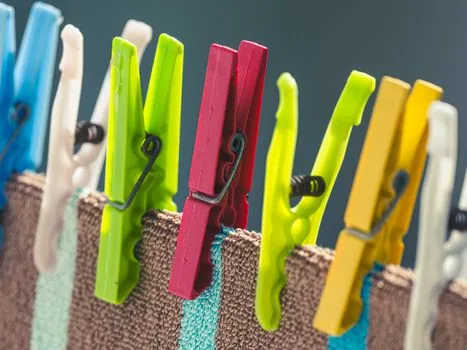
A spring clamp uses a scissors-like action with handles and padded jaws. Squeezing the handles opens the jaws, and releasing them applies spring force [S5]. Spring pressure varies with clamp type and size, is not practically adjustable on a conventional spring clamp, and the usable opening range is narrower than that of an adjustable C-clamp [S4].
Selection by reach, jaw geometry, and force
Reach is the first filter. C-clamps are available with fully open jaw spacings from less than 1 inch to 10 inches [S5]. Bar clamps are ideal for larger projects that require securing long pieces of wood.
Jaw geometry determines whether pressure reaches the intended surface. Shallow bar-clamp and pipe-clamp jaws work well on flat panels and box assemblies, but their reach is limited on thick stock and inside wide assemblies [S3]. A C-clamp surrounds the workpiece, so it can reach an edge or narrow localized feature that a shallow bar-clamp jaw may not contact cleanly [S5].
Force control separates the types clearly. Screw-driven C-clamps allow incremental pressure changes, and spring clamps apply force from a mechanism with little useful adjustment [S4][S5]. A ratcheting hand clamp bridges both designs: it resembles a spring clamp in general layout, adds adjustment, and can be operated almost with one hand [S1][S4].
Explicit comparison across four criteria
Pipe clamps cost $22 including a 36-inch pipe, which the source describes as the cheapest option for clamps with a long reach. These are reference prices from the cited guide, not universal market quotes.
On pressure control, C-clamps rank first because the threaded rod changes force in controlled increments; conventional spring clamps rank last because their pressure is fixed by spring tension; bar clamps fall between these positions, with design-dependent adjustment through the screw and movable jaw [S4][S5].
On reach, bar clamps lead because their fixed bar can be made or purchased in long lengths, while C-clamps are limited to their available jaw capacity and spring clamps have a comparatively narrow opening range [S4][S5]. On handling, spring clamps lead for one-handed placement, and ratcheting hand clamps provide adjustable spring-type handling with a broad operating range [S1][S4].
Best use cases and unsuitable assignments
Choose a C-clamp for localized gluing or fastening, holding wood to a workbench during cutting or shaping, and holding metal for welding. These applications exploit the screw mechanism's high force and controlled jaw advance [S5]. Add a soft pad when protecting finished surfaces, because an unprotected metal jaw can mar the workpiece.
Choose a bar clamp for laminating wood, assembling long frames, holding large panels flat during glue-up, and making sash windows [S5].
Choose a spring clamp for temporary holding during assembly, particularly when both hands are occupied. It is less suitable where force must be tuned closely, where the opening range is restrictive, or where a permanent high-pressure hold is required [S4]. For gap-filling epoxy work, the practical requirement is sufficient pressure to keep parts from moving and distribute adhesive across the joint, not necessarily the heavy pressure associated with conventional wood glue [S4].
Limitations, failure modes, and setup checks
Aluminum bar clamps also flex under heavy pressure [S3].
Conventional spring clamps present three practical constraints: pressure varies among types and sizes, pressure cannot be usefully adjusted, and the opening range is limited [S4]. A clamp that feels too light may not keep a joint aligned; one that is too aggressive can squeeze adhesive out or damage soft material [S4].
For C-clamps, confirm that the threaded rod, cross pin, swivel pad, and handle are free of damage before applying load. For bar clamps, inspect the bar for bowing and ensure the movable jaw locks fully. For spring clamps, check pad alignment and handle condition before placing the tool close to the workpiece [S2][S3][S5].
Standards, sourcing, and a defensible first purchase
No product-specific standard, force rating, jaw accuracy, or service-life figure was supplied in the research, so these values should be verified from each manufacturer's technical data before purchase. The cited material identifies jaw capacities, lengths, material construction, mechanisms, and reference prices, but it does not establish a universal clamping-force specification for these general-purpose hand tools. [S3]
A practical starter allocation is four pipe-clamp fixture sets, four 2-foot pipes, two 4-foot pipes, and three couplers, or a smaller selection of aluminum bar clamps where lower weight and clean glue contact matter [S3]. Add short F-clamps for bench work and several spring clamps for rapid assembly [S3][S4].
For most shops, the defensible rule is simple: specify C-clamps for compact, force-controlled work; bar clamps for long or wide assemblies; and spring clamps for fast temporary holding. Track two purchase signals before expanding the set: the workpiece width that repeatedly exceeds 10 inches and the number of tasks where one-handed placement eliminates a second helper [S4][S5].