
C10100 OFE copper has a minimum conductivity of 101% IACS, while C11000 ETP copper has a minimum of 100% IACS [S3][S8].
The choice is driven by oxygen content, purity, downstream furnace exposure, form availability, and cost rather than the 1% IACS difference; specify the UNS number, temper, product form, and final fabrication route on every purchase order [S1][S3].
Conductivity, Purity, and Oxygen Limits
C11000, commonly called C110 or electrolytic tough pitch copper, contains at least 99.90% copper, has no oxygen maximum specified, and requires a minimum conductivity of 100% IACS [S3]. C10100, commonly called C101 or oxygen-free electronic copper, contains at least 99.99% copper, limits oxygen to 5 ppm, and requires a minimum conductivity of 101% IACS [S3].
The conductivity difference is small: C101 is specified at 101% IACS against 100% for C110, equivalent to roughly 1% better conductivity at the same geometry and temperature [S1][S3]. Copper.org lists C10100 as a high-conductivity copper with a 101% IACS minimum in the annealed condition [S8]. This does not create a 1% improvement in the power-handling capability of every finished part, because resistance also depends on conductor length, cross-section, temperature, joints, surface condition, and the test method.
C10200, also designated oxygen-free copper, is the intermediate comparison point: at least 99.95% copper, no more than 10 ppm oxygen, and a 100% IACS minimum conductivity [S3]. For a general copper material decision, C101 provides the highest specified conductivity and purity of these three grades, C102 provides lower oxygen with no conductivity premium, and C110 provides the lowest cost and broadest electrical-application fit.
Selection Criteria: C110, C102, and C101
C11000 is the appropriate default for most electrical parts because it combines 99.90% minimum copper with 100% IACS conductivity, without requiring a premium purity grade [S3].
C10100 becomes the stronger choice when the part requires maximum purity, a 101% IACS minimum, or exposure to vacuum and other high-performance electrical environments [S3][S7]. Specify C101 when the component will serve in high-vacuum equipment, precision connectors, RF systems, superconductors, or other applications where low oxygen and tighter impurity control matter independently of the nominal conductivity difference [S2][S3][S7].
C10200 is the pragmatic furnace-processing choice when oxygen must be limited but C101 purity and 101% IACS conductivity are unnecessary [S3]. The decision matrix is straightforward: C110 minimizes cost at 100% IACS, C102 controls oxygen to 10 ppm at 100% IACS, and C101 controls oxygen to 5 ppm at 101% IACS with at least 99.99% copper [S3].
Furnace Processing and Hydrogen Embrittlement
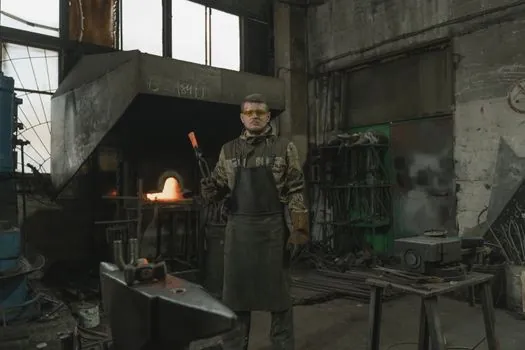
C110 is vulnerable to blistering or cracking when oxygen-bearing copper is brazed, annealed, or cleaned at high temperature in a hydrogen or vacuum atmosphere; hydrogen diffuses into the copper, reacts with internal oxygen, and forms steam that can split the material [S3]. This is not a reason to reject C110 for all fabrication. It is a requirement to expose the downstream process before material selection and identify the parts that will enter a hydrogen or vacuum furnace.
C101 and C102 limit oxygen to 5 ppm and 10 ppm, respectively [S3]. The cited comparison states that oxygen-free grades are appropriate for furnace brazing and hydrogen or vacuum processing, while C110 remains suitable for most electrical parts [S3]. For copper components carrying substantial current, the same furnace-compatibility decision also appears in Copper Busbar vs Cable for High-Current Busway.
One qualification matters: oxygen-free does not mean the component can never oxidize. Exposure to air begins forming an oxide layer, and subsequent furnace operations can therefore change the effective condition unless the process controls atmosphere, cleanliness, and time at temperature [S4]. C101 must be handled as an oxygen-sensitive material during fabrication rather than treated as permanently oxygen-free after machining.
Real Use Cases by Operating Condition
For busbars, terminals, heat sinks, RF components, and EDM electrodes, C110 is the general manufacturing choice when the downstream process does not create a hydrogen or vacuum exposure [S3][S5]. Its electrical conductivity is approximately 100% IACS, and copper has excellent thermal conductivity [S5]. For broader material context, copper has a density of 8.96 g/cm³ and a melting point of 1,085°C [S2].
For high-vacuum components, superconducting systems, precision RF hardware, and conductors with the tightest purity requirements, C101 is justified by its 5 ppm oxygen ceiling and 101% IACS minimum conductivity [S2][S3][S7]. OFHC is a trade description rather than a UNS designation, so a drawing or purchase order should identify C10100 and the applicable material standard rather than relying only on the term OFHC [S3].
Cryogenic work is a separate design problem. Copper thermal conductivity at cryogenic temperatures depends strongly on residual resistance ratio, which compares resistance at 295 K with resistance immersed in liquid helium at 4 K; common ETP and OFHC stock is often placed near an RRR of 50, far below specially processed RRR 2000 copper [S4]. For copper electrical conductivity explained in %IACS, room-temperature IACS is therefore not a sufficient specification for a cryogenic heat-transfer component.
Machining, Strength, and Joining Constraints
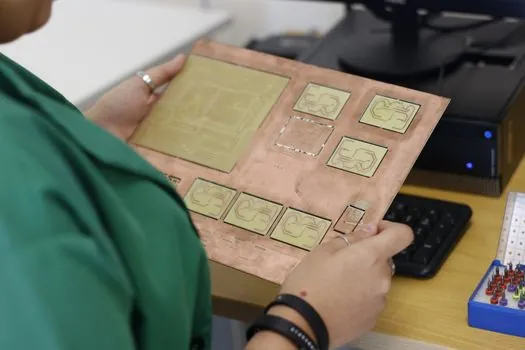
Pure copper machines poorly because it is gummy, tends to work-harden, and grabs tooling [S2][S5]. Representative C110 properties include density of 8.94 g/cm³, annealed tensile strength of about 32 ksi, hard tensile strength of about 45 ksi, annealed yield strength of about 10 ksi, and soft hardness of about 40 HRF [S5]. Exact values vary by temper, so the drawing should state annealed, hard, or another defined condition rather than leave strength undefined [S5].
C110 can be soldered and brazed, but furnace brazing changes the material-selection decision because hydrogen or vacuum exposure can blister oxygen-bearing ETP [S3][S5]. C101 and C102 are preferred when downstream heat treatment requires low oxygen [S3]. Neither grade eliminates the need to control cutting speed, feed, tool geometry, coolant, and workholding; hardness remains a fabrication issue rather than an electrical-conductivity issue.
Very high-purity copper also changes the mechanical trade-off. Annealing can raise the residual resistance ratio of OFHC, but purification removes much of the strength that makes copper useful in ordinary structural applications; highly pure copper can be scratched easily and is difficult to machine [S4]. For a component that carries current and also carries load, C110 or a controlled-strength copper alloy may be more appropriate than assuming C101 is universally superior.
Procurement, Standards, and Failure Avoidance
Put C11000 or C10100 on the purchase order, along with the product form, temper, applicable material standard, dimensions, and quantity [S3]. A complete request should also identify what happens next, including brazing, annealing, plating, hydrogen cleaning, or vacuum processing [S3]. For procurement of copper bar, “OFHC” alone does not establish whether the order means C10100, C10200, or another commercial designation.
The principal failure modes are traceable to specification or process gaps: using oxygen-bearing C110 in a hydrogen furnace can cause internal steam pressure, blistering, and cracking [S3]; using C101 where C110 would meet the electrical load and fabrication conditions adds 10–25% material cost for a 1% IACS increase [S1]; and treating room-temperature conductivity as proof of cryogenic performance overlooks the RRR dependence of low-temperature thermal conductivity [S4].
Use C11000 for cost-sensitive, ordinary electrical parts exposed to compatible joining processes; use C10200 for vacuum or furnace processing where 100% IACS is sufficient; use C10100 for maximum purity, 101% IACS minimum conductivity, and demanding vacuum, RF, or electronic applications [S1][S3]. Before releasing the final grade, verify the UNS number, temper, oxygen limit, conductivity requirement, product form, and downstream furnace atmosphere on the drawing and purchase order [S3].