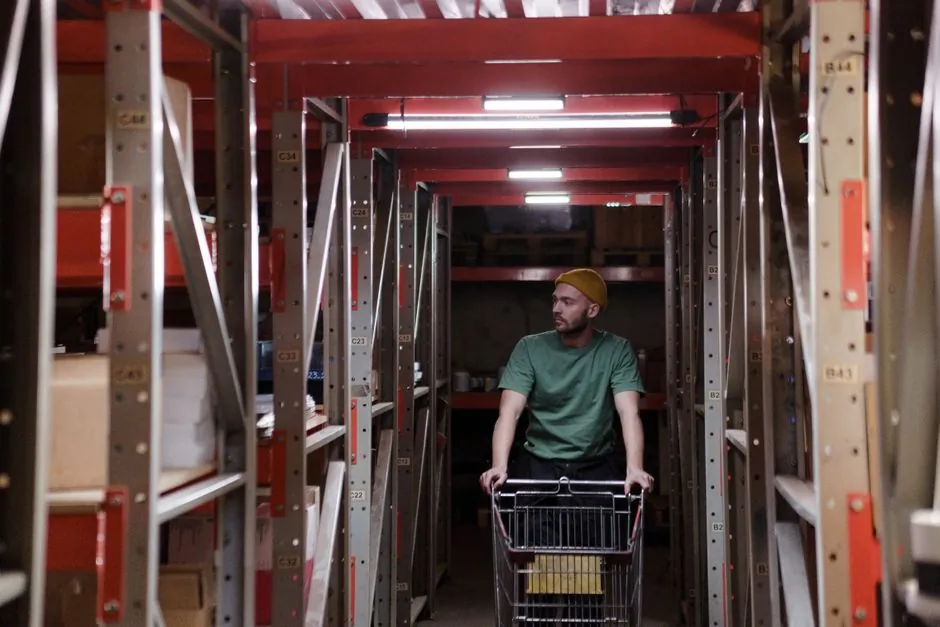
An order picker can be retrofitted with barcode scanning by adding printed location and SKU labels, one scanner per operator, and software that validates each pick against the order.
The retrofit suits low-level and mid-level order pickers used for case picking, tote handling, and batch collection, but it does not turn the machine into an autonomous picker; scan-to-confirm control still depends on the operator and a functioning inventory-system interface.
What Barcode Retrofit Adds to an Order Picker
Barcode picking makes each selected item an auditable transaction: the scanner reads a printed 1D or 2D code, the host system checks it against the required SKU and location, and the order status changes only after the match is accepted [S1][S3]. The scanned payload can identify a location, SKU, UPC, order number, or tote ID, depending on the label and workflow [S3].
The retrofit therefore has four functional layers: barcoded storage locations, barcoded products, a scanner carried by the operator, and an interface to a warehouse management system, ERP, or pick-to-light controller [S2][S3]. For guidance on the machine and picking workflow, see the order picker equipment reference.
Useful operating metrics include orders and items picked per hour, SKU lines completed per hour, pick accuracy, and cost per pick. Order-picking processes can integrate with barcode inventory systems to create a data-driven picking environment.
Retrofit Architecture and Equipment Choices
The minimum viable retrofit uses one barcode per SKU, one barcode per pick location, and a device that transmits decoded data to the order system. Printed Warehouse barcode scanners can read printed barcodes and QR codes.
Scanner selection should follow the actual reading task, not a generic warehouse specification. Handheld or mobile scanners suit operator-driven picking, hands-free image-based readers suit repeated scans with both hands occupied, fixed-mount readers suit defined conveyor or station geometry, and scan tunnels suit high-volume sorting or outbound processing [S2].
Wireless scanners use a radio connection, commonly Wi-Fi or Bluetooth, while RFID readers identify tags by radio frequency and are a different device category [S3]. An order-picker retrofit should specify “wireless barcode scanner” rather than treating “RF scanner” and “RFID reader” as interchangeable.
How to Retrofit Without Rebuilding the Machine
The retrofit starts outside the operator compartment. Apply a unique barcode to every active pick face and label each SKU with a code mapped to the correct item identifier. The master data must define one SKU, one barcode, one storage location, and the permitted substitutions; otherwise, a technically successful scan can still produce an operationally wrong pick [S5].
Mount or cradle one scanner where it cannot obstruct the operator, and route its data through the existing order-management or WMS environment. A wireless device requires network coverage across the aisle and radio configuration, while a wired device requires cable routing that will not create a trip or snag point at the pallet face [S3].
Configure the machine’s picking task through the software layer rather than through an unsupported controller modification. The practical sequence is: scan the location, scan the product, validate SKU and quantity, complete the pick line, then move to the next line [S1][S5]. This can be paired with an order picker retrofit, but the software must retain a reliable manual mode for damaged labels and unavailable systems.
At packing, scan the products again before sealing the box, then mark the order as fulfilled.
Pick-to-Light Versus Scan-Only Control
Pick-to-light guides the operator by location and quantity, while barcode scanning proves what was taken. Combining them creates a closed-loop workflow in which the light indicates the work and the scan confirms the item [S3]. This arrangement is stronger than using either control alone because visual direction and machine validation answer different questions.
A scan-only retrofit is the practical choice for an existing order picker with a paper pick list, limited software support, or a mixed assortment of operators. A pick-to-light retrofit requires a controller, illuminated location indicators, and a defined interface between the picking system and light signals [S3].
The comparison below turns the operating question into an equipment decision rather than a technology preference:
The retrofit should be judged by error rate and throughput, not by the number of scanners installed. Measure lines per hour and pick accuracy before and after deployment, while also recording scan rejects, label failures, and scanner disconnections [S1].
Where the Retrofit Performs and Where It Fails
Barcode control is most effective when every SKU has a scannable code and every pick face has an unambiguous location label. Low-cost internal barcodes can be generated for products that already carry usable codes, and printed labels can represent SKUs, variants, or storage positions [S3][S7].
Damaged, poorly printed, folded, or poorly oriented labels create repeated scans and can slow the operator. Image-based readers are used to improve capture across varied code conditions and orientations, but no scanner eliminates the need for readable labels [S2].
Quantity control remains a separate risk. Scanning one unit confirms that unit, but a multi-unit pick still needs the application to validate the required quantity rather than merely count the number of scan events. Likewise, substitute products, gift items, bundles, and variant rules need explicit master-data rules [S5].
System outages and network loss can stop scan confirmation. The operating plan therefore needs a documented exception procedure that identifies the order, location, SKU, operator, and corrective action before an item is released. A failed or unverified scan must not be treated as a successful pick.
Who Should Retrofit and Who Should Choose Another Approach
Operators with stable SKU lists, repeatable aisles, and access to order-management software are good candidates for a barcode retrofit. The workflow suits conventional low-level picking, where the operator collects cases or items, and mid-level picking where tote or load identification must be tied to an order [S1][S3].
The retrofit is less suitable where labels are generated inconsistently, item identities change frequently, or the warehouse cannot maintain location-to-SKU master data. It is also a weak substitute for a system that needs quantity-by-weight, dimensional confirmation, or automated item handling; those controls address information that a printed code may not contain.
Fixed work cells should compare the retrofit against purpose-designed alternatives. A dock leveler handles loading interfaces rather than order verification, while an electric pallet truck can move pallet loads but does not provide scan-to-confirm picking by itself. Where the problem is autonomous tote handling rather than manual SKU verification, automation may be the better engineering path.
Implementation Checklist and Acceptance Tests
A controlled pilot should begin with 1 SKU, 1 pick location, and 1 scanner, then expand to 10 SKUs and 2 locations before a larger deployment. The pilot must test 5 barcode conditions: normal label, low-light label, damaged label, misoriented label, and disconnected scanner [S2][S4].
Acceptance tests should confirm that a correct SKU at the correct location completes the line, a wrong SKU is rejected, a scan at the wrong location is rejected, a repeated scan cannot silently duplicate a line, and a multi-unit pick reaches the specified quantity before closure [S1][S5].
Measure at least 4 operating outcomes: lines per hour, pick accuracy, scan rejection rate, and average exception-handling time. Baseline the same metrics before adding scanners so a reduction in picking speed is not hidden inside an accuracy improvement. A 5% pick-rate improvement can reduce labor cost, while moving accuracy from 97% to 99% reduces the error ratio by 67% in the worked example provided by the picking guide [S1].
The first practical step is to verify that the host software can receive and validate scanner events for 10 representative pick lines. If it can, the order picker can be retrofitted without replacing the load-handling machine; if it cannot, replacing the machine will not solve the missing control function.