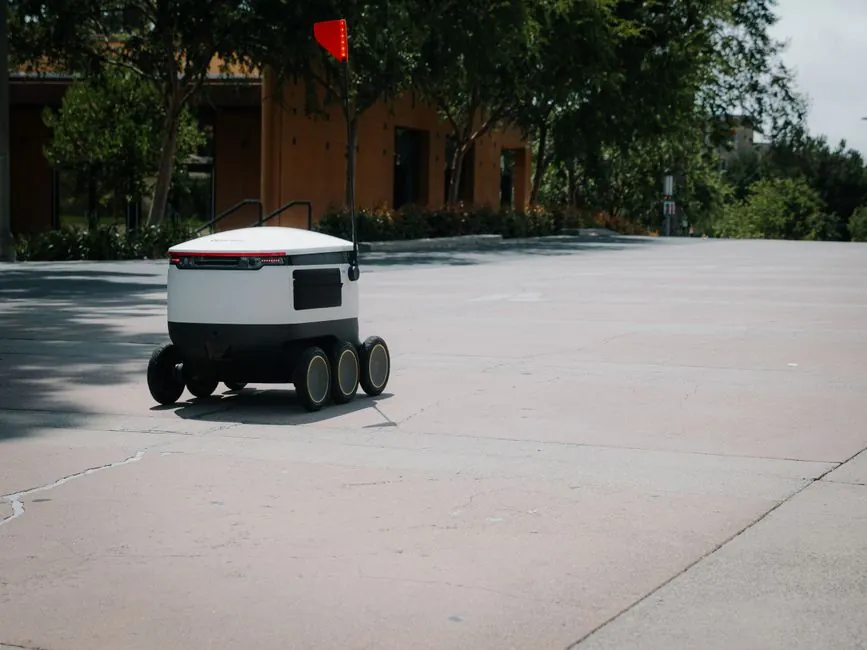
An autonomous mobile robot can move between facilities, but redeployment requires new maps, route validation, charging, communications, and safety checks.
The mechanical unit may arrive intact, while the AMR software and fleet-management configuration must be validated before it can resume transport work.
What Changes When an AMR Crosses a Facility Boundary
An autonomous mobile robot can navigate without fixed guide rails because onboard LiDAR, cameras, inertial measurement units, and navigation software support mapping, localization, obstacle detection, and route planning [S1]. That flexibility does not remove the need to establish a valid operating map in the destination facility.
A transfer requires more than physically transporting the chassis. The receiving site must have a compatible floor, suitable charging point, wireless coverage, identifiable work zones, safe pedestrian separation, and routes that accommodate the payload and turning behavior. A robot moved after an aisle, dock, fire door, or elevator configuration changes cannot simply reuse an unchanged site model [S7].
The move can therefore be classified into three levels. A basic relaunch needs map creation and a navigation test. A production restart needs work-zone definitions, mission rules, endpoint validation, and charging routines. A fleet transfer additionally requires task migration, fleet-server configuration, reporting continuity, and cybersecurity review.
AMR Versus AGV Redeployment Requirements
AMRs generally need less fixed infrastructure than automated guided vehicles because they map and navigate through onboard perception, while fixed-route AGVs depend on guides such as wires, magnets, or reflected laser markers [S2][S4]. The comparison below applies to relocation planning, not a claim that either technology can be moved without commissioning.
Facility size alone is a poor relocation criterion. A large warehouse with stable guide paths may suit an AGV, while a smaller plant with frequently changing work zones may benefit more from an AMR. The deciding factors are infrastructure dependence, route volatility, mission complexity, and integration effort.
Preliminary Tests for Receiving and Dispatching
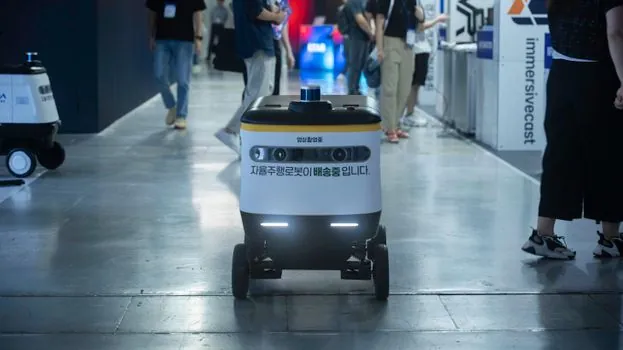
Before dispatch, record the robot's charge level, battery condition, payload configuration, attached equipment, software version, and mission history.
At the destination, confirm that the floor is traversable, the charging station is positioned correctly, and radio coverage reaches the operating area. Validate floor marking and safety fields, remove or identify obstructions, and test the robot with the actual load. The receiving site should not authorize production missions until the robot has completed localization and docking checks.
For comparison with fixed-path systems, AMR minimum aisle width versus AGV route geometry should be reviewed during layout validation.
Payload and Equipment Compatibility Across Sites
A robot that passed its load test in one building may still require a new interface at another facility because pallet dimensions, floor loads, roller heights, conveyors, and workstations can differ.
The transfer specification should identify payload mass, load center, footprint, pickup orientation, handover height, and whether the load is rigid, unstable, or requires an attached conveyor, lift table, or custom pusher [S3]. Battery selection also belongs to the receiving site because dock power, charge time, shift length, and replacement strategy determine whether the unit can support the planned workflow.
Autonomous mobile robots are a poor shortcut for a site whose material flow still depends on unstable loads, incompatible docking hardware, or manual handoffs. Those constraints belong in the acceptance test, not in the assumption that self-navigation removes all integration work.
Software, Communication, and Multi-Floor Constraints

Moving an AMR between buildings usually transfers the physical asset while recreating the digital operating environment. A fleet-management system must recognize the destination, associate correct maps with the robot, assign authorized users, and route missions to the appropriate work zones. Integration with a warehouse management system or material-handling control layer must then be tested end to end. [S4]
Multi-floor operation can be supported through elevators, but the operating sequence must include elevator reservation, compatible door timing, verified floor identification, and a robot recovery procedure if the elevator is unavailable [S7]. These are controlled-interface dependencies, not free navigation. An AMR may navigate a floor independently yet require deterministic coordination at each vertical transfer point.
Remote monitoring and fleet software also create a migration record. Before handover, operators need confirmed robot identity, firmware and application versions, map versions, mission definitions, event logs, credential assignments, and rollback arrangements. These steps separate a portable robot from a portable automation service.
Who Gains From Moving an AMR Between Facilities
Facility transfer is practical for engineering teams that need a temporary fleet addition, a pilot in a second plant, or redeployment after a layout change. It is also useful where both sites have compatible handoffs and the receiving team can support mapping, charging, wireless coverage, and workflow integration. [S1]
Facility transfer is unsuitable when the receiving site has no local technical owner, the robot is needed at full capacity at both locations, or the new process requires different load-handling hardware. It can also be inefficient if the destination requires a major mapping and integration effort that exceeds the value of relocating the robot.
For organizations comparing automation types, an AGV robot may be more appropriate where repeatable fixed routes justify permanent guidance infrastructure. An AMR generally fits where dynamic routing and minimal floor modification outweigh the burden of mapping and software validation [S2][S4].
Acceptance Criteria for a Production Restart

A production-ready handover should require successful localization, obstacle detection, emergency stop, charging, docking, payload transfer, and mission completion in the destination facility. The acceptance record should identify the tested route, load condition, software version, map version, and observed docking result. A demonstration of movement through an empty corridor is not sufficient. [S1]
The business case should also quantify downtime for transport, mapping, commissioning, operator training, and integration testing. Review material-flow compatibility against existing equipment, including any relationship with a conveyor sorting line or rack system, because AMR navigation does not correct mismatched load-transfer heights or incompatible tote dimensions.
The final decision is straightforward: move the AMR when the receiving layout, payload interfaces, software stack, and operating responsibility can support a controlled commissioning effort. If the destination lacks any of those elements, treat the transfer as a new deployment with a reused robot, not as a plug-and-play installation.
Track the commissioning record for two verifiable signals: successful completion of representative loaded missions and repeatable docking accuracy against the receiving interface. Both must remain stable across multiple shifts before the unit is accepted into the destination fleet.