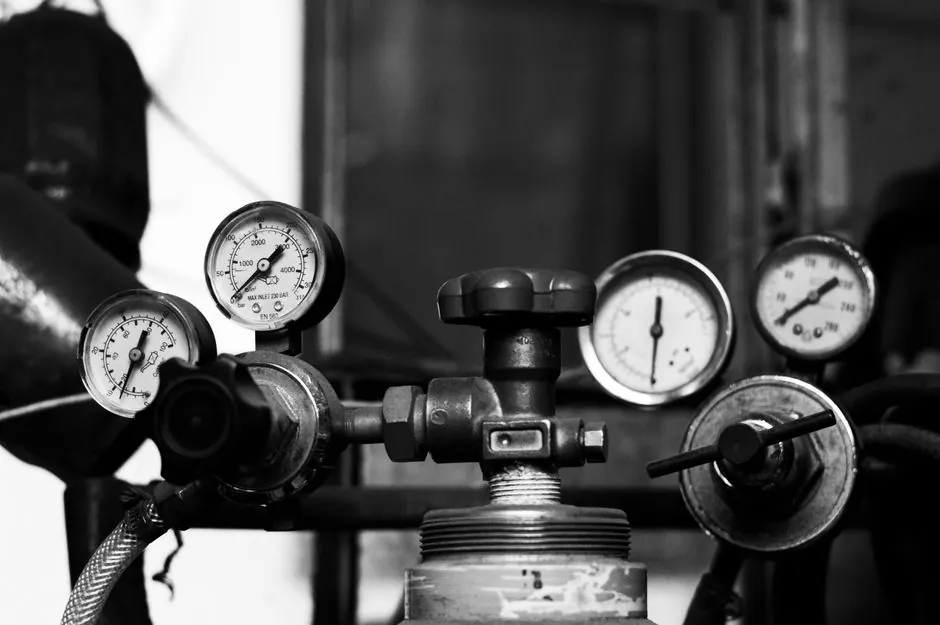
A 1.9 L Type V tank filament-wound with T700 carbon fiber weighed 0.2 kg (0.44 lb), illustrating the mass floor that wet-wound CFRP vessels can hit [S6]. Against the same duty point, an all-steel cylinder scales with wall thickness cubed against allowable hoop stress, so any pressure step above ~30 MPa tips mass economics decisively toward composite overwrap.
Type IV (all-composite, polymer liner) pressure vessels weigh only about 1/10 of the mass of all-metal vessels for the same service [S4]. Type III (metal liner, full carbon overwrap) reduces mass roughly 50% versus a Type II (fiber-wrapped steel/aluminum) baseline, per the same industry chronology [S4].
Type-by-Type Mass Math: I, II, III, IV, V
Type I is a solid-metal vessel, almost always steel, and is the only construction that does not benefit from fiber reinforcement; it is the reference point for weight comparisons. Type II wraps high-strength glass around the cylindrical section of a steel or aluminum liner, delivering roughly 30% mass reduction versus an all-metal vessel of equal pressure rating [S4].
Type III introduced in 1973 used a full glass or carbon overwrap on a metallic liner rated to carry only 10% of the hydrostatic load, cutting another 50% of mass versus Type II [S4]. The Type IV all-composite vessel arrived in 1995, with a heavy rigid plastic liner acting only as a permeation barrier and the fibers carrying the entire pressure load, again a step-change in mass efficiency [S4]. A Type V vessel, defined as a non-pressurized liner or no liner at all, was first commercialized as a 1.9 L T700 carbon fiber tank weighing 0.2 kg (0.44 lb) [S6].
Why Steel Loses on Mass Above ~30 MPa
Hoop stress in a thin-wall cylinder scales as PD/2t, so wall thickness t scales linearly with pressure P. Because vessel mass scales with cross-sectional area times length, doubling service pressure at fixed diameter roughly doubles the required steel wall thickness and therefore the empty mass, before any safety factor is applied. Type 3 or 4 pressure vessel cost, weight, and strength are dominated by fiber selection rather than the metallic or polymeric liner, which is why high-pressure duty points migrate off steel quickly [S2].
A 70 MPa (700 bar) compressed hydrogen Type IV vessel analyzed for 700 bar service in current FEA work demonstrates that fiber orientation, not liner material, drives burst pressure and weight; a hoop layer plus intermediate helical angles can match the performance of combined high/low helical patterns at lower laminate mass [S1]. Wet-filament-wound Type 4 carbon fiber pressure vessels rated to 700 bar are produced today for space applications, with mass efficiency that no steel variant can approach at that pressure class [S7].
Cost, Fatigue, and Permeation Trade-Offs
Carbon fiber is the most expensive reinforcement option but delivers the highest performance level of the common fiber choices (glass, aramid, basalt) used in pressure vessel winding [S2][S4]. A 2026 benchmark study of commercial carbon fibers across different tow sizes was published to optimize filament winding for high-pressure service, confirming that tow size selection remains an active design variable for cost-versus-mass tuning [S8].
Type IV vessels pay for their mass savings with two penalties: the polymer liner permeates gas over time, and the failure mode, while non-explosive, is a slow leak rather than a guaranteed seal [S4]. Type II and Type III designs avoid the permeation problem because their metallic liner is impermeable, which is why compressed-gas fueling stations and many industrial gas services still specify Type III over Type IV when leakage class and qualification pedigree matter more than empty weight [S4].
Decision Matrix: When to Pick Each Construction
For mobile hydrogen storage at 350–700 bar, vehicle or aircraft mass budgets force Type IV; a Type III adds tens of kilograms per vessel that no light-vehicle platform can absorb, and no steel vessel is competitive above ~30 MPa for that duty [S1][S7]. For stationary industrial gas receivers below ~30 MPa where the vessel does not move, Type I steel or Type II (glass-wrapped steel) typically wins on total installed cost and on a 30+ year service life with simple requalification [S4].
For aerospace and spaceflight oxygen or pressurant tanks, Type IV and Type V dominate because launch mass and structural mass fraction are first-order cost drivers; the 0.2 kg Type V reference tank and 700 bar Type IV space-rated vessels are direct evidence of where the trade lands [S6][S7]. For chemical plants and energy storage systems handling corrosive media, the corrosion resistance of composite overwrap versus painted or lined steel becomes a secondary argument on top of the weight saving [S5].
Material Selection for the Overwrap and Liner
Carbon fiber dominates modern Type III and Type IV winding because of its tensile strength and stiffness per unit mass, while aramid (Kevlar) and basalt fiber are layered in for impact resistance and low-temperature toughness in hybrid designs [S4]. The reference fiber-matrix data in carbon fiber is the starting point for any filament-wound vessel mass calculation, and the comparison with carbon steel mechanical properties defines the baseline the overwrap is replacing.
Liners for Type III are typically aluminum or steel; Type IV uses HDPE or PA6 polymer that must survive autofrettage, fatigue cycling, and the specific gas permeation target. For high-pressure Type III where the metal liner still sees ~10% of the hydrostatic load, alloy steel can be specified instead of carbon steel to gain fatigue life, but the overwrap carbon layer still dominates the mass budget [S2][S4].
Winding-Angle Engineering for Mass Efficiency
FEA work on Type IV hydrogen vessels at 70 MPa shows that combining positive and negative helical winding angles yields higher burst pressure at lower laminate mass than either a pure hoop or a single helical pattern [S1]. A one-factor-at-a-time sensitivity analysis in the same study confirms that wound layer thickness, not just orientation, is a primary driver of vessel mass and burst performance, which is why production filament-wound tanks are rarely built with a single fiber angle [S1].
For shop-floor engineers specifying tow size, the 2026 benchmark work on commercial carbon fibers at different tow sizes is now the practical reference for matching winder capability to vessel diameter and required layer thickness [S8]. Cross-discipline links for the underlying reinforcement options sit at carbon fiber, while stainless steel is the relevant baseline when a Type III liner demands corrosion resistance in addition to strength. The fatigue-versus-crack-propagation trade between CFRP and metal liners is detailed in CFRP Fatigue vs Metal Crack Propagation: Selection Guide.</h2> <p>Trackable signals for the next design cycle: continued FEA-driven winding-angle optimization for 70 MPa hydrogen service, with the dominant lever being layer thickness rather than angle selection [S1], and ongoing 2026 benchmark data on commercial carbon fiber tow sizes feeding winding-machine setpoint libraries for high-pressure CPV production [S8].