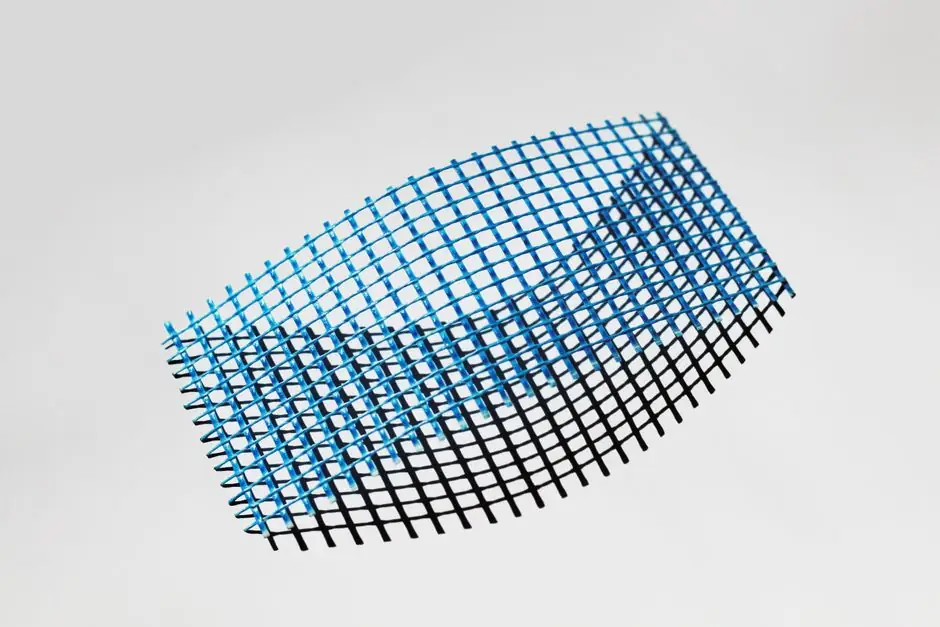
Pitch-based high-modulus carbon fiber reaches an along-fiber thermal conductivity of 500-1000 W/m·K, roughly 2.5 times the value of copper, while the across-fiber (transverse) value on the same fiber drops to single digits [S3][S7].
The through-thickness thermal conductivity of a unidirectional carbon-fiber-reinforced polymer (CFRP) laminate inherits that anisotropy and typically lands between 0.8 and 2.4 W/m·K, even when the along-fiber conductivity of the same panel exceeds 300 W/m·K [S1].
Anisotropy ratios measured on real CFRP laminates
A unidirectional panel built from pitch-based carbon fiber with an axial fiber TC of 620 W/m·K delivered 322.8 W/m·K along the fiber and 2.09 W/m·K through the thickness, an in-plane to through-thickness ratio near 154:1 [S1]. A hybrid PAN/pitch unidirectional composite widened that gap further: 223 W/m·K in-plane against 0.83 W/m·K through-thickness, a ratio above 268:1 [S1]. A 2-D pitch-based/ABS composite registered 515.6 W/m·K in-plane against 2.37 W/m·K through-thickness, again above 200:1 [S1]. These three data points define the operational band a thermal engineer should plan around when sizing heat spreaders.
Transverse fiber TC by microstructure: 2.87 vs 9.27 W/m·K
Inverse finite-element analysis on single fibers pulls the matrix contribution out and reports the bare-fiber transverse TC. A folded-radial mesophase-pitch fiber (TC-HC-800) measured 9.27 W/m·K transverse, while an onion-skin mesophase-pitch fiber (PCF-1) measured 2.87 W/m·K, more than a 3:1 split driven by graphitization degree, cross-sectional area, and aspect ratio [S1]. Higher fiber volume fraction forms more continuous heat-conduction paths through the thickness, so through-thickness panel TC climbs steeply as fiber loading rises [S1].
Modulus, precursor, and the conductivity spread
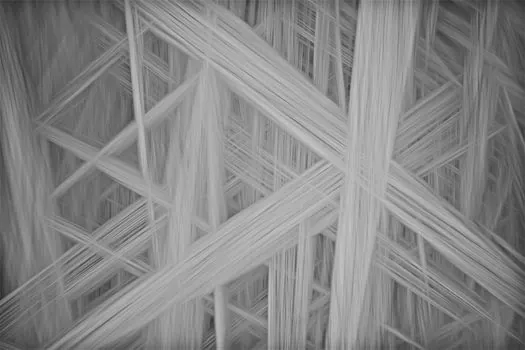
Across-fiber TC correlates with tensile modulus in the same direction: higher-modulus fibers give higher fiber-direction TC and higher perpendicular TC, an effect confirmed by tensile-modulus-coupled measurements on PAN-based yarns [S8]. Coal-pitch (mesophase) fibers with highly graphitic basal-plane alignment push the along-fiber TC to 1000 W/m·K, while standard PAN-based high-strength grades sit closer to 8-70 W/m·K along-fiber with low single-digit transverse values [S7][S9]. A high-modulus fiber that is also brittle trades impact tolerance for conduction; a high-strength fiber trades conduction for toughness, a choice set every thermal designer has to make [S9].
How NASA narrowed the through-thickness gap
NASA Langley/Ames tackled the through-thickness bottleneck by perforating pyrolytic graphite sheets and flowing CNT-doped resin through the perforations, producing more than a 10x increase in thermal conductivity over baseline CFRP and more than 2x the conductivity of Aluminum 6061 in in-plane tests [S2]. The perforations act as z-direction bridges, replicating the z-pin and 3-D reinforcement effect previously demonstrated on pitch-based laminates, but at the sheet-additive level rather than the fiber-architecture level [S1][S2]. For non-aerospace applications, similar gains are accessible by stitching, z-pinning, or curing under through-thickness pressure to push the panel through-thickness TC above 5 W/m·K [S1].
Test methods: TPS, hot-wire, and the anisotropic module

Bulk along-fiber TC is commonly read on a transient plane source (TPS) rig per ISO 22007-2, while transient hot-wire (THW) follows ASTM D7896-19 for cross-checks; an anisotropic TPS module simultaneously resolves radial and axial TC on a single carbon-fiber sample [S4]. The MP-V platform with an MTPS sensor measures both directions in one transient analysis run, which matters because a single value reported as "the thermal conductivity of carbon fiber" without direction is meaningless for heat-spreader sizing [S4]. For composite laminates, in-plane and through-plane TCs are measured separately on coupons cut normal and parallel to the ply stack, a discipline reinforced across most published datasets [S1][S6].
Decision matrix: high-modulus pitch vs high-strength PAN vs hybrid
For a heat-spreader application requiring an in-plane TC above 300 W/m·K, specify a mesophase-pitch high-modulus fiber (along-fiber 500-1000 W/m·K, transverse 3-10 W/m·K) and accept the through-thickness penalty around 2 W/m·K [S3][S7]. For a structural panel that must also dissipate modest heat, specify a PAN-based high-strength fiber (along-fiber 8-70 W/m·K) and budget for a metal or graphite heat-spreader insert at the hotspot [S9]. For applications that must move heat through the thickness (heat exchangers, radiator faces), specify a perforated PGS/CNT-modified hybrid panel delivering more than 10x baseline CFRP conductivity, or use 3-D/z-pinned reinforcement to lift through-thickness TC above 5 W/m·K [S1][S2]. A related selection discussion on carbon-filled versus glass-filled nylon stiffness sits at CF filled vs GF filled nylon filament stiffness.
When the "high-conductivity carbon fiber" claim is misleading

A single TC number printed on a datasheet is direction-agnostic and almost always measures the favorable along-fiber direction; a 500 W/m·K headline value can sit next to a 5 W/m·K transverse value on the same fiber, a 100:1 spread that voids any isotropic heat-spreader assumption [S1][S5]. For components that see heat flux in the transverse direction (e.g. a CF skin bonded to a heat source), specify the through-thickness value, not the in-plane value, and confirm the test method (TPS, THW, or guarded hot-plate) on the certificate of analysis [S4][S6]. Reference behavior of carbon fiber composites in EMI shielding and conductivity trade-offs is covered separately, including thresholds at which the material behaves more like a conductor than a dielectric.
Track the through-thickness TC of z-pinned and 3-D-reinforced CFRP coupons as the next verification step, since published numbers above 5 W/m·K remain niche and producer-dependent. A second signal to watch is the qualification data on NASA's PGS/CNT-modified hybrid under representative radiation and long-duration thermal cycling, which determines whether the 10x in-plane and through-thickness gains hold outside laboratory coupons [S2].