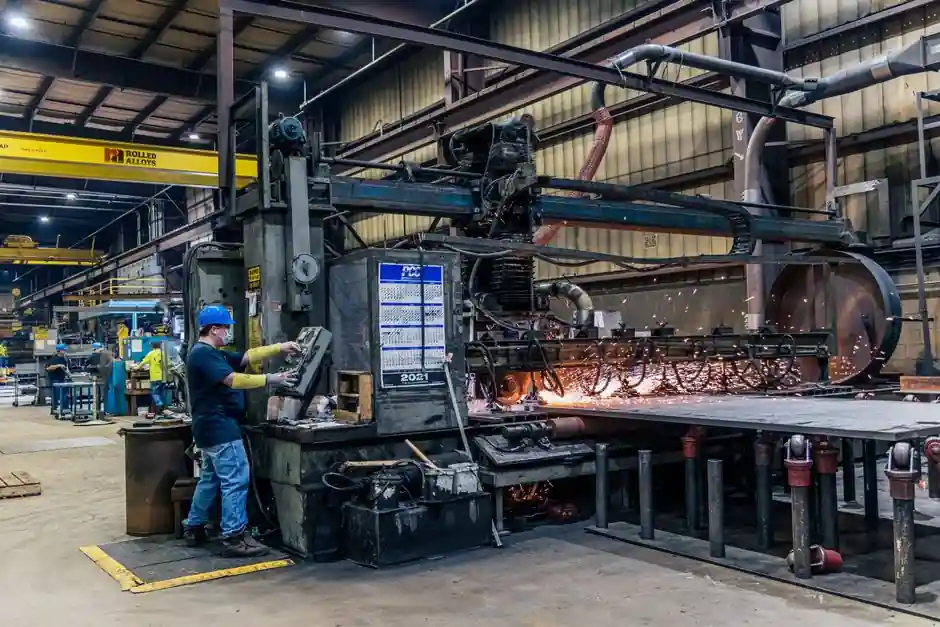
Hot-rolled carbon steel is rolled above approximately 1,700°F, producing a rough, mill-scale surface with less precise dimensions and lower cost [S1][S4].
Cold-rolled carbon steel is hot-rolled material finished at or near room temperature, adding tighter tolerances, smoother surfaces, and strength of up to 20% above hot-rolled steel [S4][S5].
Surface Finish and Dimensional Control
Hot-rolled steel retains a rough, scaly surface containing mill scale, while cold-rolled steel has a smooth finish without the characteristic scale [S3]. The hot-rolled condition also permits non-uniform shrinkage during cooling, so finished thickness and shape vary more than in cold-rolled material [S1][S5].
Cold rolling narrows dimensional tolerances and improves straightness, concentricity, and consistency compared with hot rolling [S2][S5][S7]. For carbon steel buyers, the practical distinction is straightforward: hot rolling minimizes finishing work, while cold rolling moves more value into the final surface and dimensional specification.
Both products remain within the carbon steel family, but the rolling route changes surface condition, tolerance capability, forming behavior, and cost without serving as a grade designation by itself.
Process Route Changes Material Performance
Hot rolling occurs above the steel recrystallization point, typically over 1,700°F, so the material remains pliable and easy to shape [S4][S5]. Hot-rolled carbon steel is generally produced with less delay, no reheating cycle for cold finishing, and therefore a lower manufacturing cost [S1][S5].
Cold rolling starts with hot-rolled material and re-rolls it at or near room temperature, generally followed by annealing or temper rolling [S4][S5]. This additional processing increases hardness and tensile strength, improves resistance to deformation, and can produce material up to 20% stronger than hot-rolled steel through work hardening [S5].
The tradeoff is formability. Hot-rolled steel offers increased ductility and toughness and is easier to form into large sections, while cold-rolled steel is harder, less ductile, and more difficult to form [S4][S5].
Decision Matrix for Procurement and Design
For a structure that accepts ordinary dimensional variation, hot-rolled carbon steel is the economical choice because it costs less, forms readily, and is widely used for frames, columns, I-beams, rail components, and agricultural equipment [S4][S5]. Its rough mill-scale surface normally requires pickling, grinding, or sandblasting when a cleaner or more uniform appearance is needed [S5].
Cold-rolled carbon steel is the stronger option for visible components, precision parts, and forming operations where surface quality controls fit, appearance, or downstream coating. It is used for automotive parts, appliances, furniture, storage systems, and aerospace structural components, where smooth surfaces and closer tolerances justify the added processing [S4][S5].
On cost, hot-rolled wins because it avoids the reheating and finishing operations [S1][S5]. On surface quality, cold-rolled wins because it removes mill scale and offers a smoother, oilier touch [S3][S5]. On dimensional precision, cold-rolled wins through closer tolerances, better straightness, and improved concentricity [S2][S7]. On severe forming, hot-rolled is generally easier to shape, while cold-rolled is harder and less ductile [S4].
Use Cases and Application Fit
Hot-rolled carbon steel fits building frames, columns, heavy equipment, rail components, metal buildings, stampings, and automotive frames where exact dimensions are not controlling [S1][S4][S5]. The material can also be used for air ducts and vehicle bodies when a rough surface and modest dimensional consistency are acceptable [S1].
Cold-rolled carbon steel fits appliances, metal furniture, automotive parts, aerospace structural components, and cold-formed framing [S4][S5]. For cold-formed studs, joists, and tracks, precision-thickness coil is roll-formed at room temperature to create consistent sections with tight dimensional control [S4].
Cold rolling is not the right choice for every precision requirement. A buyer seeking flat, square, round, or rectangular stock in a specified condition should identify whether the product is cold finished, annealed, or temper rolled, because “cold rolled” alone does not describe the complete delivery condition [S1][S5].
Mill Scale, Coatings, and Secondary Operations
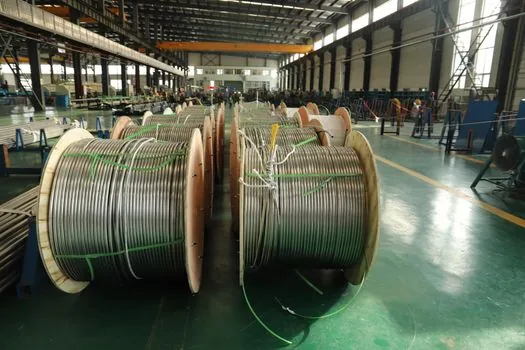
Mill scale is the principal surface difference in a visual comparison: hot-rolled steel has a rough, scaly finish, while cold-rolled steel is smooth and generally free of that scale [S3][S6]. Scale can interfere with welding preparation, coating adhesion, and appearance, so hot-rolled parts often need pickling, grinding, or abrasive cleaning before downstream finishing [S5].
Cold-rolled sheet already presents a more finished substrate for painting, plating, forming, or visible assembly, which can reduce the amount of surface preparation required. That does not make the material coating-free: the selected surface condition still determines coating-system compatibility, and the drawing must identify the required finish rather than rely on the rolling designation alone.
Rough edges and slight distortion are also more characteristic of hot-rolled plate because of cooling shrinkage and less precise finishing [S5]. Cold-rolled material offers tighter geometry, but additional processing can introduce internal stress that may cause warping when machining changes the stress distribution [S1][S3]. Stress relief before grinding or cutting can therefore be necessary for highly stressed cold-finished components [S1].
Procurement Checks for Carbon Steel Orders
A purchase specification should identify product form, carbon steel grade, thickness or section size, dimensional tolerance, straightness, surface condition, and any coating requirement. Hot-rolled descriptions should be paired with an acceptable scale condition and, where appearance matters, a defined pickling, grinding, or blast-cleaning operation [S5][S6].
Cold-rolled descriptions should state whether annealed or temper rolled material is required, the required finish, and the dimensional inspection basis. The distinction between hot-rolled and cold-finished products is a processing difference: all cold-finished material is hot-rolled, but hot-rolled material is not automatically cold finished [S1].
Buyers should also separate surface-finish requirements from alloy selection. Carbon steel, alloy steel, and stainless steel have different corrosion and heat-resistance characteristics, while the hot-versus-cold decision primarily controls dimensional precision, surface condition, strength, formability, and processing cost [S2][S5].
The next procurement checkpoint is the finished-part drawing: require mill-scale removal for hot-rolled carbon steel when appearance or coating quality matters, and specify an annealed or temper-rolled cold condition when forming, machining, or fit depends on stable dimensions [S1][S3][S5].