
Carton box selection for e-commerce fulfillment is governed by three coupled parameters: the corrugated board's edge crush test (ECT) rating, the flute profile (E, B, C, or BC), and the inner dimensions versus the SKU's dimensional weight, not the product's actual mass [S1][S5].
For typical small-parcel flows under 18 kg with edge length below 60 cm, single-wall B-flute containers in the 200-400 mm × 150-300 mm × 80-200 mm range cover the majority of orders and align with most carrier parcel tiers [S5][S8]. Operations handling apparel, books, and lightweight electronics typically standardize on a four-SKU grid of FEFCO 0201 regular slotted containers (RSC) to minimize die inventory and to keep packer pick time under 4 s [S8].
Board and Flute Specification by Weight Class
Single-wall B-flute cartons rated ECT-32 (roughly 5.5 mm wall thickness) are the de-facto standard for parcels up to 18 kg and are accepted by major US small-parcel carriers for standard ground service, with the corrugation providing roughly 4-6 mm of cushion depth for edge protection [S8][S1]. Double-wall BC-flute, ECT-44 to ECT-48, becomes mandatory above 18 kg or when any single edge exceeds 60 cm, because the dual liner structure lifts stacking strength to roughly 250-275 lb/in² and prevents carton crush in stacked-pallet transits [S1][S8].
The reference carton box terminology matters here: an RSC (0201) has four flaps top and bottom that meet in the middle, while a 1-2-3 bottom or auto-bottom carton (FEFCO 0711 or 0713) eliminates bottom flap taping, dropping pack-station sealing time to roughly 2-3 s per parcel in mechanized lines [S2]. A full-depth turnover box is a different category altogether: rigid, reusable, plastic or corrugated plastic, designed for closed-loop bin cycles, not single-parcel e-comm shipping, so it should not be confused with the disposable corrugated RSC on a packer's bench.
Inner Dimensions, Dimensional Weight, and Carrier Compliance
Carrier billing uses the greater of actual weight and dimensional weight, calculated as L × W × H (in or cm) divided by a divisor (139 for domestic US ground, 5000 for international cm³/kg), so a 30 × 20 × 15 cm carton at 0.4 kg actual is billed at roughly 1.8 kg volumetric and inflates cost roughly 4.5× versus a right-sized 26 × 18 × 12 cm box [S5][S3]. Box-height clearance of 10-15 mm above the tallest product face, plus void fill budget of 25-40 mm around each side, is the practical guideline to hit both packer ergonomics and the carrier's no-excess-space expectation.
Pack-Station Cycle Time and Box-Opening Mechanization
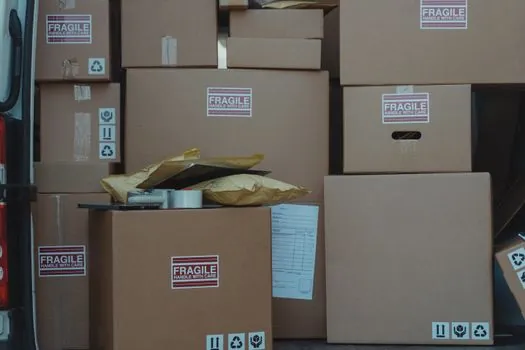
Pack-station throughput is bounded by the box-opening step, and a high-volume e-comm pack line runs at roughly 360-600 parcels/hour per operator, equivalent to a 6-10 s cycle time, when the carton is fed pre-erected and the carton erecting machine discharges the RSC square and bottom-sealed ready for load [S2]. Manual erection of an RSC from a flat blank typically consumes 8-12 s and dominates the packer cycle, so operations above roughly 500 orders/day per station will see measurable ROI from a semi-automatic erector with hot-melt glue bottom seal running at 15-25 cartons/min [S2][S1].
Designing the pack station itself, including a 36-42 in (≈900-1070 mm) adjustable-height work surface, U-shaped supply layout, scales for weight capture, and integrated label printer, is the variable that turns a 12 s manual cycle into a 6-7 s cycle on identical cartons [S2]. An under-bench rack for the next three SKUs of box and an overhead bin for void fill and dunnage keeps the packer's reach inside the ergonomic golden zone (shoulder to knee height), which directly lowers pick error rate and rework in a 1- to 2-SKU-a-second cadence.
Single-Wall vs Double-Wall vs Auto-Bottom: Criteria Comparison
For an order profile under 18 kg with no edge over 60 cm, single-wall B-flute ECT-32 RSC is the cost baseline at roughly $0.18-$0.35 per carton at pallet-quantity pricing, and it integrates with standard 50 mm tape sealing and existing pack benches [S1][S8][S6]. For orders in the 18-30 kg range, or any unit with fragile contents, double-wall BC-flute ECT-44/48 is the right call at roughly $0.45-$0.85 per carton, with the thickness adding roughly 2-3 mm per wall that must be budgeted into inner-dimension planning to avoid forcing the SKU into the next larger box tier [S1].
For high-volume lines above 500 orders/day per station, auto-bottom 1-2-3 or crash-lock cartons (FEFCO 0711, 0713, 0771) eliminate bottom taping and drop packer cycle time to 4-6 s, but the unit cost roughly doubles to $0.50-$1.10, so the payback window typically requires 50,000+ units/month per SKU [S2].
Failure Modes and Sourcing Constraints
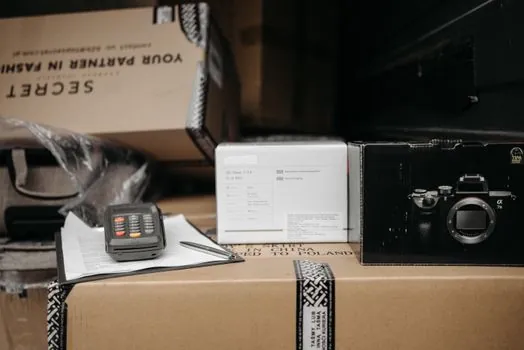
Three failure patterns dominate returns data on poorly specified cartons: top-flap seal failure under vibration (linked to using a single 50 mm tape strip instead of an H-pattern or 75 mm strip on ECT-32 RSC above 12 kg load), corner crush on stacked pallets (linked to single-wall C-flute at pallet-stack loads above 150 kg, where double-wall BC is required), and box bulge from insufficient burst strength on irregular SKUs (linked to ECT-26 stock used beyond its 18 kg rated limit) [S1][S8].
Sourcing risk concentrates at two points: domestic corrugated supply at 2,000-3,000 unit MOQs runs 8-12 weeks lead time in normal conditions and stretches to 20+ weeks during peak (September-December), while import containerboard is exposed to 2025-2026 tariff schedule revisions that have moved landed cost 12-25% on China- and Mexico-origin stock [S5][S6]. A practical mitigation is a primary supplier on a quarterly blanket PO plus a secondary domestic supplier on monthly releases, which together hold cost variance within roughly 5-8% across a peak season.
Trackable Signals for Q4 2026 Procurement
Two signals are worth watching through the next ordering window: ECT-32 and ECT-44 linerboard price index movement, which historically tracks within roughly 4-6 weeks of OCC (old corrugated container) scrap pricing, and the 2026 peak-season surcharges from major small-parcel carriers, which in 2025 were announced in mid-October and ranged $0.30-$1.50 per parcel on oversize tiers [S1].
For a related spec-driven read on the reusable side of the same fulfillment loop, the Turnover Box Selection for E-Commerce Fulfillment map lines the 600 × 400 mm and 400 × 300 mm footprints against bin weight, rack compatibility, and trip lifecycle, useful if a B2B share of orders is being routed into a closed-loop pool instead of a one-way corrugated flow.
