
Both treatments harden the pin-bushing interface, but they distribute hardness differently: a case-carburized pin has a wear-resistant exterior and tough core, while a through-hardened pin has uniform section hardness.
Pin Hardness Determines the Failure Mode
Silent-chain pins connect adjacent plates and operate as bearing surfaces for the bushings, so they carry tensile, shear, bending, and sliding-wear loads during articulation [S3][S8]. A conventional silent chain uses riveted pins at each joint, making pin condition a direct control on joint integrity and chain elongation [S8].
Case carburizing diffuses carbon into the surface before quenching and tempering. It produces a hard, wear-resistant exterior while retaining a softer, ductile core that absorbs bending shock [S2][S3]. Through hardening treats the full cross-section, creating uniform hardness without a soft core or a hard-soft interface for a crack to follow [S3].
This distinction controls how the chain fails. Wear-limited chains generally elongate before a pin breaks, while overload-dominated systems can suffer fractured or turned pins with little preceding elongation [S3]. The hardening decision should follow the anticipated failure mode rather than assume that greater hardness always means longer life.
Case-Carburized Pin: Surface Wear With a Shock-Absorbing Core
Standard alloy-steel chain pins can be case hardened to 54–58 HRC, providing a proven balance of surface wear resistance and core toughness [S7]. Carburizing is suited to most industrial chain drives because the hard case addresses the pin-bushing wear interface while the tougher core resists brittle fracture under shock [S1][S3].
Typical case-hardened pin diameters are 3–20 mm, with the same heat-treatment principle also applicable to industrial pin formats up to approximately 30 mm [S5]. The relevant specification is not merely “hardened pin”: it should identify surface hardness, core condition, case depth, and dimensional tolerance, because a shallow case can wear through and expose the softer core [S5].
Case hardening is the conventional choice for general roller-chain drives that are lubricated, moderately loaded, and expected to wear out slowly and predictably while oiled. It is not the preferred response to dry-running or grit ingestion. Once the hard case is penetrated, wear can accelerate sharply, and a hard surface layer can provide a path for cracking under repeated overload [S3].
Through-Hardened Pin: Uniform Strength for Shock Drives
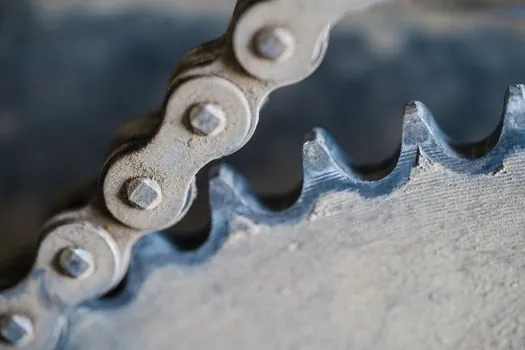
Through hardening produces uniform hardness across the pin section and removes the hard-soft boundary found in a case-hardened component [S3]. Case-hardened pins provide a hard surface that resists wear and a ductile core that absorbs shock without cracking, whereas through-hardening improves tensile strength and working load.
Uniform hardness does not eliminate sliding wear. A through-hardened chain operating dry can elongate like any other chain because lubrication, rather than pin strength, controls much of the wear rate [S3]. One manufacturer specifies through-hardened pins at 47–51 HRC through the entire pin, while its solid bushings use SCM420 alloy steel at 57–58 HRC and its rollers use SAE 1035 steel at 44–47 HRC [S4].
Specify it where shock, fatigue, or high static shear loads justify the additional cost, and pair it with the chain manufacturer’s required plate and rivet construction rather than treating the pin as an isolated upgrade.
Decision Matrix for Silent Chain Pin Selection
Case-hardened pins provide a wear-resistant surface and a tough core, while through-hardening improves overall tensile strength and working load but may wear faster where surface wear resistance is critical. Neither treatment solves contamination, misalignment, or overload by itself [S1][S3][S5].
For a packaging-line silent chain exposed to dust, dry contamination, or repeated shock, the practical sequence is to correct the environment first, then match the chain and pin treatment to the residual load. A roller chain selected for breaking strength does not necessarily provide the best wear life, while stronger pins cannot compensate for lubrication, alignment, or contamination problems [S1][S3].
Service Evidence and Failure Diagnosis
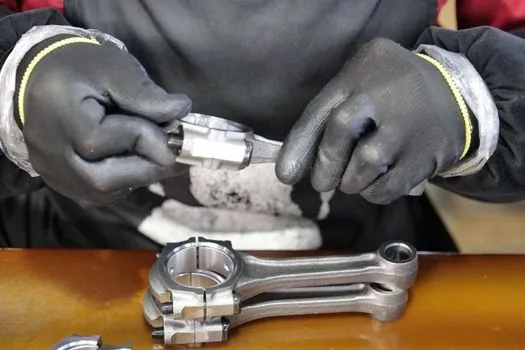
Wear can accelerate after the hardened case is worn through, and a joint that runs dry or fills with grit can cause this condition.
“Wear points to lubrication, breakage points to load” is a practical rule for inspection triage [S3]. If elongation and breakage occur together, poor lubrication and worn sprockets may be causing chain climbing and secondary damage, so those causes should be corrected before the pin treatment is reassessed [S3].
Specification Requirements for Procurement
A defensible silent-chain pin specification requires the heat-treatment process, case depth for a case-hardened pin, surface and core hardness targets, pin diameter, and dimensional tolerance [S5]. For through-hardened pins, state the required through-section hardness range and verify that pin construction matches the chain series; a manufacturer’s HV series, for example, combines through-hardened pins with heavier plates [S3].
For silent chain, confirm whether the proposed pin is a riveted structural pin and whether the manufacturer specifies case-hardened alloy-steel pins at 54–58 HRC [S7][S8]. Keep the pin, bushing, plates, and rivets as a system: changing hardness without matching the chain’s load rating and joint geometry can create an inconsistent assembly.
For mining, cement, and other dusty or high-shock installations, chain pitch, speed, service factor, lubrication, and environmental exposure should be reviewed together. The decision framework for silent chain selection in mining operations provides a useful way to separate operating severity from pin hardening rather than treating hardness as the sole design variable.
Record the observed failure mode and chain elongation before changing pin treatment, specify hardness distribution rather than a generic “hardened” note, and compare expected wear life against the cost of unscheduled chain removal and joint replacement.