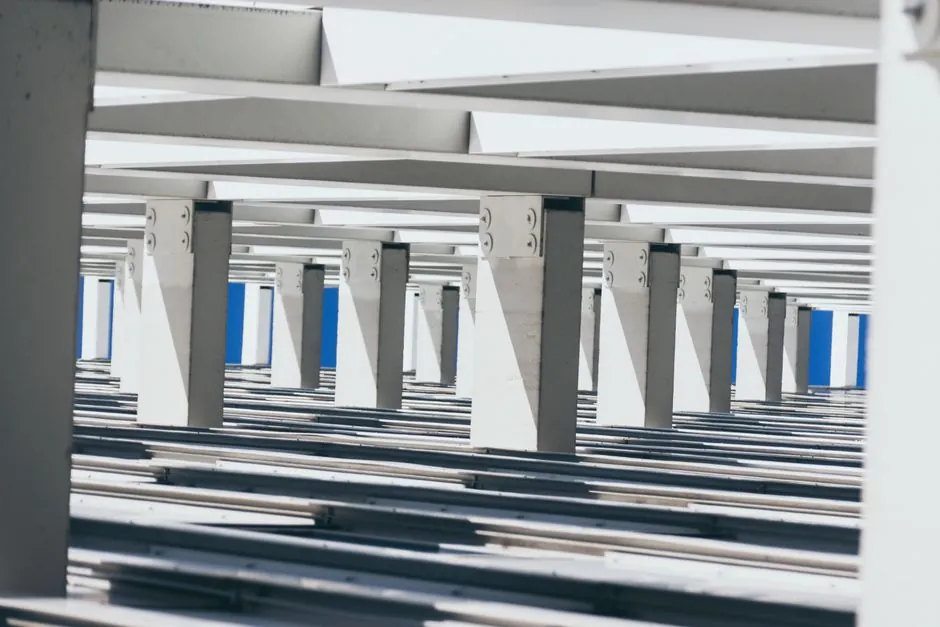
Cast-in embed plates deliver higher tension and shear capacity because the headed studs or hooked bolts are fully encased in fresh concrete during the pour, locking the anchorage into the structural section rather than depending on hole-wall friction or adhesive bond after the fact [S4][S5].
Post-installed anchors (mechanical wedge, screw, sleeve, and adhesive types) are the default choice for retrofit, tie-in, or layout-driven work: the framer or steel erector places the anchor after the wall framing is known, eliminating the misplaced-embed problem that has long plagued J- and L-bolt construction [S2][S3].
What the two systems actually are
An embed plate is a steel plate with headed studs (commonly Nelson studs), deformed bars, or anchor bolts welded to its back, set into the formwork before the pour so the assembly becomes an integral, flush-mounted part of the cured concrete [S4][S6]. A base plate by contrast sits on top of cured concrete over a non-shrink grout bed and is held down by cast-in or post-installed anchor bolts [S4].
Post-installed concrete anchor bolts fall into three groups: cast-in place (the legacy J/L/T/hex-head set before the pour), mechanical post-installed (wedge, screw, sleeve, undercut), and adhesive/bonded post-installed [S3][S5]. Each is qualified for tension, shear, and combined loading under different evaluation documents, with mechanical and adhesive types now required to demonstrate cracked-concrete performance across more than 1,000 crack and load cycles [S2].
Code basis and qualification documents
IDEA StatiCa Connection 25.1 added direct embed-plate anchorage checks against ACI 318-25: tension resistance per 17.6.1, concrete breakout per 17.6.2, pullout per 17.6.3, sideface blowout per 17.6.4, shear per 17.7.1, pryout per 17.7.3, and combined tension/shear interaction per 17.8.3 (concrete) and 17.8.4 (steel) [S1]. Reinforcement-anchored embed plates share the same concrete-side checks (17.6.2, 17.7.3) with steel-side resistance referenced to 20.2.2 [S1].
Post-installed mechanical and adhesive anchors are evaluated in the US under ICC-ES AC193 (mechanical) and AC308 (adhesive), and in Europe under EOTA TR 048, which adds fire exposure and sustained load testing beyond the standard tension/shear/cracked-concrete matrix [S2]. Light-frame sill-plate anchors additionally follow IRC Section R403.1.6: within 12 in. of each plate segment end and not more than 6 ft on center [S2].
Capacity, tolerance, and constructibility compared

Embed plates carry significantly higher shear and tension than most post-installed options because the anchorage is fully encased in the structural concrete rather than relying on wedge expansion or adhesive bond at a drilled hole, which is why they dominate tilt-up wall panels, elevator shaft supports, and heavy industrial mezzanine connections [S4]. The trade-off is positional risk: any stud or anchor bolt located before the pour is locked in place when the concrete cures, so a misplaced embed cannot be corrected without chipping and remedial work [S2][S5].
Post-installed anchors flip that trade. The installer drills the hole, sets the anchor, and torques or cures it after the framing layout is known, giving exact control of spacing, edge distance, and alignment, and making the connection inspectable before any wall or column load is hung off it [S2][S3]. Independent testing on 5/8 in. threaded rod anchors at 1-3/4 in. edge distances in cold-formed steel track reached ultimate loads around 7.5 kips, with cyclic loading to roughly 5 kips causing no damage to concrete or anchor when ductile-bearing steel failure governed [S2].
Material and geometry specifics to nail down
For embed-plate headed studs, IDEA StatiCa 25.1 supports ASTM A108 Types A and B, with the device defined by diameter, material, head diameter, and embedment depth, and shear transfer limited to the Anchors option with Direct stand-off [S1]. Embed plate reinforcement uses L-bars with diameter, material, embedment depth, and hook length as inputs, again with shear limited to the Anchors/Direct stand-off path; the rebar group can be rotated as a whole but individual bars cannot be re-oriented independently [S1].
For post-installed work the anchor material and coating drive service life: wedge and sleeve anchors are commonly zinc-plated or stainless for general interior use, while adhesive anchors are the typical pick where reduced edge distance, sustained tension, or chemical exposure is in play [S5]. The brittleness mismatch between adhesive anchor rod and concrete is one of the reasons EOTA TR 048 and AC308 demand sustained-load and cracked-concrete cycling, not just static tension [S2].
Spec-side decision matrix for the engineer

For a new concrete foundation supporting a steel column or braced frame where anchor positions are fully coordinated with the steel shop drawings, specify a cast-in embed plate with headed studs per ACI 318-25 Chapter 17 checks; the higher encased capacity and the elimination of drilled-hole QA usually win on life-cycle cost even with the placement-tolerance risk [S1][S4].
For retrofit, equipment tie-in, or any case where the framing layout is finalized after the concrete is placed, specify a post-installed anchor qualified under AC193 (mechanical) or AC308 (adhesive), designed per ACI 318 Chapter 17, and set spacing and edge distance to the evaluation report's cracked-concrete values; verify the installer can prove category, drill bit diameter, hole cleaning, and torque or cure time on the QC log [S2][S3]. The same logic applies to light-frame sill plates under IRC R403.1.6, where post-installed anchors have effectively displaced embedded J and L bolts on most US residential jobs [S2].
Failure modes and inspection traps
Embedded J and L bolts typically fail not from material weakness but from misplacement: anchors end up under framing members, at wall intersections, or at splices where edge distance and spacing are violated, producing failed inspections, field modifications, and in some cases compromised structural anchorage [S2]. Embed-plate studs avoid that misalignment failure mode but introduce their own risk if the plate is not securely fixed to the formwork, since a stud displaced during the pour lands in the same trouble spot as a misplaced J-bolt [S4][S5].
Post-installed mechanical anchors fail by concrete breakout when edge distance is too small, by slip when the hole is oversized, or by ductile steel failure when properly specified; adhesive anchors additionally fail by bond degradation under sustained load or elevated temperature unless the product is specifically qualified for those conditions [S2][S5]. On every post-installed install, inspection should confirm hole diameter, hole cleaning per the manufacturer's instructions, embedment depth, torque value (mechanical), and cure time (adhesive) before any load is applied [S2].
Recent software and workflow changes worth knowing
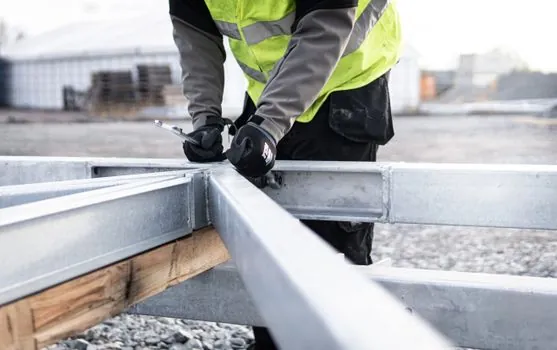
IDEA StatiCa version 25.1 introduced a two-step anchor selection that separates installation process (post-installed vs cast-in-place) from anchor type, and added embed-plate design with ACI 318-25 checks directly inside the Connection application so anchorage no longer has to be verified in an external tool [S1]. Headed stud and reinforcement anchorage are both supported under the Design tab, with the listed ACI 318-25 clause references for tension, shear, and interaction checks [S1].
The wider shift visible across the reference set is that post-installed systems are now treated as fully equivalent to cast-in bolts when designed to Chapter 17 and installed to the evaluation report, a position that has displaced J and L bolts from most spec-driven US wood-frame and light-steel work over the past several years [S2]. For process engineers weighing a retrofit or a greenfield pour, the practical question is no longer which is "stronger" but which gives a layout you can actually inspect on site without chipping concrete. For a deeper look at the stud welding process that lands those embed-plate headed studs, see CD vs drawn-arc stud welding: process selection; for a related framing decision on the cold-formed side, C channel vs lipped channel purlin: 2026 spec guide covers the secondary framing that often hangs off these connections.
The underlying component specifications are covered under cast iron, embedded part, and chemical anchor.