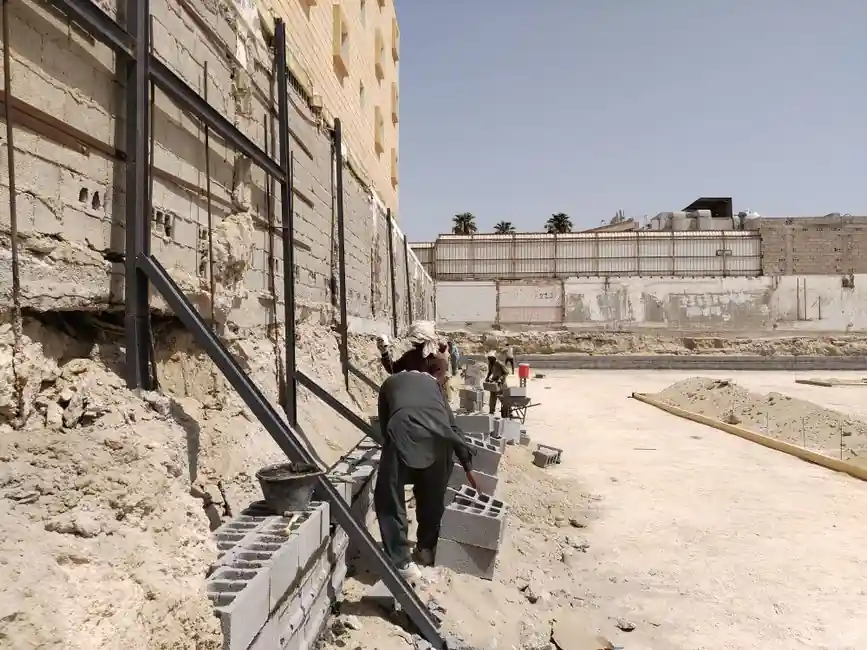
Standard expansion anchors perform well in the solid sections and mortar joints of concrete masonry units (CMU), but their holding values drop sharply in the hollow core where only a 1-1/4" to 1-1/2" face shell supports the expansion cone [S1][S5]. Wedge and drop-in anchors in particular are explicitly excluded from hollow cinder block because localized outward expansion pressure cracks the thin face shell or fails entirely inside the empty cell [S5][S7].
The reliable options for hollow or variable-density substrates are sleeve anchors, double-expansion shields, lag shields, concrete screws (Tapcon-style), toggle bolts, and adhesive anchors installed with a screen tube [S1][S3][S4]. Each routes the load differently: sleeve and double-expansion anchors spread bearing across a larger surface area, screws cut threads into the face shell with a minimum 1" embedment, toggles bridge the void, and adhesive systems form a chemical key inside the cell [S1][S2][S3].
Why wedge and drop-in anchors fail in hollow block
Wedge anchors develop their holding power by driving a small clip outward against the wall of a drilled hole, generating very high local bearing stress designed for the 3,000 to 5,000+ PSI compressive strength of poured concrete [S5]. In a hollow CMU, that same point load is delivered into a face shell only 1-1/4" to 1-1/2" thick, which either spalls on installation or, if the clip expands inside the empty cell, simply slips with no reaction mass to push against [S5][S7]. Drop-in anchors behave the same way: the deformation is concentrated at a single depth and is only resisted when the surrounding base material behaves like a continuous solid [S5].
Two failure modes dominate. First, the cone-shaped blow-out described in field guides, where the bit tip reaches the unsupported inner edge of the face shell during drilling and ejects a fragment, leaving less material for the anchor to expand into [S1][S2]. Second, an expansion that engages nothing because the anchor has crossed the face shell into the void; pull-out values in that case are essentially zero [S1][S5]. Wedge anchors are likewise off-limits for brick, which is also brittle and inconsistent [S2][S7].
Anchor types that do work, and the loads they suit
Sleeve anchors are the most versatile mechanical option for hollow block: tightening the nut draws a tapered bolt head into a slotted sleeve, distributing expansion force along the full length of the sleeve rather than at one point, and the same SKU works in solid concrete, brick, block, and stone [S1][S4]. They are rated for light to medium loads in materials that are softer or hollow, and they come pre-assembled in multiple diameters and lengths [S1][S4].
Double-expansion anchors and lag shields are specified by manufacturers for brick and masonry because they expand in two directions simultaneously, multiplying the bearing area against the hole wall [S3]. Concrete screws of the Tapcon family are a third route: they cut threads directly into the base material, so holding depends on thread-tap quality rather than expansion force, with a published minimum embedment of 1" into the substrate even in the hollow section [S1][S2]. For high-load attachments, through-bolts (drilled through the full wall with plate washers on both faces) and epoxy adhesive anchors installed through a screen tube give the most consistent results, since the screen tube provides both an adhesive bond and a mechanical key against the inner face shell [S1][S5]. The same family of decisions shapes how engineers treat related connections, as discussed in C channel vs lipped channel purlin: 2026 spec and selection guide, where member type and base material jointly govern fastener choice.
Composite and FRP substrates: when the base material is the variable

Composite materials and fibre-reinforced polymer (FRP) panels are increasingly specified for chemical-plant builds and wastewater structures because they resist corrosion, but their through-thickness bearing strength is much lower than CMU and they tend to delaminate at the hole wall if loaded in expansion mode. For these substrates, the same logic that excludes wedge anchors from hollow block applies with even more force: a through-bolt with backing plates, a chemical anchor with a screen tube sized to the panel thickness, or a purpose-made FRP composite fastener is the appropriate route. The deeper point, captured in the composite material selection reference, is that expansion bearing is only valid when the base material behind the expansion zone can supply a continuous reaction. [S5]
Engineers working with autoclaved aerated concrete (AAC) panels face a milder version of the same problem: the cellular structure is uniform but soft, so mechanical expansion anchors are typically limited to light loads and are paired with longer embedment or adhesives; the AAC block reference summarises the load class where mechanical fastening remains acceptable. Hollow AAC panels, by extension, are handled with screen-tube adhesive anchors rather than expansion sleeves.
Comparison: which anchor for which base material
Four decision criteria cover most field choices: load class, whether the substrate is solid or has a void at the anchor depth, brittleness, and access to both sides of the wall. The table below lines up the four most common anchor families against those criteria, drawn from the published guidance in [S1] through [S7].
Wedge anchor: high load, solid substrate only (poured concrete), brittle substrates excluded, single-side access sufficient. Sleeve anchor: light to medium load, works in solid or hollow, acceptable in softer or hollow materials, single-side access sufficient. Concrete screw (Tapcon): light to medium load, works in solid or hollow with 1" minimum embedment, brittle substrates usable because the thread cuts rather than expands, single-side access sufficient. Adhesive with screen tube / through-bolt: high load, specifically suited to hollow cells or unknown infill, can be used in brittle substrates because the bond area is distributed, through-bolt requires two-sided access. The mechanical behaviour of an expansion anchor is therefore a property of the surrounding material, not of the bolt itself.
Installation practices that protect the face shell

A carbide-tipped bit in a hammer drill is the standard tool for CMU; standard HSS bits glaze the hole wall and reduce holding values [S1][S2][S3]. Hole cleaning with a wire brush, compressed air, or vacuum is required before adhesive or expansion anchor installation, because dust left at the hole base prevents the expansion clip from seating or contaminates the chemical bond [S3].
Drilling into the hollow section risks inside spalling when the bit tip gets close to the unsupported inner edge of the face shell, ejecting a cone-shaped fragment and leaving less material to grip [S1][S2]. When the fixture dictates a hollow-section location, toggle bolts, screen-tube adhesive systems, or through-bolts are the documented fixes; a wedge or drop-in anchor in that location is an installation error, not a calculated risk [S5][S6][S7]. For the broader question of how fasteners interact with the base material's chemical anchor chemistry, the chemical anchor reference and the related expansion joint page cover load-transfer behaviour under thermal and vibration cycling, which is the usual reason hollow-cell anchors are paired with adhesives rather than relying on expansion alone.
Selection rules and trackable signals
Three rules follow from the guidance in [S1] through [S7]. First, never specify a wedge or drop-in anchor where the hole ends inside a void or in a brittle face shell thinner than the anchor's expansion zone, because the local bearing stress will exceed the substrate's capacity. Second, where the load is medium to high and the substrate is hollow, default to either a through-bolt with plate washers on both faces or an adhesive anchor installed through a screen tube; both give consistent values across cell and web landings. Third, mark the drill target relative to the block's face shell, web, or hollow zones on the layout drawing, because the same anchor SKU performs very differently in each.
Trackable signals for the next specification cycle: revised ICC-ES and AC193 acceptance criteria for adhesive anchors in grout-filled CMU, manufacturer pull-out data for double-expansion shields in 8" CMU, and updates to ACI 318 Chapter 17 on anchoring to concrete, which is increasingly read together with masonry annexes. Field failures to watch for are wedge-anchor retrofits in existing cinder block walls (a common rework pattern when original specs called for solid concrete) and adhesive anchors installed without screen tubes in hollow cells, where the bond ends at the face shell and the screen-tube keying action is lost.