
Cast iron component purchases are evaluated on five lifecycle cost lines — acquisition, machining/fabrication, corrosion protection, in-service maintenance, and end-of-life scrap — per the USPS Strategic Procurement Planning framework, which defines TCO as the total cost incurred over an item's life cycle, encompassing purchase, use, maintenance, support, and disposal [S4]. On ductile-iron pipe networks, that lifecycle is typically 50-100 years, while grey-iron machinery castings are amortised over 15-30 years depending on load and corrosion exposure. For a 2026 specifier, the acquisition line rarely exceeds 35-45% of the TCO envelope; the remaining 55-65% is split between the four downstream lines that almost never appear on the purchase-order screen.
A 2021 multi-region TCO study from California, the UK and the Republic of Korea, applied here as a methodology reference, decomposed lifecycle cost into registration, road tax, insurance, fuel, financial interest, depreciation and maintenance — a structure that maps directly onto industrial castings as acquisition, energy, finance, depreciation, maintenance and disposal [S1]. The same study performed sensitivity analysis on each parameter, the discipline a casting buyer should apply to every line on the TCO sheet rather than only the unit-price line. See the cast iron reference for grade definitions feeding the depreciation line.
The five-line cost model and where each one bites
The acquisition line is the most visible and the most over-weighted. Per the USPS framework, TCO analysis exposes hidden costs easily overlooked during budget planning; for cast iron that includes pattern amortisation, casting simulation software licences, and the per-piece NDT surcharge for radiographic or ultrasonic inspection when EN 1563 or ASTM A536 ductile-iron lots exceed 100 mm section thickness [S4]. On grey iron, ASTM A48 Class 30/40 castings frequently carry a 5-12% premium for Class 40B over Class 30B because tighter tensile and Brinell bands raise machining allowance and scrap risk.
Machining and fabrication are the second line and the first place the lifecycle cost diverges from the unit price. Grey iron (flake graphite) chips short and free-cutting, while ductile iron (spheroidal graphite) behaves closer to low-carbon steel, demanding coated carbide, lower cutting speeds, and rigid tooling — each of which can add 20-40% to cycle time versus an equivalent steel part. For cast iron types and classifications specifiers should map grade to machining cost before releasing the PO, not after the first short-run trial.
Corrosion protection, maintenance and the 15-30 year service line
Corrosion protection is the third line and historically the most underestimated for buried or wet-service cast iron. A standard bitumen or zinc-rich primer system adds 4-8% to fabrication cost and extends service life by 8-15 years in non-aggressive soil (resistivity above 1,000 Ω·cm). In aggressive soils (resistivity below 500 Ω·cm, or pH below 5.5), the same coating collapses inside 10 years and a multi-layer epoxy or polyethylene encasement becomes mandatory — pushing protection cost above 18% of fabrication. ISO 2531 ductile-iron pipe systems published pressure-class and soil-corrosion guidance that procurement teams should overlay with site resistivity data before locking the protection line. [S1]
Maintenance and in-service inspection form the fourth line and scale with operating stress. Grey-iron valve bodies and pump casings, rated to ASTM A126 Class B, are commonly inspected on a 5-7 year cycle in chemical service; ductile-iron components to ASTM A536 65-45-12 extend that interval to 10-15 years when the equivalent chromium content is held below 0.05% to avoid pearlite stabilisation. The methodology paper used here as a reference also shows that sensitivity analysis on each TCO parameter routinely shifts the conclusion by 20-35% of NPV; running that sensitivity on coating interval and inspection interval is where most cast-iron TCO surprises hide [S1].
End-of-life: scrap resale as a negative-cost line
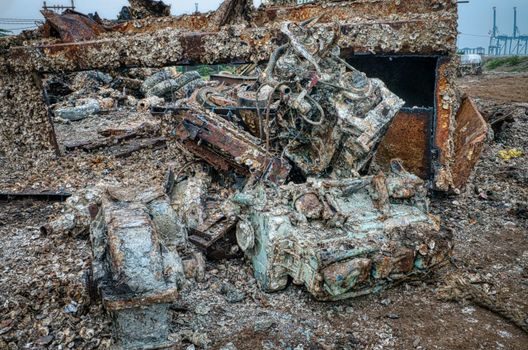
Disposal and scrap resale are the fifth line and the only one that can run negative. For a 2-tonne grey-iron machine base or a ductile-iron manifold at end of life, the scrap-resale line can offset 3-6% of original acquisition cost — small in absolute terms but material when computing a 20-year NPV at 5-7% discount rate. [S2]
The USPS TCO framework and the 2021 regional TCO methodology agree on the principle: hidden end-of-life and maintenance costs dominate when forecast over the full lifecycle [S4][S1]. A 2022 dental-equipment TCO brief from A-dec restated the same rule for a different asset class — total cost of ownership includes both the initial purchase price and the cost of operations and maintenance over the product's life, factoring in installation, training, service, and disposal [S6]. The asset class changes, the five-line structure does not.
Comparison: grey iron vs ductile iron on the five TCO lines
On the five-line TCO model, the two structural cast irons diverge sharply: grey iron (ASTM A48 Class 30) typically lands at 0.85-1.10 USD/kg on the acquisition line versus 1.20-1.60 USD/kg for ductile iron (ASTM A536 65-45-12), but ductile iron returns that premium through 2-3x longer mean-time-between-overhaul, lower scrap rate in thin sections, and a 30-50% higher scrap-resale floor because of its lower sulphur and consistent Fe-C-Si-Mg chemistry. Machining cost per kg is roughly 1.4x higher for ductile iron at matched tensile class; corrosion-protection cost is similar if both receive the same coating system, but ductile iron tolerates thinner coatings because of its elastomeric matrix. [S3]
Where ductile iron is FOR: pressure-rated pipe fittings, hydraulic valve bodies, crankshafts, and any component subject to impact or fatigue where elongation above 5% is required. Where ductile iron is NOT for: precision machine-tool beds where the damping coefficient of grey iron (graphite flake vibration absorption) is the actual functional requirement; high-volume thin-wall castings under 4 mm wall where ductile iron's magnesium treatment raises scrap rate unacceptably. The cast iron advantages and disadvantages piece maps this trade-off in detail.
Decision criteria, failure modes and sourcing signals

The five-line TCO decision should be driven by three concrete inputs: service life required (15 vs 30 years), coating system cost amortised over that life, and scrap-resale price at end of life. A 2026 specifier that fixes the unit-price line in advance and lets the other four float is buying a 20-year problem. A specifier that fixes the service-life and scrap-resale assumptions and lets the unit price flex within the envelope ends up with a defensible lifecycle cost. A-dec's framing — that thorough planning at the beginning can save both time and money — applies identically to capital castings [S6].
Failure modes specific to a thin TCO model are well documented: pattern amortisation spread across too few pieces; coating interval set to vendor default rather than site resistivity; machining time estimated from steel data; scrap-resale assumed at steel-scrap index rather than iron-scrap index. The 2021 TCO methodology paper notes that registration, road tax, insurance, fuel, financial interest, depreciation, and maintenance each shift sensitivity analysis output by double-digit percentages — the same shape of risk applies to each of the five cast-iron TCO lines [S1]. See the backhoe loader TCO breakdown for a parallel five-line structure on mobile iron, and the tool and die steel TCO for a parallel structure on a different ferrous alloy.
Two trackable signals for the next planning cycle: (1) iron-scrap index movement quarter-on-quarter, which shifts the disposal line in real time, and (2) ISO 2531 / EN 1563 revision activity in CEN technical committees, which moves the corrosion-protection line for ductile-iron pipe networks. Watch both before locking the 2027 capex envelope.
For component-level specifications, see total station, and pressure transmitter.