A catalytic gas detector, often called a pellistor, is a single technology inside the wider gas-detector category, and the engineering choice between them hinges on the target gas, background oxygen level, and presence of sensor poisons [S2].
The general gas-detector product class covers combustible, toxic, oxygen, and VOC instruments using catalytic bead, IR, electrochemical, PID, and laser-TDL sensing elements, and the same housing may swap sensor modules to match the hazard [S1][S2][S3].
Sensor Technology Stack: Pellistor vs IR vs EC vs PID vs TDL
Catalytic-bead sensors operate on Wheatstone-bridge combustion: a catalysed "active" bead and a passivated "reference" bead are heated; flammable gas oxidises on the active bead, the resistance imbalance is read as a bridge voltage, and the output is linearised against the lower explosive limit (LEL) of the calibration gas [S2].
NDIR (non-dispersive infrared) sensors avoid combustion entirely, measuring hydrocarbon absorption at characteristic IR wavelengths; this is why an IR option on a portable multigas unit such as the Crowcon Triple Plus+ can read both %LEL and %vol for purge applications, with no poisoning effect and no burnout risk in the absence of oxygen [S1]. Electrochemical cells drive a current proportional to toxic-gas concentration and dominate CO, H2S, NH3, Cl2, SO2, and NO2 monitoring, while PID (photoionisation) and laser-TDL (tunable diode laser) close the VOC and remote-methane gaps respectively [S3].
Comparison Matrix: Catalytic vs IR vs EC vs PID for Flammable & Toxic Gases
On cost, a catalytic-bead LEL head is the cheapest entry point per sensing channel; IR modules carry a 2-5x premium, electrochemical toxic cells sit between the two, and laser-TDL methane units sit at the top of the capex curve [S3]. On oxygen dependence, catalytic beads require O2 above roughly 10-15%vol to combust correctly, so they under-read in nitrogen-purged tanks and confined spaces; IR, EC, and laser-TDL remain quantitative in oxygen-free or oxygen-rich backgrounds [S1].
On poisoning and inhibition, catalytic pellistors are vulnerable to silicone vapours, lead, halogens, and H2S, which permanently or semi-permanently mask the active bead; IR sensors are described by manufacturers as having very high resistance to such inhibitors [S1]. On response and lifetime, pellistors respond in seconds but degrade with exposure; IR sensors carry a multi-year life and no burnout, while electrochemical toxic cells are consumed by the gas they measure and are typically rated for 2-3 years in clean service [S1][S2].
The decision rule that follows is direct: specify catalytic bead when the atmosphere is air, the target is a single LEL hydrocarbon, and budget dominates; switch to infrared combustible sensing the moment the background is inert, the gas stream is hot, or %vol measurement is needed for line purging; specify electrochemical toxic-gas cells for H2S, CO, NH3, Cl2, SO2 exposure monitoring against TWA/STEL/IDLH thresholds [S2].
Target Gas and Range: LEL vs %vol vs ppm

Catalytic pellistors are normally scaled to 0-100%LEL, with methane LEL around 4.4%vol and propane LEL near 1.7%vol, so the same head can be used across different hydrocarbons if correction factors are loaded into the firmware [S1]. The Triple Plus+ explicitly supports field selection of flammable-gas correction factors so a single unit can be deployed across multiple locations on a site [S1].
IR modules on the same portable multigas instrument cover both 0-100%LEL and 0-100%vol, which is the configuration used for tank and line purging verification where the LEL reading alone does not tell the operator whether the space is approaching fuel-rich or fuel-lean conditions [S1]. Electrochemical toxic sensors work in ppm and ppb ranges; for personnel safety, the standard exposure metrics are TWA (8-hour weighted average), STEL (15-minute weighted average), IDLH (immediate threat to life and health), and MAC (maximum permissible concentration) [S2].
Deployment Scenarios: Portable, Fixed, Multi-Gas, Wireless
Portable multigas units, typified by the IR-equipped Triple Plus+ with over 90,000 units deployed in oil and gas, chemical, utility, and manufacturing sites, combine LEL pellistor or IR with up to four electrochemical toxic/oxygen channels plus data logging and fleet annotation [S1]. Fixed-point installations use a fixed gas detector head, a controller, and an alarm chain; Chinese suppliers such as Nuoan list fixed-type IR combustible, fixed-type CC (catalytic combustion), fixed-type PID VOC, and fixed-type toxic/O2 families on a single product matrix, with a separate wireless gas detector line for retrofit sites [S3].
For personnel entering confined spaces, a portable gas detector with at minimum LEL, O2, CO, and H2S channels is the de-facto requirement; the safety driver is that an oxygen-deficient or fuel-rich atmosphere can incapacitate a worker in a single breath, which is the rationale behind the IDLH threshold concept [S2]. For a worker walking the same route all day, a multi-gas detector in diffusion mode is usually lighter and cheaper than four separate single-gas units.
Failure Modes, Calibration, and Cross-Sensitivity
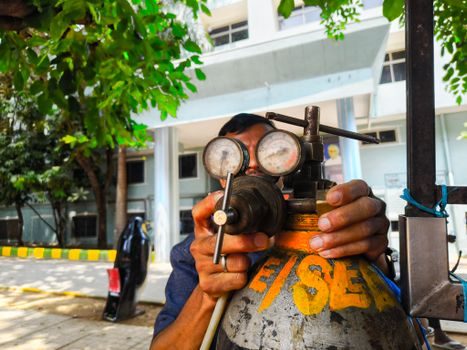
The dominant failure mode of a catalytic-bead sensor is poisoning or inhibition, expressed as a loss of sensitivity that may be partial (reversible) or permanent (irreversible), and that is why bump testing with a known gas concentration before each shift is non-negotiable in hazardous-area work [S1][S2]. IR sensors fail mainly through optics contamination (dust, oil mist, condensate on the window) rather than chemical poisoning, so the maintenance plan is window cleaning and zero/span verification rather than bead replacement [S1].
Calibration of any gas detector follows the same skeleton: expose the sensor to a certified span gas at a known concentration, adjust the reading to match, document the response, and record the date; ATO's reference procedure and most OEM manuals converge on zero-gas (clean air or N2) first, then span gas, with a recommended interval of 30-90 days for catalytic and electrochemical heads depending on the environment [S2]. Cross-sensitivity is a hidden cost: an electrochemical H2S cell will respond to SO2, an IR hydrocarbon sensor will respond to any C-H bond in the optical band, and a catalytic bead will respond to any combustible at a ratio driven by its correction factor relative to methane [S1][S2].
Standards, Sourcing, and 2026 Manufacturer Map
Hazardous-area certification drives the housing and labelling more than the sensor inside, with ATEX/IECEx zones and North American Class/Division systems defining where any of these detectors can be installed, and the same pellistor or EC cell appears in both certified and non-certified enclosures depending on the deployment [S1]. Instrument selection at the engineering level is governed by exposure-limit conventions: TWA, STEL, IDLH, and MAC, which sit above the sensor's raw ppm/LEL output and tell the user when to alarm [S2].
For a 2026 sourcing view, the catalytic gas detector supplier landscape is concentrated in Chinese manufacturing hubs (Shenzhen, Wuxi, Jinan) and in Western brands (Crowcon, Honeywell, Dräger, MSA, Industrial Scientific), with portable multigas units such as the Triple Plus+, the GD200 series, and the SNE600/SNE4100B fixed catalytic heads representing the typical product lines carried by these vendors [S1][S3][S4]. Trackable signals to watch over the next two quarters: wider IR adoption as a pellistor replacement in inert and H2S-rich service, growth of laser-TDL methane for remote leak survey, and the gradual appearance of wireless fixed detectors on plant retrofits where cabling cost dominates [S3].