
Use bulk density for cement transport calculations because it includes interparticle voids and therefore determines the mass carried by a given container volume [S1][S4].
Cement bags provide a fixed packaged mass, while bulk cement transport requires the measured loose or compacted bulk density of the actual material [S2][S3].
Define the Cement Density Used in Transport
Bulk density is the mass of cement divided by the total volume occupied by the bulk material, including void spaces between particles. Particle or true density describes the solid material without those voids and is not the correct basis for loading a ship, truck, silo, or pneumatic tanker [S1][S4].
The calculation is:
<strong>Transport mass = available bulk volume in m³ × applicable bulk density in kg/m³</strong>
For example, 30 m³ of cement at 1,000 kg/m³ represents 30,000 kg, while 30 m³ at 1,500 kg/m³ represents 45,000 kg. The same geometric volume can therefore differ by 15,000 kg before any allowance for packaging, equipment, or density variation.
Compare Bulk Cement and Cement Bag Transport
Bulk cement transport is governed by the relationship among container volume, bulk density, and rated carrying mass. A 1,000 kg/m³ loose-density value and a 1,500 kg/m³ maximum-density value should be evaluated for the same 10 m³ bay, producing 10,000 kg and 15,000 kg respectively [S4].
Cement bag transport is governed by a declared packaged mass. For 25 kg bags, 400 bags represent 10,000 kg; for the same 10,000 kg of bulk cement at 1,500 kg/m³, the occupied bulk volume would be 6.67 m³ before considering bag volume and void space between bags.
The practical comparison is therefore density condition versus packaging mass. Bulk cement offers a volume-based loading calculation, but it requires a condition-specific density. Bagged cement gives a fixed mass count, but its actual transport volume depends on bag dimensions, pallet configuration, and the space occupied by the bags themselves.
Select Loose or Compacted Bulk Density
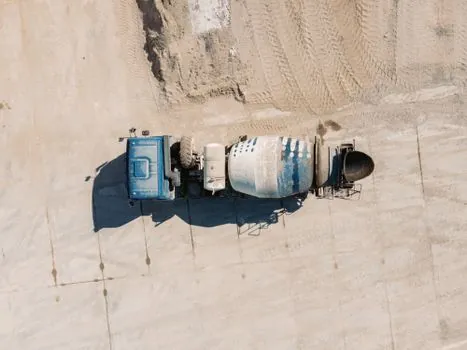
Loose, or poured, bulk density represents cement in an aerated state and reflects natural packing after filling. Tapped, or compacted, bulk density is measured after vibration or settling and normally increases as voids close [S3].
Use the loose value to estimate how much material can occupy a specified volume at filling. Use the highest foreseeable compacted density when checking structural loads, pressure equipment, and maximum vehicle or vessel mass [S3][S4]. Material condition, moisture, particle size, particle shape, handling history, and compaction all affect the measured result [S1].
This margin is an engineering allowance, not a substitute for a representative test, and it should be applied to the design load rather than hidden inside the nominal density.
Apply the Calculation to Equipment Capacity
Transport equipment must satisfy both its volumetric limit and its safe load limit. The volumetric limit is reached when the container is full; the load limit is reached when the contained mass exceeds the rated capacity [S4].
For a 20 m³ bulk cement compartment, use the equation below:
<strong>Mass at density ρ = 20 m³ × ρ</strong>
At 1,000 kg/m³, the load is 20,000 kg. At 1,250 kg/m³, it is 25,000 kg. At 1,500 kg/m³, it is 30,000 kg [S4]. Equipment rated below the applicable mass limit must not be filled to geometric capacity, even when the compartment appears only partly loaded.
When estimating throughput through a pneumatic transport system, the same distinction remains important. Detailed capacity and pneumatic discharge calculations are covered in Bulk Cement Tanker Capacity and Pneumatic Discharge Rates.
Test Cement Instead of Assuming One Density
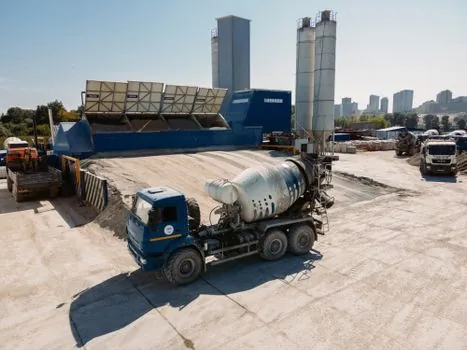
Representative testing is required because the same cement can change bulk density within a batch as moisture, grading, compaction, and handling change. A small non-uniform sample can produce a misleading result, so the sample should represent the material being transported [S1].
The basic laboratory procedure is to weigh a representative sample, fill a container of known volume without changing its packing state, and calculate mass divided by occupied volume [S1]. For the published example, 1.1 lb occupying 0.03 ft³ gives 36.7 lb/ft³.
Record whether the result is loose or tapped, and document moisture, temperature, humidity, sample handling, and degree of compaction [S3].
Prevent Overload and Underloading Errors
Using particle density in place of bulk density overstates the calculated mass for the occupied bulk volume because particle density excludes interparticle voids. Using an unverified average bulk density can produce the opposite error, leaving usable volumetric capacity unused [S4].
For cement bags, count certified bags and use the labeled net mass rather than treating a bag as a density-defined volume. For bulk cement, use the measured loose density for filling estimates and the maximum expected density for structural and overload checks [S3][S4].
Bagged cement also requires a packaging density calculation when comparing logistics footprints. Divide total product mass by the occupied volume of the bags and pallet arrangement. Do not substitute the cement particle density for that packaging density, because the calculation must account for both void space within the bulk cement and space occupied by packaging [S1].
Set the Specification for Procurement and Handling

Specify loose bulk density, tapped bulk density, test method, sample condition, and allowable transport range for each cement grade. The nominal transport density should not exceed the capacity approved for the receiving and loading equipment under its maximum foreseeable condition [S3][S4].
For a supplier audit, require three verifiable items: a representative measured bulk-density value, the moisture and packing condition associated with that value, and confirmation of the maximum density used in the load calculation. If the supplier provides only particle density, request bulk-density data before approving a transport calculation [S1][S4].
Close the specification loop by checking the calculated mass against the rated capacity of the bulk container, unloading system, access route, and receiving silo. The next trackable signals are the cement grade’s tested density range and the revised maximum-load calculation after any change in moisture, compaction method, or handling route.