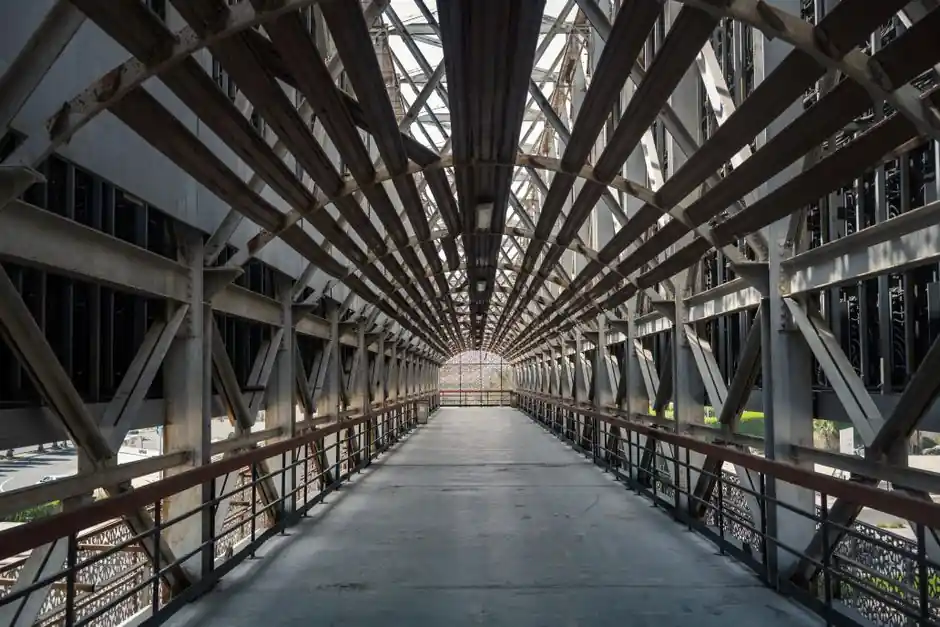
Checkered steel plate is used for walkways, stairs and ramps where its raised pattern provides traction.
Checker plate is available in thicknesses from 2 to 8 mm and is used for flooring, stair treads, ramps and platforms, with galvanized or powder-coated surfaces available for protection.
Decision Criteria for Pedestrian Flooring
Checkered plate is preferable where footwear can contact oil, water or debris, because the raised diamond, five-bar, lentil or teardrop pattern provides a grip surface that plain steel lacks [S3][S4].
Plain steel plate has no raised pattern, is lighter at equal nominal base thickness and generally costs less because less metal is rolled into the product [S1]. It remains appropriate for dry indoor platforms, base plates, skids and fabricated components where traction is secondary to flatness, cleanliness or cost.
The key comparison is traction, weight, cost and maintenance:
Thickness, Span and Load Selection
Chequer plate has a flat underside, and the plate thickness is calculated from the base thickness.
Published supply ranges differ by product scope: one supplier lists 2–8 mm thickness, 600–1800 mm width and 2–12 m length, with thickness tolerance of ±0.02 mm and width tolerance of ±2 mm [S2]. A broader commercial reference lists 2.5–12 mm plate in standard sizes of 1220 × 2440 mm, 1500 × 3000 mm and 1500 × 6000 mm [S3].
Reference theoretical weights for 6 mm checker plate are 47.1 kg/m², or 9.65 lb/ft², while 3 mm and 10 mm versions are listed at 23.6 kg/m² and 78.5 kg/m² respectively [S3]. Use the supplier's base-thickness calculation for procurement, then verify the actual span against the project's support spacing and pedestrian load rather than selecting from thickness alone.
Steel Grade and Surface Condition

Typical mild-steel checker grades include A36, Q235B and S235JR, while S235JR is described as the usual hot-rolled mild-steel grade.
Higher-strength checker-steel options include A572 Grade 50 and Q345. Grade choice does not replace a span calculation, and a higher-strength grade is not a substitute for adequate supports, edge restraint or corrosion protection.
Hot-dip or electro-galvanized checker plate carries an indicated cost premium of 15–25%. Aluminium chequer plate is described as a lightweight, corrosion-resistant alternative to steel chequer plate.
Walkway Layout and Fabrication
Checkered plate is used with steel grating on industrial walkways, access ramps, stair treads and platforms to improve slip resistance, provide a walking surface and distribute loads more evenly in heavy-foot-traffic areas [S2].
The raised pattern must face the traffic direction, while the flat underside makes the panel easier to position and fix [S4]. For a larger access system, the comparison between lightweight aluminum checker plate and heavier solid plate is covered in ACM vs solid aluminum plate: weight, dead load, and when to pick each.
Documented checker-plate patterns include diamond, five-bar, lentil or teardrop, and hexagonal. Pattern direction and spacing should be coordinated with stair nosings, grating frames, drainage paths and the orientation of pedestrian travel.
Corrosion, Wear and Maintenance
Uncoated mild steel is vulnerable to corrosion, so hot-dip galvanized checker plate is the appropriate starting point for outdoor or humid installations [S3]. Hot-dip and electro-galvanized checker-plate options are available.
Raised patterns can wear down through repeated traffic, and cleaning around the raised edges is more difficult than cleaning a flat plate [S5]. Inspect high-traffic routes for flattened tread, damaged welds, loose fasteners and water accumulation, because a visibly worn pattern no longer delivers the original traction benefit [S5].
Plain steel also requires corrosion control in wet environments and has no patterned surface to trap debris. For clean, dry and low-risk internal areas, that simpler finish may justify plain plate; for wet, oily or contaminated access, the pattern normally earns its extra cost and mass.
Application Fit and Procurement Checklist
Choose checkered plate for industrial walkways, stair treads, ramps, platforms, mezzanines, vehicle beds and threshold plates where people or tyres require grip [S3][S4]. Choose plain plate for flat structural closures, base supports, smooth transfer surfaces and dry indoor areas where anti-slip texture is not required [S1].
For checkered plate, issue the base thickness, sheet dimensions, steel grade, pattern type and orientation, coating requirement, dimensional tolerances and support spacing. For example, a procurement line can require 5 mm checker plate, S235JR to EN 10025-2, five-bar pattern, hot-dip galvanized finish, and a stated width and length [S4].
For the steel plate package, specify whether the stated thickness excludes the raised pattern, because that convention controls both structural calculation and delivered weight [S4]. Do not compare quoted weights unless both products are calculated on the same base thickness.
The next procurement decision is to confirm the longest unsupported span, expected pedestrian or vehicle load, exposure condition and cleaning regime, then compare a properly sized 3–6 mm checkered plate option against plain steel with the same structural and corrosion specification.