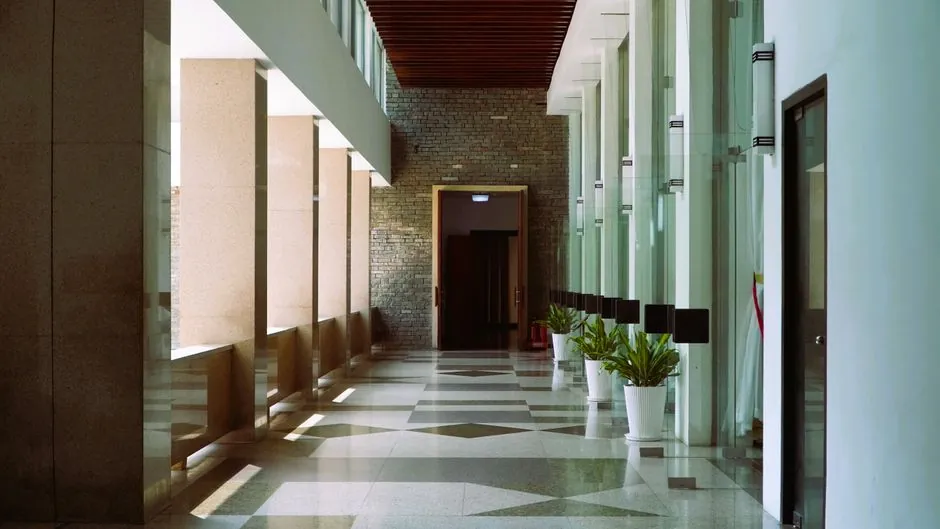
Ceramic and porcelain tile are treated as non-combustible floor finishes, but the product alone does not establish the fire performance of the complete corridor floor-covering system [S1][S2].
For corridor procurement, the useful distinction is between reaction-to-fire testing, assembly fire resistance, and product-specific documentation, with the required classification determined by the adopted code and project fire strategy [S1][S3].
What a corridor tile fire rating actually covers
A floor-covering fire classification describes how a tested specimen behaves under specified laboratory exposure. Ceramic tile is commonly identified as non-combustible, and EN 13501-1 assigns Afl to non-combustible floor coverings including ceramic tile, stone, and concrete [S3].
That classification is not an hourly fire-resistance rating for the supporting slab, deck, underlayment, adhesive, or ceiling construction. A floor covering can have a strong reaction-to-fire classification while the structural assembly beneath it has no hourly rating, and the reverse can also occur [S2].
Specifiers should therefore request three separate items where applicable: the tile product declaration, the tested floor-covering system evidence, and the fire-resistance documentation for the structural assembly. The phrase “fireproof tile” is not a code term and should not be used as the basis for submittal [S1][S2].
North American classification checks
ASTM E84 addresses surface-burning characteristics and does not establish noncombustibility, structural endurance, or an hourly floor-assembly rating. Its commonly associated Class A, B, and C terminology uses flame-spread index ranges of 0–25, 26–75, and 76–200, subject to the applicable smoke-index provisions [S1].
For corridor floor coverings subjected to radiant exposure, ASTM E648 measures critical radiant flux for a horizontally mounted floor-covering system. Class I and Class II floor-finish terminology commonly uses thresholds of 0.45 W/cm² and 0.22 W/cm² respectively, while the project team determines which classification applies under the adopted provisions [S1].
NFPA 253 is the associated floor-covering radiant-flux standard used in the United States [S1].
For a tiled corridor, ask the manufacturer for the exact ASTM E84 or ASTM E648 result, the tested tile and substrate combination, and the applicable classification. A generic statement that tile is noncombustible does not answer every corridor requirement.
European classification for corridor floor coverings
Under EN 13501-1, ceramic tile is identified as Afl because it makes no contribution to fire, while Cfl denotes a limited contribution to fire and s1 denotes low smoke production [S3]. EN 13501-1 classifies construction products and building elements by reaction to fire and smoke production, and it is the framework referenced by the UK Building Regulations.
The full notation must remain attached to the evidence. “Cfl-s1” identifies reaction to fire, floor-covering use, and smoke production; it does not certify the structural floor for a stated period [S3].
For comparison, EN ISO 9239-1 is the radiant-panel floor test, while EN ISO 11925-2 is the small-flame ignition test. The EN 13501-1 classification draws on the applicable reaction-to-fire evidence, so a supplier should identify the test report and classification rather than quote “EN 13501-1” without a classification notation [S6].
This European route is appropriate where EN 13501-1 and the applicable national building regulations govern. A corridor specification that mixes an ASTM letter class with an EN notation should be returned for clarification rather than treated as a stronger combined claim.
Tile versus alternative corridor finishes
Ceramic tile, porcelain tile, concrete, and polished concrete are identified among the principal non-combustible floor-finish options. Their fire behavior supports corridor use, but appearance, installation method, substrate, wet-area performance, and mechanical durability still determine suitability [S1][S2].
Fire classification does not establish slip resistance, impact resistance, or wear life.
Evidence required in the corridor submittal
The first document check is product identity. The submittal should name the tile manufacturer, product series, body material, thickness, finish, color, and manufacturing location rather than describing the floor simply as “ceramic.” Fire certificates for tile ranges can support ignition and high-temperature resistance, but only the product-specific test evidence should be credited [S7].
The second check is system identity. ASTM E648 evidence must identify the specimen arrangement, including any underlayment and representative support. EN 13501-1 documentation must show the complete classification, including the floor-covering suffix and smoke class where applicable [S1][S3].
The third check is project applicability. Occupancy, corridor location, building height, adopted code, and the fire strategy determine whether the classification is sufficient. The project team should also confirm whether the corridor is an exit route and whether the jurisdiction imposes a classification beyond the cited baseline [S2][S3].
The fourth check is the supporting construction. A ceramic tile finish does not provide a 30-, 60-, or 120-minute structural fire rating by itself. That duration belongs to the complete floor assembly and requires its own fire-resistance documentation [S2].
Installation details that can invalidate the evidence
Adhesive, underlayment, grout, backer board, joints, and substrate cannot be treated as minor accessories when the cited test represents a system. A changed adhesive or underlayment can leave the submitted test report without a defensible match to the installed corridor condition [S1].
Ceramic tile itself may crack, spall, or lose capacity under severe sustained exposure, so “non-combustible” must not be converted into an indefinite fire-resistance promise. Smoke-developed indices also do not measure toxicity, total smoke volume, or occupant exposure in a building fire [S1][S2].
For exposed tile, the grout and adhesive documentation should be reviewed along with the tile. For concealed systems, confirm that the tested thickness, backing, and support correspond to the bid construction. The broader selection context for non-combustible surfaces is covered in industrial flooring, while ceramic tile provides the product-level reference for the finish itself.
Where ceramic tile is and is not the best choice

Ceramic tile is a strong candidate for commercial, institutional, industrial, and high-traffic corridors because it is non-combustible, does not readily ignite, and does not depend on a combustible film-forming wear layer [S1][S3][S4]. It can also serve wet areas where grout, slip resistance, substrate preparation, and detailing are controlled.
It is less suitable as a substitute for a rated structural assembly, a resilient sports surface, or a floor design selected primarily for acoustic comfort. Ceramic tile transmits impact sound and requires a compatible underlayment, while resilient products may offer greater underfoot compliance and specialized acoustic performance [S2].
For projects comparing finish systems, spc flooring represents a different product family with its own fire-test evidence, while suspended ceiling may form part of the supporting floor assembly. Neither comparison changes the rule that the corridor finish and the complete assembly require separate evidence.
The next verification step is straightforward: obtain the code-required classification, the matching test report for the actual tile-and-substrate build-up, and the supporting floor assembly's fire-resistance documentation before releasing the corridor flooring schedule.