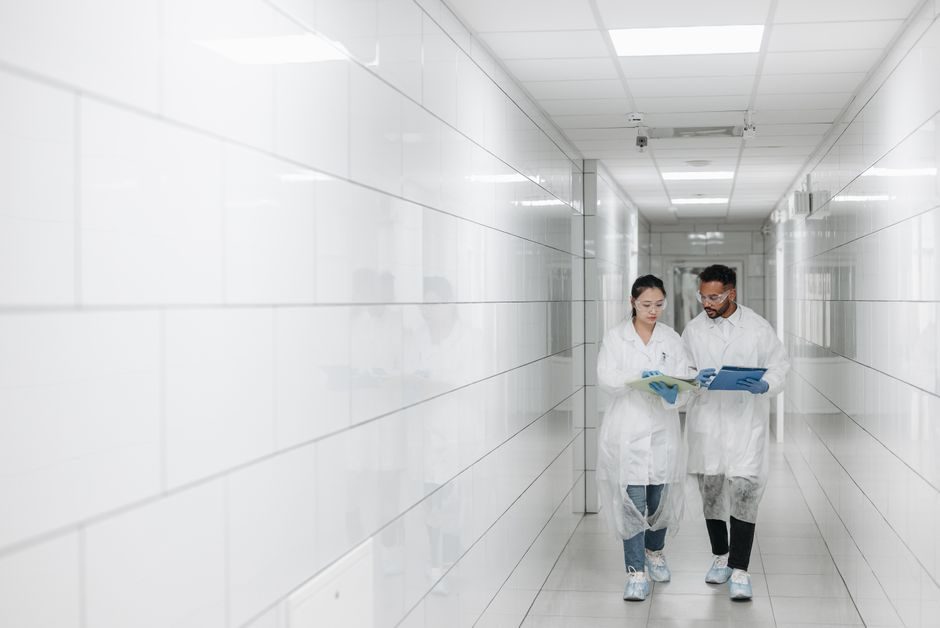
Mechanised cleanroom sandwich panels with rockwool, magnesium-oxysulphate (MgO) or polyurethane cores and colour-coated galvanised steel skins were listing in a US$ 50–200/m² FOB-China band on major B2B platforms as of June 2026, with pharmaceutical-grade turnkey cleanroom projects quoted at US$ 200–500/m² and stainless-steel cleanroom doors at US$ 500–800 per piece [S4].
The cost of the wall and ceiling panel itself is rarely the biggest line item in a regulated build; HVAC, HEPA filtration, structural steel, and validation routinely push a GMP cleanroom envelope two to four times above the bare-panel figure, so any pricing conversation has to start from core type, fire rating, and skin grade before talking $/m² [S3][S4]. For buyers comparing a cleanroom wall to a general architectural sandwich panel, the relevant delta is the surface smoothness, joint sealing, and cleanability spec — not just the steel thickness.
What a "cleanroom panel" actually is, and why it costs more than a metal composite panel
A cleanroom panel (净化板) is a sandwich composite with colour-coated steel, stainless steel, or aluminium skins bonded to a structural core — rockwool, gypsum, glass-magnesium, paper honeycomb, aluminium honeycomb, or PU — produced as either a continuous mechanised line product or a hand-laid board, and the construction detail (four-side closed edge, embedded steel stiffeners, flush skin) is what separates it from commodity metal composite plate [S3].
Per Wuxi Kwang Purification's specification write-up, cleanroom panels must deliver flat, dust-shedding-free surfaces, airtight joints under thermal/humidity cycling, cold-bridge-free edges for low-temperature rooms, and abrasion-resistant, anti-static floors; these four requirements alone rule out cheap cold-rolled composite plate and force thicker paint films (typically Baosteel-grade colour-coated stock) plus tighter flatness [S3]. For specifiers cross-checking wall systems against HVAC integration, the same edge-sealing logic that shows up in linear guide enclosure design applies — small gaps become particle traps.
Price bands observed in mid-2026 sourcing channels
Made-in-China aggregated cleanroom-project listings in June 2026 showed pharmaceutical GMP turnkey cleanrooms at US$ 200/m² and budget modular cleanrooms from US$ 50/m², with stainless-steel automatic sliding doors for cleanroom envelopes at US$ 500–800 per piece depending on glazing and interlock spec [S4]. CPHI制药在线 listings for both mechanised (机制净化板) and hand-made (手工净化板) cleanroom panels carried a "price on application" tag with a stated 10-day delivery window and T/T payment on balance — implying the channel is quote-driven, not list-priced, for anything beyond commodity gauges [S2][S5].
Across these channels, the typical unit of trade is the square metre for walls/ceilings and the piece for doors, lights, and pass-boxes; cleanroom LED panel lights (e.g.
Cost drivers ranked, from biggest mover to smallest
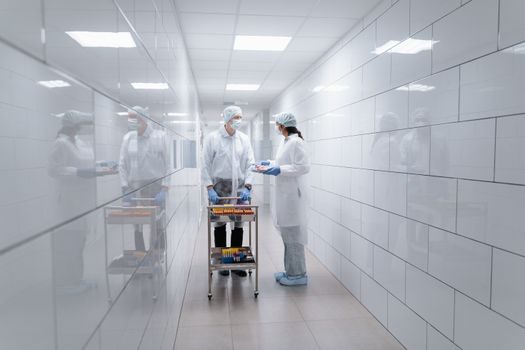
1) Core material: rockwool is the baseline (best fire rating, A-grade non-combustible) and the cheapest; PU and PIR push price up 20–40% for higher thermal performance; aluminium honeycomb and paper honeycomb sit at the top for flatness and are quoted case-by-case. 2) Steel skin grade and coating: Baosteel-equivalent colour-coated galvanised steel with ≥25 µm paint film is the de facto cleanroom spec; switching to stainless-steel 304/316 skin roughly doubles the skin cost contribution. 3) Panel thickness: 50 mm is the commodity gauge; 75 mm and 100 mm for cold-room or higher-fire-rating envelopes add core volume linearly. 4) Mechanised vs hand-made: hand-made (手工) panels run a documented 15–30% premium over mechanised (机制) because of lower line speed and tighter edge finishing [S2][S3][S5]. 5) Order volume and lead time: 10-day CPHI-quoted lead times indicate stock-gauge common sizes; custom lengths/colours add 20–40 days and tooling charges [S2][S5].
Fire rating, cleanability, and edge-sealing spec outrank raw $/m² in any value-engineering exercise — a 10% saving on panel that fails a GMP audit costs more than the saving, and the same logic drives the enclosure and HMI choices on the controls side, where an HMI panel specified to NEMA 4X or IP65 is non-negotiable for washdown rooms.
Mechanised vs hand-made vs turnkey: a side-by-side comparison
The three purchasing routes are not interchangeable: mechanised panels are continuous-line, high-volume, lower unit cost, and best for large rectangular footprints with standard 1,000–1,180 mm module widths; hand-made panels are batch-built, accommodate non-standard widths, curved walls, and integrated service penetrations, and they cost more per m² but reduce on-site modification [S2][S3][S5]. A turnkey GMP cleanroom at US$ 200–500/m² bundles the panel envelope with HVAC, HEPA, lighting (e.g. cleanroom LED panels), pass-boxes, and validation documentation — convenient for one-point accountability but harder to value-engineer than a separate-supply model [S4].
Buyers who only need a hard-wall partition around a single ISO 7 line should price the panel + aluminium honeycomb core + cleanroom LED separately, then add a 20–30% contractor markup; buyers building a full pharmaceutical suite from a green-field room should benchmark the Marya-style US$ 200/m² turnkey figure and challenge what is excluded (HVAC capacity, BMS integration, IQ/OQ documentation) [S4]. For a specifier also evaluating the controls and sensing layer, the same vendor-evaluation discipline applies to digital panel meters on the room's monitoring side.
Total cost of ownership: panel is one-fifth of a 10-year cleanroom budget

On a representative 500 m² ISO 7 / Class 10,000 pharmaceutical suite budgeted at US$ 200/m² turnkey, the wall-and-ceiling panel line is roughly 18–25% of capital cost; the remaining 75–82% sits in HVAC, HEPA filtration, lighting, BMS, flooring (epoxy or conductive vinyl, often with aluminium veneer panel returns at air-handler interfaces), and qualification [S4]. Over a 10-year horizon, energy for fan-filter units typically dwarfs panel depreciation; specifying higher-insulation PIR-core panels can pay back the core premium in 3–5 years on a continuously conditioned room.
Maintenance is dominated by panel-surface re-coating and joint re-sealing cycles (every 5–8 years for a well-run room) rather than panel replacement; the rockwool/MgO cores themselves are inert and typically outlast the steel skin coating life, so the operational risk is corrosion at cut edges and around service penetrations, not core degradation [S3]. Specifying stainless-steel 304 skin in splash zones and at floor-to-wall coving returns the skin-cost premium several times over a 15-year service life, even on a room where the wall field is colour-coated steel.
Where the 2026 market is still moving
Two verifiable signals worth tracking: (1) B2B listings continue to converge on a 10-day CPHI-quoted lead time for both mechanised and hand-made panels into Eastern Europe, the Middle East, and Asia, suggesting Chinese suppliers are running standard-gauge stock rather than full build-to-order [S2][S5]; (2) the made-in-china cleanroom directory still prices turnkey at US$ 200/m² floor in mid-2026, with the spread to US$ 500/m² driven almost entirely by door count, stainless content, and HVAC scope rather than wall-panel upgrade [S4]. For buyers who want to triangulate against another adjacent building-product spec, the ALC panel cost map covers the non-cleanroom lightweight-wall benchmark that cleanroom walls are frequently compared against on $/m² and lead-time.