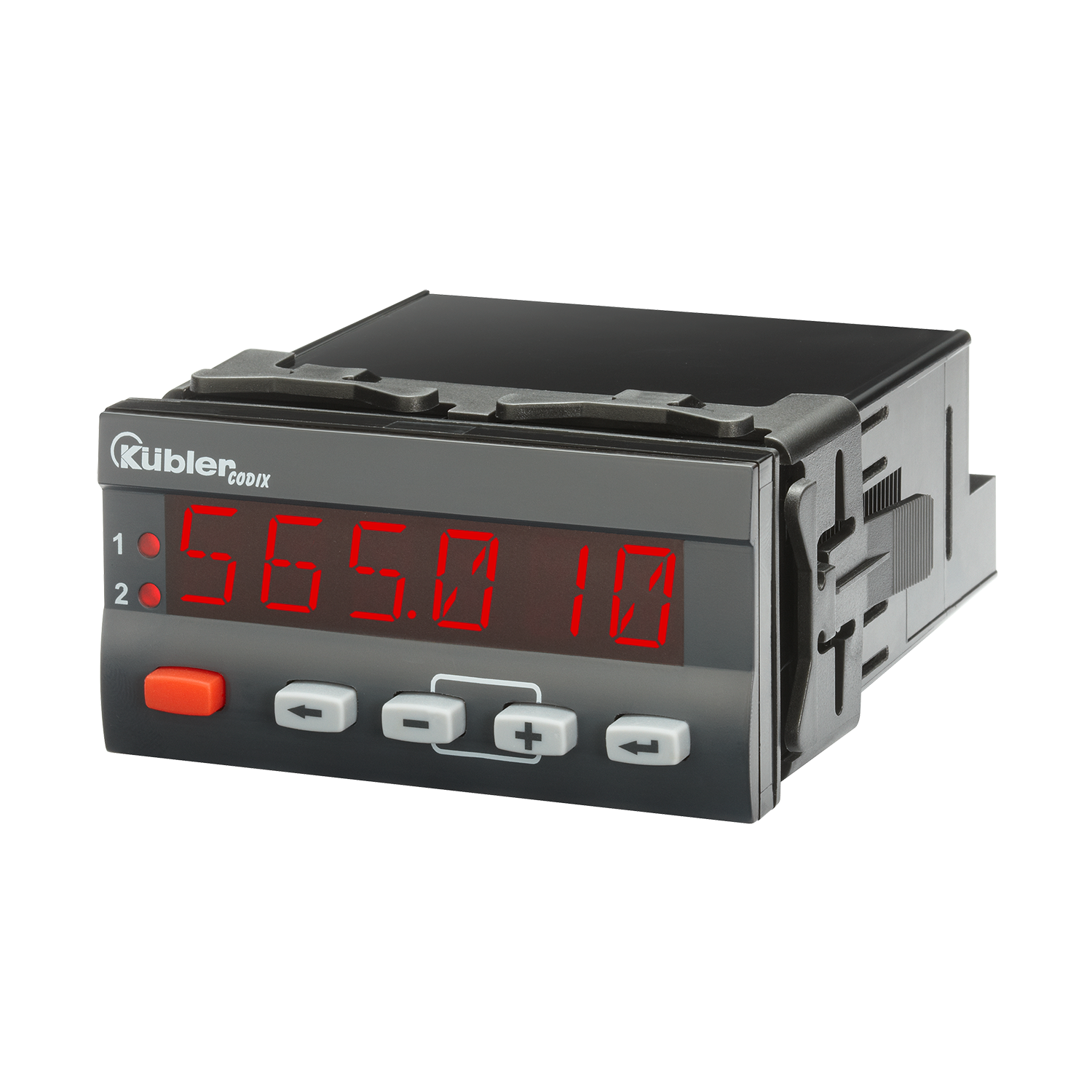
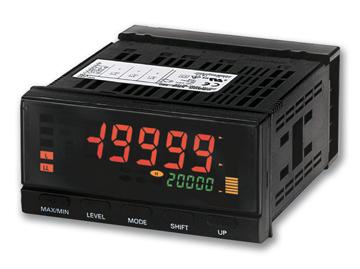
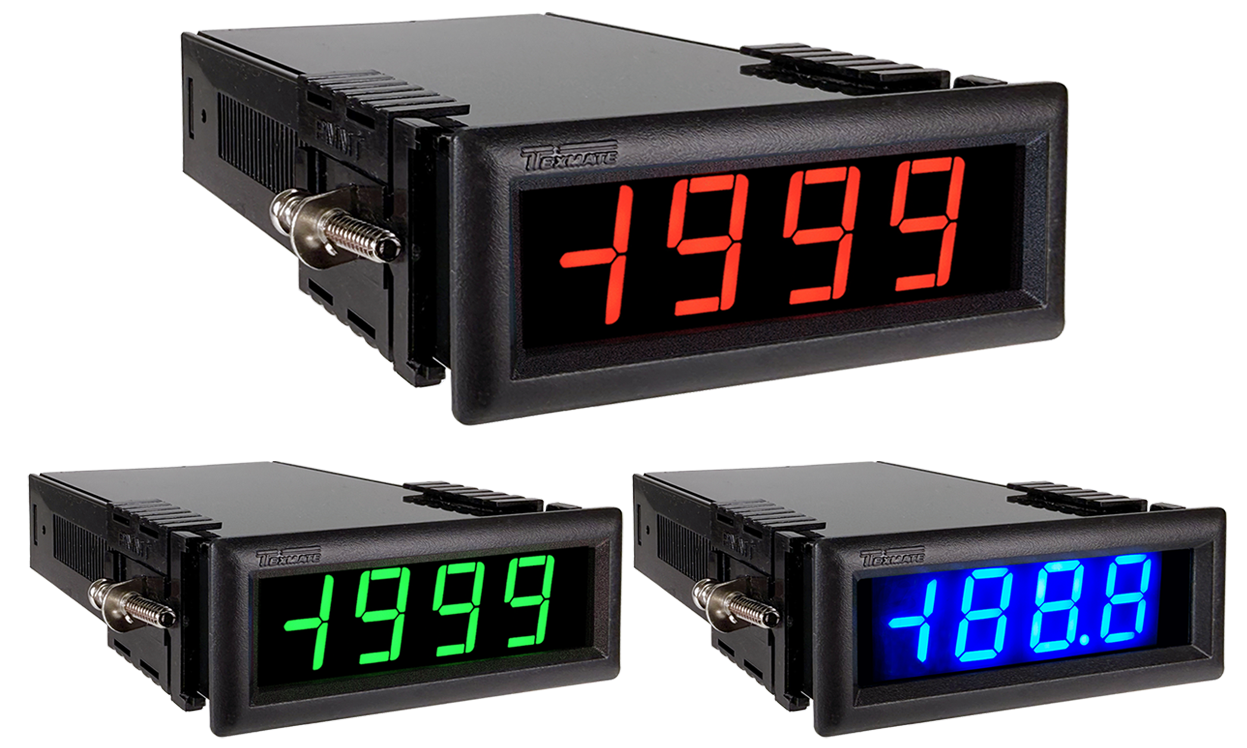
A digital panel meter is a panel-mounted electronic indicator that measures a process or electrical signal, scales it into engineering units, and presents the value on a numeric LED or LCD display. It is the workhorse readout of the control panel: where a transmitter generates the signal and a controller closes the loop, the panel meter is the human-facing window that lets an operator see flow, level, pressure, temperature, current or voltage at a glance.
Modern panel meters do far more than display. They linearize and root-extract signals, trip alarm relays, retransmit a scaled 4-20 mA copy, log min and max, and report over Modbus or Ethernet. This guide treats the panel meter as a precision instrument with a spec sheet that deserves the same scrutiny as the sensor feeding it.
Photo: Mister rf, CC BY-SA 4.0, via Wikimedia Commons
This guide is written for industrial purchasing engineers and design engineers. Across 6 chapters it covers DIN cutout standards, input types, display and ADC technology, accuracy decoding, and selection decisions, with 7 selection FAQs and manufacturer comparisons. Dimensional and rating references draw on the public standards DIN 43700 and its successor IEC 61554 for panel cutouts, IEC 61010-1 for instrument safety, the IEC 61326 series for EMC, IEC 60529 for ingress protection, and IEC 60584 and IEC 60751 for thermocouple and RTD reference tables.
Chapter 1 / 06
What is a Digital Panel Meter
A digital panel meter, often abbreviated DPM, is an electronic instrument designed to mount through a rectangular cutout in a control panel, enclosure door or machine fascia, displaying a measured value as digits rather than as a needle on a dial. It replaced the analog moving-coil panel meter for most industrial readouts because a numeric display removes parallax error, resolves far finer increments, and can show a value in the same engineering units an operator already thinks in, such as bar, degrees Celsius, litres per minute or amperes, regardless of the underlying electrical signal.
Functionally the meter sits between a sensor or transmitter and the human operator. A signal arrives at the input terminals, the front end conditions and digitizes it, firmware applies scaling and linearization, and the result is shown on the display while optional relays and outputs act on the same value. Because the meter is the point where a raw 4-20 mA or millivolt signal becomes a meaningful number, it is also the natural place to put alarm thresholds, peak capture, and a retransmitted copy of the reading for a chart recorder or PLC.
The lineage runs from the analog edgewise and round panel meters of the early twentieth century, through the first LED digital panel meters of the early 1970s that paired a dual-slope integrating analog-to-digital converter with discrete seven-segment displays, to today's microcontroller-based universal meters. The arrival of the single-chip ADC and the inexpensive microcontroller let one product accept many sensor types, linearize nonlinear curves in software, and add serial communications, collapsing what used to be a shelf of dedicated instruments into a single configurable part number.
It is important to fix terminology, because catalogs blur it. A digital panel meter is an indicator first: it reads and displays. A panel-mount controller adds a control algorithm, typically PID with auto-tune, that drives an output to a setpoint. A paperless recorder or data logger adds trending and storage. Many products straddle these boundaries, and a meter with two relays can perform crude on-off control, but the core identity of a panel meter is measurement and indication rather than regulation.
Four engineering metrics dominate panel meter quality and total cost of ownership: measurement accuracy and its temperature coefficient, input flexibility, display readability under real lighting, and the integration features that let the meter talk to the rest of the system. A bargain meter with a noisy converter, a dim display, or no communications can quietly cost far more in commissioning time, nuisance alarms and rework than its purchase price ever saved, which is why this guide decodes each of these dimensions in turn.
Chapter 2 / 06
DIN Sizes and Meter Categories
The single most practical fact about a panel meter is its physical size, because the meter must drop into an existing or newly punched panel cutout. Sizes follow the DIN 43700 family of nominal front and cutout dimensions, a German standard now superseded internationally by IEC 61554. The convention names sizes as fractions of a notional full panel: 1/8 DIN, 1/16 DIN, 1/4 DIN and so on. The bezel is the visible front frame; the cutout is the hole behind it. The cutout numbers are the ones that must match across brands, since a compliant meter from any maker fits a standard hole.
DIN Size
Nominal Bezel (W x H)
Panel Cutout (W x H)
Typical Use
1/4 DIN
96 x 96 mm
92 x 92 mm
Large readouts, multi-line process meters
1/8 DIN
96 x 48 mm
92 x 45 mm
Most common process and temperature meters
1/16 DIN
48 x 48 mm
45 x 45 mm
Compact temperature and count meters
1/32 DIN
48 x 24 mm
45 x 22.5 mm
Dense panels, single-variable indicators
1/8 DIN is the dominant industrial size, with a nominal 96 by 48 mm bezel and a 92 by 45 mm cutout confirmed across Omega, Laurel and other major catalogs. It balances a readable display, typically 14 mm or 0.56 inch digits, against panel real estate, and it is the size most universal process meters target. 1/16 DIN, a square 48 by 48 mm bezel over a 45 by 45 mm cutout, is the standard for compact temperature meters and counters where many points crowd a small door. The square format also matches most panel-mount PID controllers, so meters and controllers can sit in a tidy row.
Depth behind the panel is deliberately not standardized, and this is a frequent installation surprise. A simple loop-powered indicator may be only 30 to 40 mm deep, while a fully optioned line-powered meter with stacked relay and communications cards can exceed 130 mm, with one universal 1/8 DIN process meter family quoting a maximum instrument depth of 134.5 mm. Always verify clearance to the back of the enclosure, to wiring ducts and to any door swing before committing a layout.
Beyond size, meters split into functional categories. Process meters accept analog transmitter signals such as 4-20 mA or 0-10 V. Temperature meters take thermocouple or RTD inputs directly and apply linearization. Counters and rate meters accept pulse trains for production counts, flow totalization and tachometer speed. Electrical and power meters measure true-RMS voltage, current, power and energy. Universal meters collapse several of these into one firmware-configurable product. The table below contrasts the categories so you can match a meter family to the measurement before comparing brands.
The input front end defines what a meter can measure and how it must be wired. Choosing the wrong input class is the most expensive early error, because it forces a hardware change rather than a configuration edit. Industrial panel meters cluster around five input families: process analog, temperature sensor, true-RMS electrical, pulse and rate, and strain or load. Universal meters merge several of these and select the active input in firmware, while dedicated meters fix one input to lower cost.
Process analog inputs accept the standardized transmitter signals: 4-20 mA, 0-20 mA, 0-10 V, 0-5 V, 1-5 V and millivolt ranges. The 4-20 mA two-wire current loop is the default because current is immune to wire resistance over long runs and a 4 mA live zero distinguishes a true zero reading from a broken wire. A meter on this loop may be loop-powered, drawing its own energy from the same current with a typical burden of 1.5 to 3.5 V, or line-powered with a separate supply that frees a larger feature budget for relays, communications and bright displays.
Temperature inputs connect a sensor directly and do the linearization the sensor cannot. Thermocouples generate a small, nonlinear voltage following the IEC 60584 reference tables, and the meter must add cold-junction compensation plus polynomial linearization for each type, commonly J, K, T, E, N and the noble-metal R, S and B. RTDs, chiefly the platinum Pt100 to IEC 60751, vary resistance with temperature and are read through a two-, three- or four-wire connection that the meter uses to cancel lead resistance. A temperature meter therefore embeds a small library of sensor curves selected at configuration.
True-RMS electrical inputs measure AC voltage and current by their root-mean-square value, which is correct for distorted and nonsinusoidal waveforms common on drives and switching loads, unlike cheaper average-responding meters. Direct ranges on true-RMS units such as the Laurel Electronics Laureate family span from 200 mV AC to 600 V AC and from 2 mA AC to 5 A AC, with larger circuits scaled through external current and potential transformers. The table below compares the main input families against the parameters that drive selection.
Input Family
Typical Signals
Powering
Selection Notes
Process analog
4-20 mA, 0-10 V, 1-5 V
Loop or line
Most common; loop power simplifies wiring
Temperature
Thermocouple J/K/T/E/N/R/S/B, Pt100
Line
Needs CJC and linearization per IEC 60584 and 60751
Pulse and rate inputs accept digital pulse trains and quadrature encoder signals for production counting, flow totalization, and speed or frequency measurement, with programmable scale factors that convert raw counts into units such as litres or revolutions per minute. Strain and load inputs read the low-level millivolt-per-volt bridge of a load cell or pressure transducer and must supply a stable excitation voltage, which is why strain-gauge meters are a distinct configuration rather than a process-input afterthought. Universal meters such as the Red Lion PAXT and Dwyer Omega DPi let a single part number be field-set to most of these, which slashes spares inventory at the cost of a higher unit price than a dedicated meter.
Chapter 4 / 06
Display and Conversion Technology
Two subsystems govern what a panel meter shows: the display that the operator reads, and the analog-to-digital converter that turns the input into the number behind it. They are independent, and a common error is to assume a high digit count implies high accuracy. Display count sets how finely a number can be shown; converter quality sets how truthfully that number tracks the real signal. A meter can have a brilliant six-digit display and a mediocre front end, or the reverse.
Display technology divides mainly into LED and LCD. LED seven-segment displays, typically red or green at heights from 10 mm to over 20 mm, are bright, readable across a workshop, and sunlight-readable in the red variant, which is why they dominate industrial process meters; a representative 1/8 DIN meter uses a 14.2 mm, 0.56 inch, five-digit LED. LCD displays, often with a tri-color or selectable backlight, allow more digits and dual-line text in a small space and consume far less power, which makes them the choice for loop-powered and battery instruments, though they wash out in direct sun without an active backlight.
Digit count is described two ways. The older convention counts half-digits: a 3.5-digit meter shows 0 to 1999, conventionally called a 2000-count meter, and a 4.5-digit meter shows 0 to 19999, or 20000 counts. The half-digit is a leading place that can only display 0 or 1, so it doubles range rather than adding a full decade. The 2000-count display has a theoretical resolution near 0.05 percent, the 20000-count near 0.005 percent. Modern process meters increasingly quote count directly, such as a 999999 six-digit field or a 100000-count converter, which is clearer than the half-digit shorthand.
The converter is where measurement integrity lives. Classic panel meters used a dual-slope integrating ADC, which integrates the input over a fixed period and so averages out mains-frequency noise, an excellent fit for slow, stable process readings. Contemporary meters favor the sigma-delta ADC, which oversamples and digitally filters to deliver 16 to 24 bit resolution with strong noise rejection at moderate update rates. The A/D conversion rate of a typical industrial process meter runs around 20 readings per second, with the visible display update deliberately throttled to roughly 1 to 20 updates per second so the digits are readable rather than a blur.
Two display behaviors round out usability. Update rate and digital filtering let the user trade responsiveness against steadiness: heavy filtering stops the last digits flickering on a noisy signal but adds lag, which matters when watching a fast transient. Programmable decimal point and scaling let the same converter show 0 to 100.0 percent, 0 to 1500 litres per minute or minus 50.0 to plus 250.0 degrees Celsius from one 4-20 mA input, because the meter maps the raw counts to engineering units in firmware. Good scaling and a readable display do as much for day-to-day operation as a fraction of a percent of headline accuracy.
Chapter 5 / 06
Key Specification Parameters
Reading a panel meter datasheet is a core purchasing skill. Across brands a meter may list twenty or more parameters, but eight truly drive the decision: accuracy and its components, temperature coefficient, input range and resolution, display count and readability, update rate, isolation, outputs and communications, and environmental rating. Each is explained below so the numbers on competing datasheets can be compared on equal terms.
Accuracy for a process meter is usually written as a percentage of span plus a fixed number of counts, for example plus or minus 0.03 percent of span plus or minus 1 count. The percentage term scales with the calibrated range while the count term is a fixed floor set by display resolution and converter noise. Crucially, this is the meter accuracy alone: the loop is never better than the sensor feeding it, so a 0.03 percent meter on a 0.5 percent thermocouple gives a 0.5 percent measurement. For temperature inputs, add the separate cold-junction compensation error, often a 1 to 2 degree Celsius term that can dwarf the electrical accuracy.
Temperature coefficient states how the reading drifts as the ambient moves away from the reference, usually 23 degrees Celsius. A typical figure of 50 to 100 ppm per degree Celsius means a meter reading at 0.03 percent in a temperature-controlled room can drift several times that on a sun-baked outdoor panel. Input range and resolution define the spans the front end accepts and the smallest increment it resolves; an oversized range wastes resolution, so pick the narrowest range that covers the signal with sensible headroom.
Isolation separates the input, the power supply, the outputs and the communications so that ground loops and common-mode voltages do not corrupt the reading or damage the meter. Three-way or four-way galvanic isolation, often specified to a withstand voltage such as 250 V AC working, is essential when the meter shares a panel with motor drives, contactors and other electrical noise sources. Update rate, covered in the previous chapter, is the cadence at which the display and outputs refresh and is traded against digital filtering.
Outputs and communications turn an indicator into a node. Common options, frequently delivered on field-installable plug-in cards, include the following:
Alarm relays: one to four setpoint relays for high, low or band alarms and simple on-off control, with configurable hysteresis and delay.
Retransmission output: an isolated, scaled 4-20 mA or 0-10 V copy of the reading for a recorder, PLC or remote indicator.
Transmitter power supply: an onboard 24 V DC excitation output, often rated around 200 mA, to drive a two-wire transmitter without a separate supply.
Serial communications: Modbus RTU over RS-232 or RS-485, and on some meters DeviceNet or Profibus, for integration into a PLC or SCADA system.
Ethernet: Modbus TCP, EtherNet/IP or Profinet on higher-end meters for direct connection to modern control networks.
Environmental and agency rating closes the list. A NEMA 4X or IP65 front bezel resists washdown and dust from the panel face, which is mandatory for food, water and outdoor service. Electrical safety follows IEC 61010-1 and EMC follows the IEC 61326 series, bundled under CE marking for Europe and under UL or cUL listing for North America. Where the meter sits in a classified area, look for ATEX, IECEx or Class I Division 2 approval, noting that loop-powered meters with their tiny energy budget are the easier path to an intrinsically safe rating.
Chapter 6 / 06
Selection Decision Factors
To turn the preceding five chapters into a specific model, follow the decision sequence below. Most selection mistakes come not from one wrong answer but from deciding in the wrong order, for instance fixing on a brand before confirming the input type or the panel cutout. These eight steps double as a reusable RFQ template.
Input type and range: First fix the input family, process analog, temperature, true-RMS electrical, pulse or strain, then the specific signal and range. This choice is hardware, not firmware, on dedicated meters, so getting it right avoids a return.
DIN size and cutout: Confirm 1/4, 1/8, 1/16 or 1/32 DIN against the existing or planned panel hole, using cutout dimensions, and verify depth clearance behind the panel including wiring ducts and door swing.
Accuracy class and stability: Match the meter accuracy to the loop, remembering the sensor sets the ceiling, and check the temperature coefficient against the real ambient rather than the 23 degree reference.
Display and readability: Choose LED for sunlight and across-room reading or LCD for low power and dense text, and size the digit count to the resolution the process actually needs.
Powering: Decide loop-powered for simple two-wire remote indication, or line-powered where you need relays, retransmission, transmitter excitation or a bright backlight.
Outputs and communications: Specify the number of alarm relays, any retransmission output, transmitter power, and the serial or Ethernet protocol the host system speaks, preferring field-installable option cards for future flexibility.
Environmental and agency rating: Set the front-bezel ingress rating for the location, washdown, outdoor or clean panel, and confirm IEC 61010-1 safety, IEC 61326 EMC, regional listing, and any hazardous-area approval the site demands.
Total cost of ownership: Add purchase price, wiring and configuration labor, spares strategy and calibration interval. A universal meter costs more upfront but can cut spares to a single part number across a mixed-signal panel.
One commonly overlooked dimension is serviceability and configuration: how the meter is programmed (front-panel keys, PC software or a phone app), whether configurations can be cloned across a fleet, whether option cards are field-installable without returning the unit, and how long the maker stocks spares. These matter little at purchase but determine downtime years later. Red Lion, Precision Digital and Dwyer Omega are mainstream choices for universal process and temperature meters with NEMA 4X faces and plug-in option cards, while Siemens, Schneider Electric, ABB and Eaton lead electrical and power metering, and Murata, Lascar and Trumeter serve compact OEM and battery applications. Verify the exact series and current datasheet before any order, since model lines and ratings change.
FAQ
What is the difference between a digital panel meter and a panel-mount controller?
A digital panel meter is fundamentally an indicator: it measures one or more process inputs, scales them to engineering units, and displays the value, often with alarm relays and a retransmission output. A panel-mount controller adds a closed-loop control algorithm, most commonly PID, that drives an output to hold a setpoint. In practice the hardware overlaps heavily, and many meters such as the Red Lion PAX2 or Precision Digital ProVu offer relay setpoints that perform simple on-off control. The dividing line is the presence of a true PID engine with auto-tune. If you only need to read and alarm, buy a meter; if you need to modulate a valve or heater to a setpoint, buy a controller.
What do 1/8 DIN, 1/16 DIN and 1/4 DIN mean for panel meters?
These are standardized front-bezel and panel-cutout sizes originally defined by DIN 43700, now superseded by IEC 61554. The nominal bezel for 1/8 DIN is 96 by 48 mm with a panel cutout of 92 by 45 mm; 1/16 DIN is a 48 by 48 mm bezel with a 45 by 45 mm cutout; and 1/4 DIN is a 96 by 96 mm bezel with a 92 by 92 mm cutout. The cutout dimensions are the load-bearing numbers because they let any compliant instrument drop into an existing panel hole. Instrument depth behind the panel is not standardized and ranges from roughly 30 mm for shallow meters to over 130 mm for fully optioned units, so always confirm clearance.
What does a 3.5-digit or 4.5-digit display actually mean?
The half digit is a most-significant digit that can only show 0 or 1, so it doubles the displayable range rather than adding a full decade. A 3.5-digit meter displays 0 to 1999, conventionally quoted as a 2000-count meter, giving a best-case resolution near 0.05 percent. A 4.5-digit meter displays 0 to 19999, or 20000 counts, for roughly 0.005 percent resolution. Modern process meters often state count rather than digits: a 999999 six-digit display or a 100000-count converter. Count sets display resolution, but it is not the same as accuracy, which also includes linearity, gain and temperature error.
How do I read the accuracy spec of a digital panel meter?
Process panel meter accuracy is normally written as a percentage of span plus a fixed count, for example plus or minus 0.03 percent of span plus or minus 1 count. The percentage term scales with the calibrated range, while the count term is a fixed floor set by display resolution and ADC noise. Always separate the meter accuracy from the sensor accuracy: a 0.03 percent meter reading a 0.5 percent thermocouple yields a loop no better than the thermocouple. Temperature coefficient, typically 50 to 100 ppm per degree Celsius, must be added when the ambient differs from the 23 degree Celsius reference. For thermocouple and RTD inputs, also check cold-junction compensation error, often a separate 1 to 2 degree term.
Can a digital panel meter accept thermocouple, RTD and 4-20 mA at the same time?
Not simultaneously on a single channel, but universal-input meters such as the Dwyer Omega DPi and Red Lion PAXT accept many sensor types through field configuration. One meter can be set for J, K, T, E, N, R, S or B thermocouples, two-, three- or four-wire Pt100 and Pt1000 RTDs, DC voltage, DC current, and resistance, selected in firmware rather than by changing hardware. Universal inputs simplify spares because a single part number covers many points. Dedicated process meters that accept only 4-20 mA or 0-10 V are cheaper and are preferred for high-volume OEM panels where the input is fixed.
What is a loop-powered panel meter and when should I use one?
A loop-powered meter draws its operating energy from the same 4-20 mA current loop it measures, needing no separate supply. It is wired in series with the transmitter and consumes only a few volts of loop drop, often quoted as a 1.5 to 3.5 volt burden. The benefit is simple two-wire installation in remote or hazardous areas where running mains power is costly. The trade-off is limited features: the tiny power budget rules out backlights drawing significant current, relays and most retransmission outputs. Use loop-powered meters for local indication at a tank or skid; use line-powered meters where you need relays, communications or a bright display.
What enclosure and safety ratings should a panel meter carry?
The front bezel rating matters most because the rear sits inside the panel. NEMA 4X or IP65 on the face means the meter resists washdown and dust from the front when properly gasketed, which is standard for food, water and outdoor service. Electrical safety is governed by IEC 61010-1 for measurement and control equipment, and electromagnetic compatibility by the IEC 61326 series. CE marking bundles both for the European market, while UL or cUL listing covers North America. For hazardous areas, look for ATEX, IECEx or a Class I Division 2 rating, and remember that loop-powered meters are easier to certify as intrinsically safe than line-powered units.
Digital Panel Meter Manufacturers
Source-backed product routes. Open a company dossier for procurement scope and cited evidence.