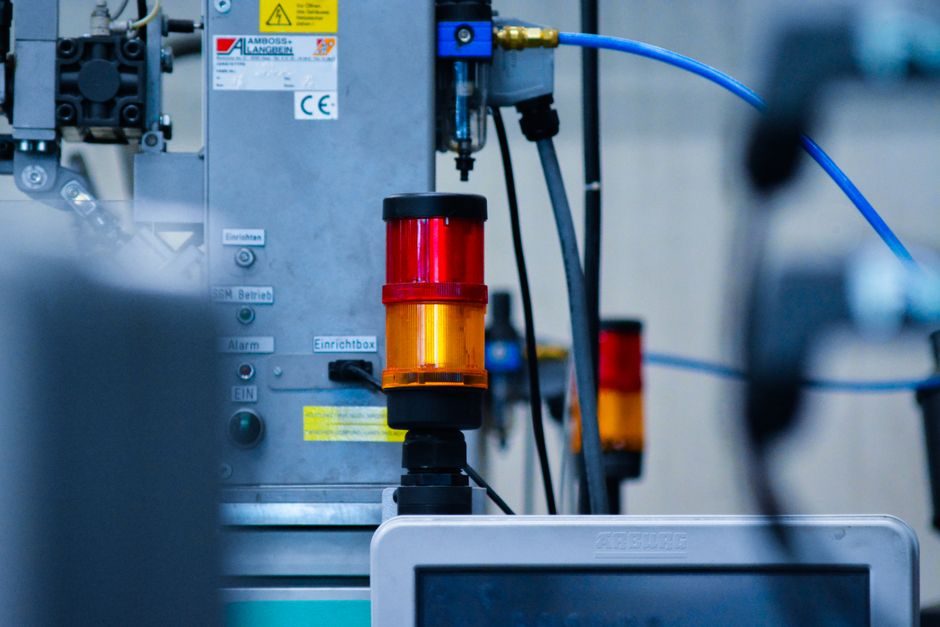
A Coordinate Measuring Machine (CMM) is a 3-axis (or multi-axis) probing system that measures point coordinates on a workpiece by physical contact, with accuracy governed by machine geometry, probe type and thermal stability per THORS fundamentals training [S2].
A Vision Measuring Machine (VMM) is an optical system that captures 2D or 2.5D images of a part under a camera, then computes edge geometry and feature dimensions from the pixel data, with ZEISS's optical series explicitly combining non-contact optics with optional tactile probing in the same frame [S5].
Working principle and where each system breaks
CMMs resolve a feature only at points the probe physically touches, so cycle time scales with the number of measured points and the move-and-settle time of each axis, while VMMs acquire a full field of view in one frame and extract hundreds of edges in software, so cycle time scales with the number of distinct image captures and lighting changes [S2][S5]. CMM accuracy is limited by probe deflection, stylus ball form and thermal expansion of the granite or aluminum frame; VMM accuracy is limited by pixel resolution, lens distortion, telecentricity and edge-detection sub-pixel algorithm performance [S3][S5].
CMMs can measure hidden features (deep bores, undercuts, behind-edge points) by extending the probe stylus, while VMMs are restricted to features visible from above or from a limited oblique angle, with no access to internal geometry [S2][S5].
Selection criteria: 6 decision gates that decide the machine
Six gates dominate a 2026 specification: feature type (form/GD&T vs 2D edge), tolerance band (typically sub-5 µm vs 5–20 µm), material (metal vs polymer/film/PCB), throughput (sample N per shift), probe access (open vs recessed), and the ability to automate (loading robot, pallet, inline conveyor) [S3][S7][S10]. Each gate pushes the choice one direction.
Where tight volumetric tolerance, true 3D features, and metal materials dominate, a CMM wins. Where 2D edges, fragile surfaces, small batch with many part types, or 100% inline inspection dominate, a VMM wins. The crossover is the 2.5D case (stamped, milled, turned parts with a few critical 3D features) where a hybrid machine with both tactile and optical heads is now the standard answer [S3][S5].
Who a CMM is for — and who it is wasted on
CMMs are built for job shops, aerospace, medical implant and mold tooling where GD&T call-outs (position, profile, cylindricity, runout) must be verified on metal or hard-plastic workpieces, with sample sizes of 5–200 per lot and tolerances typically below 10 µm [S2][S10]. Element Materials' 2026 service description positions CMM inspection as the workhorse for "strict tolerance limits" on R&D-to-production components [S10]. THORS' basics course frames the CMM as a fully automated 3D instrument that improves the inspection methodology by removing operator-driven variability [S2].
A CMM is wasted on a PCB shop measuring 0.1 mm trace pitch, on a film extruder checking web width, or on a mass-production screw shop running 50,000 parts per shift. The probe is too slow, the metrology is overkill, and the cost-per-feature is wrong [S2][S8].
Who a VMM is for — and where it falls short
VMMs are built for electronics, micro-machined parts, gaskets, medical disposables and any application where contact would deform the part or contaminate the surface. ZEISS markets its optical VMM series specifically for high-resolution camera work and variable illumination, with tactile probing as an option rather than the primary mode [S5]. KEYENCE's 2026 CMM-portable line explicitly emphasizes 3D/GD&T measurement but coexists with image-based systems for fast 2D screening of large part counts [S8].
A VMM falls short on a transmission gear, a thread pitch diameter, a deep blind hole, or any feature whose reference frame is occluded from above. Edge-detection confidence collapses on shiny or transparent surfaces unless the lighting is dialled in by a skilled operator [S5].
Side-by-side: CMM vs VMM vs hybrid on the 4 decision criteria that matter
For a process engineer quoting 2026 equipment, the four decision criteria that actually drive the purchase are measurement dimensionality, accuracy class, cycle time per feature, and capital cost per inspected feature. [S1]
On dimensionality, a classic CMM delivers true 3D point clouds, a classic VMM delivers 2D edges plus 2.5D height via focus or laser, and a hybrid VMM-CMM delivers both with a shared base and a swappable probe/optic head [S2][S5]. On accuracy class, CMMs typically reach MPE-E of 1.9–4 µm L/250 on the smallest bridge and gantry frames, while VMMs typically sit in the (3 + L/200) µm range dominated by pixel-count and field-of-view trade-offs [S3][S5]. On cycle time per feature, VMMs win at under 1 s per simple 2D edge and lose on multi-point 3D scans where a CMM's probed point is faster than an image-stitching sequence [S2][S5]. On cost per inspected feature in a 5000-part batch, a VMM with automated loading beats a CMM by an order of magnitude on 2D features, but the CMM wins back the lead when a single part has 30+ measured points [S3][S7][S10].
Real use cases from 2026 industrial service offerings
Element's 2026 CMM service line positions the technology as the answer for "strict tolerance limits" on R&D and production components, with non-destructive testing in the workflow and traceable measurement uncertainty [S10]. LEAD Metrology's 2026 full guide frames 3D measurement as a "core definition" exercise for precision manufacturing, walking the reader from CMM kinematics into planning [S7].
Springer Nature's measurement-planning chapter (2026 access) treats the CMM as the canonical case study for measurement-process planning — fixture, probe selection, point distribution, and uncertainty budget — and remains the de-facto reference on why a CMM is a measurement system, not just a machine [S3]. For buyers who want a tactile-plus-optical single footprint, the vision measuring machine reference page covers the non-contact side, while the coordinate measuring machine reference page covers the tactile 3D side, and the machine vision system reference page covers the camera-and-image-processing layer that runs the same kind of edge-detection algorithms under the hood of a VMM [S5].
Limitations, failure modes and sourcing discipline
The biggest CMM failure mode is thermal drift on a shop floor that swings 4–6 °C across a shift; the standard mitigation is a climate enclosure or a 20 ± 1 °C room, not a software patch [S2][S3]. The biggest VMM failure mode is edge-detection noise on a specular or transparent surface; the standard mitigation is coaxial, ring, and programmable multi-angle illumination, not a higher-resolution camera [S5].
Calibration sourcing should be ISO 10360-2 for CMM length-measurement test and ISO 10360-7 for image-probe systems on a VMM; both are the industry-default acceptance tests, and any quote that cannot name the test standard is a quote to walk away from. For calibration artifact strategy on the shop floor adjacent to a CMM, the calibration artifact discussion in gauge block vs roundness tester for calibration work covers the artifact dimension; for any inline 100% inspection decision the spec engineer is making in parallel, the open channel flowmeter vs thermal mass flowmeter frame is the same decision logic applied to flow. Quoting structure and the 5-gate discipline behind any 2026 instrument purchase are mirrored in the RF admittance level switch buying guide [S2][S3][S5].
Track two signals over the next 6–9 months: (1) whether hybrid VMM-CMM frames from the major metrology vendors continue to absorb tactile and optical into a single shared base — the 2026 ZEISS optical-series literature already shows this is the published direction [S5]; (2) whether AI-assisted edge detection on VMMs is being sold as a tolerance-grade feature or only as a screening-grade feature, because the answer determines whether VMMs eat the low end of the CMM market in 2026–2027 [S3][S5][S7].