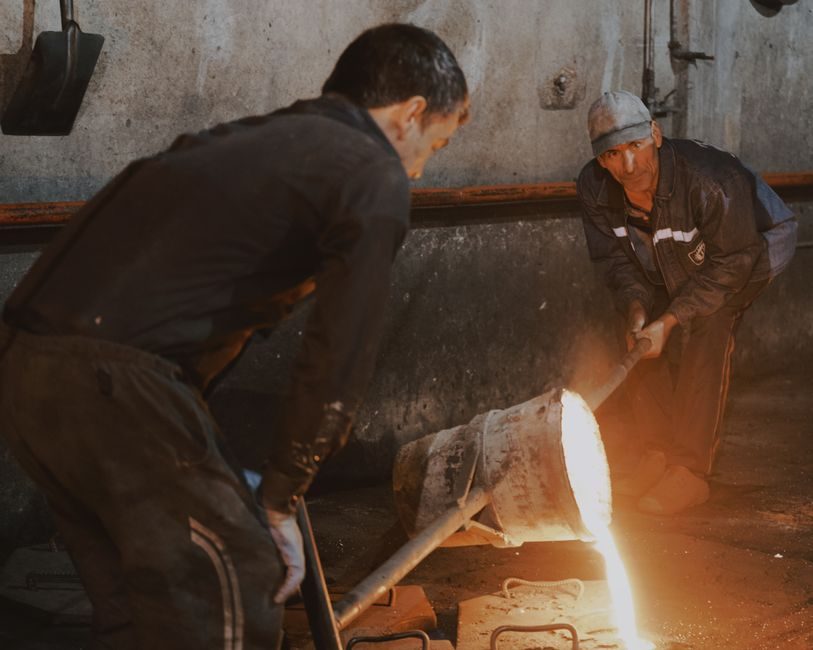
Sizing a cold chamber die casting machine starts with three hard numbers: shot weight of the part, total projected area at the parting line, and the resulting required locking force, with most production units sold in the 200-tonne to 5000-tonne clamping-force band [S5].
Chinese suppliers such as Lanson and Bengbu Long Hua (Bengbu, Anhui) publish 200T-500T small-frame models alongside 500T LH-series presses and a 2026 line that includes both hot and cold chamber builds for export to North America, South America, Eastern Europe, Southeast Asia, Africa, Oceania, the Middle East, Eastern Asia and Western Europe. On the European side, Italpresse — founded 1969 inside SIL Industrie Saleri Italo, itself founded 1942 — supplies new and used cold chamber machines for aluminum, brass, magnesium, zinc, Zamak and lead [S4].
Why a Cold Chamber, Not a Hot Chamber
A cold chamber die casting machine keeps the melt separate from the injection cylinder, so molten metal is ladled into the shot sleeve for each cycle rather than being drawn through a submerged gooseneck [S1]. That geometry is what allows cold chamber presses to handle aluminum, magnesium and brass — alloys whose melting points and metallurgical reactivity rule out the gooseneck immersion used in a hot chamber die casting machine [S1][S3].
Within the cold chamber family there are dedicated variants: an aluminum die casting machine sized for HPDC alloys such as A383 and A384, a magnesium die casting machine configured for thixomolding-adjacent feed and SF6-cover gas safety, and vacuum die casting machine builds that evacuate the cavity to below 50 mbar for structural and aerospace parts [S3][S5]. Heavy-section brass and copper radiator components typically use vertical cold chamber layouts because of the melt density and the shot volumes required [S3].
The Three Numbers That Drive Tonnage
Required clamping force in tonnes is the product of total projected area (cm²) × peak cavity pressure (MPa or bar) ÷ a unit-conversion factor, with a 1.3-1.5× safety multiplier applied for high-pressure aluminum die casting machine work [S3][S5]. A typical thin-wall automotive structural part running at 600-900 bar intensification pressure lands in the 800-1600T range, while a 3C (communication, computer, consumer-electronics) enclosure with 200-400 cm² of projected area can ship on a 200-500T press [S6].
Lanson's 200T-500T small-frame line, for example, pairs a digital-set shot position with a high-speed toggle link mechanism and a hidden stroke guide designed for fast mold changeover, both relevant when cell uptime is part of the unit-economics case [S3]. Process parameters — intensification pressure, slow-shot velocity, fast-shot velocity, dwell time, die temperature — are stored as digital recipes so repeatability does not depend on operator memory [S3].
Selection Criteria Compared

Four criteria usually decide between a 200T, an 800T and a 2500T+ cold chamber: part projected area, shot weight, alloy and annual volume. The table below maps how each frame typically performs against them on machines seen in the 2026 sourcing catalogues [S5].
On part size, a 200-500T press covers up to roughly 600 cm² of projected area; an 800-1600T press covers the 1000-3500 cm² band typical of automotive subframes, EV battery housings and larger 3C heat-spreader plates; machines above 2500T are reserved for multi-slide structural castings and large transmission housings [S3][S5]. On shot weight, small-frame 200-500T machines cap at single-digit kilograms per shot, mid-frame 800-1600T presses handle 5-25 kg aluminum shots, and the largest cold chamber presses move 30-80 kg per stroke [S5]. On alloy fit, the same press frame can be configured for aluminum, magnesium or copper/brass, but the shot sleeve, plunger tip material, and cover-gas plumbing change between the magnesium die casting machine and the aluminum die casting machine variants [S3][S5]. On annual volume, machines specified for 24/7 automotive tier-1 lines tend to be ordered with extended tie-bar spacing, higher platen sizes, and shot-sleeve cooling circuits that the standard catalog build omits [S3].
Who the Cold Chamber Is For, and Who It Is Not
The cold chamber is the right answer for foundries running aluminum structural castings, magnesium instrument panels and laptop housings, brass / copper radiator and valve bodies, and any part where the melt chemistry, the shot volume, or both rule out a gooseneck feed [S1][S3][S5]. Within a tier-1 automotive supply chain — a market segment Italpresse has served since 1969 — the cold chamber is the default for engine blocks, transmission cases and increasingly EV battery trays [S4].
It is the wrong answer for zinc, Zamak and lead, all of which are processed on hot chamber presses because their low melting points and non-reactive chemistry tolerate the submerged plunger [S4]. It is also the wrong answer for prototyping a single tooling trial: a manual or short-stroke cold chamber in the 200-500T small-frame class can be ordered, but lead time from suppliers such as Lanson and Bengbu Long Hua runs to one month in peak season and roughly 15 workdays off-season under FOB or CIF Incoterms with LC, T/T or D/P settlement.
Real Use Cases From 2026 Catalogues

Three use cases recur across the 2026 product pages: 3C consumer electronics enclosures, automotive structural parts, and brass / copper radiators. In 3C, an aluminum cold chamber cell running a 200-500T press produces laptop chassis, tablet frames and heat-spreader plates; the same factory layout appears in the Lanson industry-case library mapped to LCD TV, desktop computer, notebook computer, tablet computer, GPS and mobile-phone housings [S6]. The closer cold-chamber process boundary for aerospace structural castings is discussed in Hot Chamber vs Cold Chamber for Aerospace: Process Boundary, Spec Levers and Sourcing, which traces how the same cold-chamber geometry moves upstream when the cavity must be evacuated.
For automotive tier-1 work, the LH-500T unit from Bengbu Long Hua and Lanson 200-500T small-frame machines sit on the same press footprint, but the LH-500T is the one that opens onto North American, South American, Eastern European, Southeast Asian, African, Oceanian, Middle Eastern, Eastern Asian and Western European OEM lines per the supplier's 2026 distribution map. For radiator work, an OEM listed in the Alibaba top-3 supplier index at 91.6% response rate ships die-casting moulds, plastic moulds and radiator components out of a factory whose main products are radiator cores, radiator accessories and mould sets — that vendor mix is the fingerprint of a brass / copper cold chamber cell.
Limits, Failure Modes and Spec Gates
Three failure modes dominate cold chamber commissioning: flash (insufficient tonnage, wrong intensification pressure, worn tie-bar stretch), short-shot (cold slug at the gate, low sleeve temperature, wrong slow-shot profile) and die sticking (excessive dwell time, wrong release agent, plunger tip wear) [S3]. Each is a sizing or recipe error before it is a machine error — the digital shot and ejection position setting, plus recipe memory, are the levers operators use to keep the cell inside the spec envelope [S3].
Spec gates that must be checked before a purchase order is cut: platen size and tie-bar spacing versus the largest die the foundry expects to run, ejection force and stroke versus part draft and draw depth, and motor / accumulator sizing versus the cycle-time target (a 200-500T small-frame cell typically targets 60-120 shots/h on small 3C parts, while an 800T+ automotive cell targets 30-90 shots/h on structural parts) [S3]. Sourcing levers on payment, lead time and trade terms — FOB / CIF Incoterms, LC / T/T / D/P settlement, one-month peak-season lead time, within-15-workdays off-season lead time — are quoted by the same Chinese suppliers on every product page and should be priced into the comparison. Mold and die steel selection sits inside the same engineering package; the grade bands and sourcing levers in How to Choose Tool & Die Steel: Grade Bands, Spec Gates and Sourcing Levers cover the die side of the cell.
Standards, Sourcing and a Trackable Next Node
International standards referenced by 2026 supplier pages for cold chamber die casting machine builds are described generically as "international standards" in the Lanson product literature, with the OEM confirming manufacture against those frameworks without enumerating the document numbers in the public catalogue [S5]. Buyers who must cite a specific standard in their RFQ should request the compliance schedule from the OEM's engineering team rather than infer it from the marketing page.
Trackable signals to watch: 2026 hot-chamber / cold-chamber model releases from Bengbu Long Hua and Lanson, both refreshed in mid-2026 catalogues; new and used Italpresse inventory cycles — Italpresse remains a worldwide buyer and seller of cold chamber, hot chamber, aluminum, brass, magnesium, zinc, Zamak and lead machines, which is a useful channel for tier-1s capacity-balancing between 2026-H2 and 2027-H1 [S4]. Buyers who already maintain a die-steel sourcing file can cross-reference the tool side of the cell against the bearing and motion-control selection guides on the site — Tapered Roller Bearing Selection: Load Case, Envelope and Tolerance and Self-Aligning Bearing Sizing and Selection Guide 2026 cover the toggle-link and platen-guide bearings that show up on every cold chamber BOM.