Black and brown are the standard FKM colors, while green, red, white, and other shades are available for application-specific identification or appearance [S1][S4].
FKM compounds span general-purpose copolyymers and specialty terpolymers, with material choice governed by chemical exposure, temperature, hardness, and process requirements rather than color [S1][S7].
Color Is a Selection Signal, Not a Performance Grade
Black FKM does not identify one uniform formulation. A representative stock compound, Precision Associates Item 8706, is a 70 nominal durometer black fluoroelastomer compound, demonstrating that black parts can still require a specific hardness and compound code [S1].
Black and brown are listed as the standard FKM colors, with several additional colors available [S1]. Other published ranges include black, brown, green, red, and white, while custom-screened compounds and calendered sheets can be supplied in various colors [S3][S5]. Color is therefore an identification variable, not proof of a particular polymer architecture, chemical resistance, or service rating.
The material context remains FKM, the ASTM designation associated with fluoroelastomers; FPM is used in ISO nomenclature, while Viton is a trademark for a specific Chemours product family rather than the name for every FKM compound [S5]. For readers comparing related elastomer families, FKM rubber and nitrile rubber cover the distinction between fluorinated and non-fluorinated sealing materials.
Black and Brown: Default Colors for General Sealing
Black FKM is the practical default for general-purpose molded seals because black and brown are established standard colors, and black is widely used for FKM O-rings [S1][S6]. The color itself does not change the base polymer when the same compound is used; chemically identical black and brown FKM can differ only by pigmentation [S2].
Standard black FKM compounds are generally suitable where the design requires conventional oils, fuels, chemicals, heat resistance, and weather resistance. Precision Associates Item 8706 is a 70-durometer, black fluoroelastomer compound [S1]. The exact seal performance still depends on durometer, cure system, polymer composition, compression set, and the fluid and temperature conditions [S7].
Standard FKM O-ring temperature ranges are from -15°F to 400°F, while different formulations can extend that range [S4]. These are not guarantees for every black part, because compound and test conditions determine the actual limits.
Specialty Colors: Use Them for Functional Identification
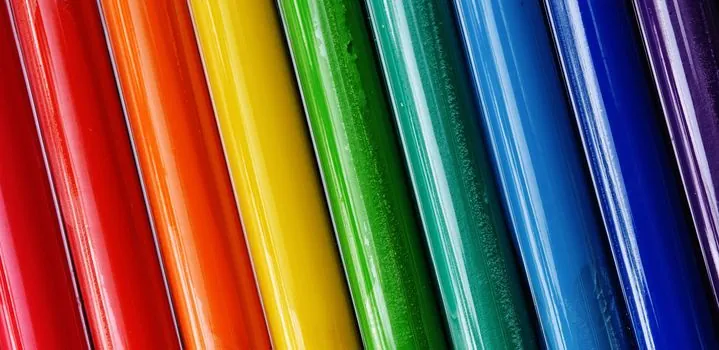
Green, red, white, and other specialty-colored FKM compounds are most useful when an assembly requires visual identification, inspection control, or a controlled manufacturing distinction between parts [S4][S5]. A color code can prevent a black seal and a chemically different seal from being mixed during assembly, but the purchase specification must still identify the compound separately.
Specialty FKM is generally more complex than standard FKM because the compound may be a terpolymer rather than a general-purpose copolymer [S1]. Fluoroelastomers are commonly referred to as FKM, FPM, or Viton and are defined by ASTM D1418 and ISO 1629 [S5]. Those figures cannot be inferred from color. For example, green FKM could represent an identified assembly color, but the material data must establish whether it is an A-type, GLT-type, or another formulation.
Specialty formulations may also be developed for improved low-temperature behavior, chemical resistance, food or medical qualification, or a specific durometer [S8]. The engineering plastic page is useful for the adjacent decision between a compliant elastomer seal and a chemically engineered polymer component, although an engineering plastic does not provide the elastomeric sealing behavior associated with FKM.
Compare Black, Brown, and Specialty Colors by Decision Criteria
Black FKM, brown FKM, and specialty-colored FKM are compared below on availability, compound-definition risk, intended function, and qualification burden. The table is a sourcing framework, not a claim that every color has identical properties. [S2]
Where Colored FKM Fits in Real Seals
FKM O-rings are primarily used in aerospace, automotive, and chemical-processing applications [S4]. It is also useful for molded seals, calendered sheet, tubing, cord, and custom profiles produced in colored batches [S3].
Specialty-colored material is not the right choice when appearance is the only objective and no inspection or assembly benefit exists. A standard black or brown compound with an identified supplier code is simpler to control, particularly for high-volume molding. For custom mixes, production scale can extend from 2-pound laboratory samples to 500-pound lots, with separate compounds tailored to compression molding, injection molding, transfer molding, extrusion, and calendering [S3].
For chemical processing, color should remain separate from compatibility approval. Specialty FKM may be selected for concentrated acids, water, steam, automotive fuels, and sour-gas environments, but these applications require compound-specific evidence rather than a visual color designation [S1][S3]. If the seal also interfaces with another elastomer, review the complete material system rather than substituting on color alone.
Limitations: Pigment Does Not Establish Compliance
A black, brown, green, red, or white FKM part does not establish FDA, medical, food, or other regulatory compliance by appearance. WARCO states that its standard FKM sheet is black unless noted otherwise and that custom colors and color matching are available, but the product designation and test reports remain separate from the visible color [S9].
Specialty FKM may be offered for food processing, medical, or other specialty applications, and specific Viton-family grades can carry approvals such as NSF 61, FDA, UL 157, EN 549, API 6A, or NORSOK M710 [S1][S5]. These certifications apply only to the named grade and intended conditions. A color match supplied on a different base compound does not inherit them.
Two qualification risks deserve particular attention. First, pigment can complicate visual inspection of defects, flash, contamination, or surface damage; the drawing should identify whether cosmetic uniformity is mandatory. Second, custom color development can introduce a separate acceptance tolerance for hue, gloss, and appearance. Neither issue changes the chemical compatibility decision, but both can affect production acceptance and traceability.
Specify the Compound Before the Color
A defensible FKM purchase specification identifies the polymer family, manufacturer compound or grade, Shore A hardness, cure system, continuous-service temperature, chemical exposure, color, and applicable certification. Precision Associates Item 8706 illustrates the useful level of definition: a 70 nominal durometer black fluoroelastomer compound [S1].
For the standard-versus-specialty decision, use black or brown FKM when the application needs ordinary sealing performance and visual differentiation has no engineering value. Use specialty-colored FKM when the color supports inspection or assembly control, but require the underlying terpolymer or specialty compound to be identified independently. EPDM rubber remains an alternative for specified low-temperature or non-oil service, but it is a different elastomer family and should not be treated as a colored FKM substitute.
The trackable next document for procurement is the supplier datasheet and certificate package for the exact color and compound, including durometer, temperature limits, chemical compatibility, certification scope, and lot traceability. Do not release a molded seal on the basis of a swatch or the words “black FKM” alone.