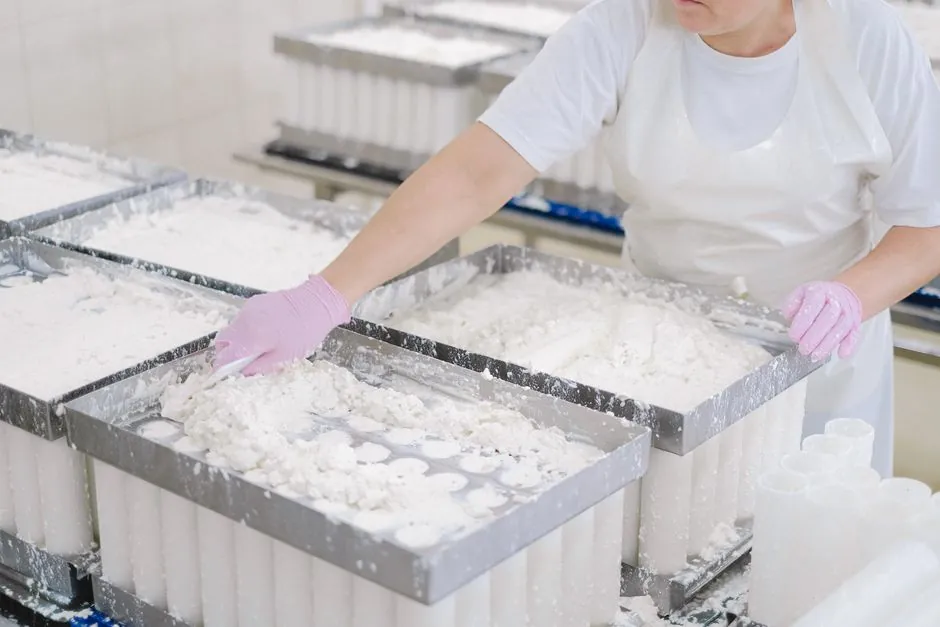
White food-grade NBR costs more in material control but prevents the staining associated with carbon-black compounds, making it the appropriate choice for hygienic seals, gaskets, and sheet barriers [S1][S3].
Both materials are nitrile elastomers with oil resistance, but black NBR is normally a general-purpose compound, while white NBR uses a light-colored formulation designed for food and drink contact [S2][S3][S8].
Material Identity and Contact Suitability
Standard black NBR is not automatically food grade, even though its base polymer has useful oil resistance and mechanical strength [S8]. White food-grade NBR is compounded with ingredients selected for food contact, and commercial grades are supplied with a white, smooth, non-tainting surface [S2][S5][S6].
The defining formulation change is the exclusion of carbon-black filler from white nitrile. Removing that filler reduces the risk of visible staining, discoloration, or black transfer to a product or processing surface [S3]. A white compound may still contain non-carbon-black reinforcement, so color alone does not establish compliance.
For specification purposes, request the supplier's food-contact declaration and test documentation rather than accepting a statement such as “FDA approved.” NBR can be formulated to meet FDA 21 CFR 177.2600 for static food-contact applications, but the regulation applies to the evaluated compound and use conditions rather than to the word “nitrile” alone [S8]. A white NBR compound is designed using white-list ingredients for food-grade use [S6].
Side-by-Side Selection Criteria
On hygienic appearance, white food-grade NBR wins because its formulation eliminates carbon-black fillers that can stain or discolor product-contact surfaces [S3]. On general cost, standard black NBR normally wins because the additional formulation and color-control requirements of food-grade white material add cost, although no universal price percentage can be derived from the available product data.
On mechanical suitability, both are NBR and therefore belong in the same general family.
On chemical exposure, both grades are selected for resistance to oils, grease, and some fuels, with white nitrile described as resistant to organic and synthetic oils [S4][S9]. On regulatory scope, only a documented food-contact white compound should be considered for direct food contact; standard black NBR should remain in non-contact service unless its specific formulation and intended use are approved [S8].
Application Fit by Service Condition

Use white food-grade NBR for static gaskets, hygienic belting, liners, sheet barriers, and sealing faces where appearance, cleanliness, or non-tainting performance matters [S1][S2][S5]. Typical food-contact configurations include conveyor-side sealing surfaces and static joints that can be removed for cleaning. White NBR retains the oil-resistance rationale that makes NBR useful in processing environments, but contact approval still depends on the compound documentation [S1][S6].
Use standard black NBR for hydraulic seals, general industrial gaskets, and oil-handling components where the elastomer is concealed and no light-colored food-contact surface is required. NBR is valued for its resistance to oils and certain types of fuels, making it suitable for applications where oil resistance matters [S4].
For applications combining visible product contact with substantial oil or grease exposure, specify a white NBR grade with both the food-contact declaration and verified chemical compatibility. Do not infer oil resistance or food suitability from color: one product line describes oil resistance as the defining performance of white NBR [S4], while a separate compound sheet establishes the food-contact formulation [S6].
Fabrication, Cleanability, and Operating Limits
White food-grade NBR is commercially supplied as sheet and custom-fabricated material. One hygienic product is listed at 1200 mm width, 65 Shore A hardness, a smooth white surface, and a non-tainting classification [S5].
The practical advantage is contamination control during food handling. A white, smooth, non-tainting surface allows inspection of the sealing or wear surface for embedded debris and avoids black particulate transfer associated with carbon-black grades [S3][S5]. It does not make the joint self-cleaning, and its hygiene benefit is lost if a black or non-compliant elastomer contacts the product.
Temperature must be taken from the selected supplier's datasheet.
Approval, Traceability, and Procurement Checks

A food-contact procurement file should identify the compound, manufacturer, product code, intended food-contact condition, and supporting compliance documentation. A white compound described as using white-list ingredients is a traceability lead, not a complete specification [S6]. FDA 21 CFR 177.2600 is applicable to static food-contact applications when the formulation and conditions meet that regulation [S8].
For seals and gaskets, verify whether the component is static or dynamic. The cited FDA provision is for static food-contact applications, so a dynamic wiper seal, rotating seal, or repeatedly flexing hygienic membrane requires separate suitability evidence [S8]. Also request confirmation that adhesives, release films, fillers, pigments, and backing materials are permitted for the same contact condition.
For sheet and fabricated barriers, check surface finish, thickness tolerance, and joining method. A 65 Shore A white hygienic grade with a smooth surface is materially specified as non-tainting [S5], while the 60 Shore A commercial sheet range and fabrication limits are stated separately [S4]. Do not merge these properties into one universal white-NBR specification.
Failure Modes and Avoidable Misfits
The primary failure is false equivalence: treating standard black NBR as food grade because both grades are NBR. Black NBR can stain product-contact surfaces, and it may also shed carbon-black contamination, making it unsuitable where visual cleanliness or non-tainting performance is required [S3][S8].
The second failure is overextending the temperature rating. The stated -20°F to 180°F range applies to a specific commercial 60 Shore A white sheet, not to every white food-grade NBR compound [S4]. A higher operating temperature requires a supplier-rated product or a material change, with white food-grade silicone serving as a documented high-temperature option [S4].
The third failure is assuming food approval transfers across a fabricated assembly. Compliance belongs to the actual compound and intended contact conditions, while adhesives, laminations, compression rings, and foreign-material exclusion remain separate design obligations [S6][S8]. The engineering choice is therefore not simply white versus black; it is a controlled compound, a stated contact condition, a verified temperature range, and a fabricated assembly that preserves both.
For procurement control, require a numbered datasheet, the FDA 21 CFR 177.2600 status where claimed, hardness, continuous and intermittent temperature limits, oil and chemical compatibility, surface finish, and batch traceability. For a plant trial, record stain transfer, compression set, swelling, cleaning-agent exposure, and actual product-contact temperature rather than relying on the generic category “food grade NBR.”