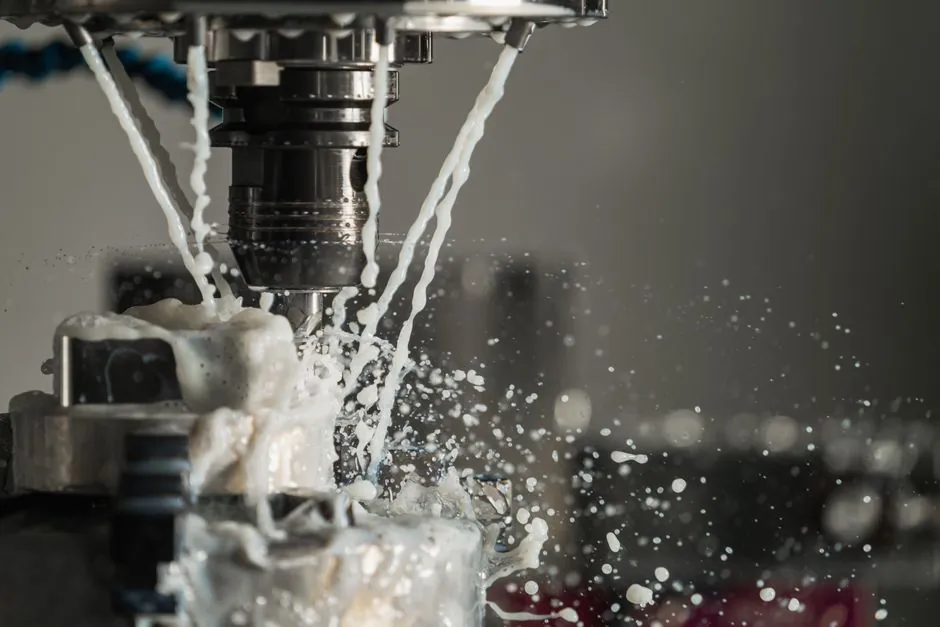
Electrostatic water-free die lubricant can deliver effective lubrication with as little as 1/800 of the volume required by a conventional water-based release agent [S1].
For aluminum die casting, the decision depends on die temperature, geometry, lubricant delivery equipment, cycle time, and the cost of porosity, die cracking, maintenance, and wastewater.
What the two lubrication systems do
Each droplet carries oil through water, so the water must evaporate before the useful oil film forms.
Electrostatic dry-powder or water-free oil-based lubrication uses an electrically charged spray to move lubricant toward the die, producing a wraparound effect around complex surfaces [S1][S2]. The source material does not establish a universal powder particle size, conductivity range, deposition efficiency, or compatibility limit, so these values must be established through supplier data and production trials rather than assumed.
Do not confuse die lubricant with the aluminum die casting die surface treatment used after casting. Powder coating is a separate finishing operation in which dry powder is electrostatically deposited and thermally cured, whereas die lubricant is consumed during the shot to separate molten metal from the cavity [S4].
Decision criteria: temperature, coverage and waste
An electrostatic spray gun produces a wrap-around effect with the spray mist when applying second-generation water-free die lubricants. Ultraseal International reported that diecasters might save up to 85% of the total operating costs of die-casting machinery in an 800-metric-ton comparison by using a water-free die lubricant applied in an electrostatic spray. These are case-specific results, not universal guarantees.
For a fixed die and product mix, run a controlled comparison using lubricant consumption per shot, seconds added to cycle time, porosity rejection rate, die temperature at spray, and die-cleaning labor. The spray automation cell equipment selection guide is relevant because nozzle positioning, air supply, electrical grounding, and control interlocks determine whether electrostatic delivery is repeatable.
Direct comparison by operating criterion
Water-based spray wins where the die can be held between 150°C and 250°C, existing equipment is already configured for liquid spray, and the operation requires a fire-resistant fluid [S1][S3].
Water-free die lubricants can provide excellent results with only 1/800th of the volume that would be required if a water-based die-release agent were used. Water-based spray needs evaporation and drying air, whereas water-free oil-based lubrication avoids the same water-removal step [S1]. Powder delivery adds an electrical charging requirement and supplier-specific equipment constraints; the cited material gives no universal cost figure for that retrofit.
Lifecycle is not automatically better for either system. Reduced thermal stress and porosity may extend die life, but lubricant interaction, build-up, residue, and cleaning practices still determine actual die condition. The die life and maintenance reference provides a separate framework for comparing cracking, erosion, corrosion, and maintenance indicators.
Applications suited to electrostatic delivery
Electrostatic spray is particularly suitable for complex cavities, deep recesses, surfaces behind slide cores, and areas that are awkward to reach with a straight liquid spray [S1][S2]. The electric field can draw the charged mist around the die, which reduces repositioning or multiple-angle spraying [S2].
Switching from traditional water-based lubricants to a water-free electrostatic solution allows users to cast larger components with higher process temperatures. This does not mean the lubricant alone determines casting quality. Molten-metal temperature, shot volume, fill time, venting, die temperature, and surface chemistry remain separate process variables.
It is also relevant where fire resistance is a specified handling property and local process validation has already established stable film formation inside 150–250°C [S1][S3].
Limitations and failure modes to control
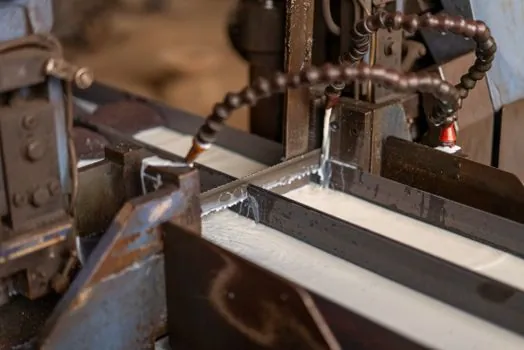
Inadequate air drying can leave water in the cavity, increasing the risk of blocked nozzles, water staining, and porosity; electrostatic water-free lubrication is presented as reducing die cracking and porosity by removing water from the spray system [S2].
Electrostatic systems have their own commissioning discipline. Poor electrical bonding can make deposition uneven, and nozzle-to-die spacing, spray pattern, polarity, air pressure, and temperature must be controlled. Excessive coating can create residue or interfere with cavity dimensions, while insufficient coating can permit aluminum adhesion or soldering. The supplied research provides no general tolerance for film weight, so specify an approved test method and acceptance limit with the lubricant supplier.
Thermal compatibility must be checked at the actual cavity temperature, not merely at the nominal lubricant temperature. Water-free oils and powders can also age, separate, contaminate, or form deposits, so storage limits, filtration, agitation, nozzle cleanout, and die-cleaning intervals must follow the product technical data sheet and a defined maintenance plan [S6][S7].
Equipment, validation, and operating practice
Retrofit the die casting machine only after confirming that the die surface can be electrically referenced and that the spray head can maintain the required distance, pattern, and transfer efficiency. A laboratory coupon cannot represent the thermal mass, shadowing, slide movement, or residue behavior of a production die, so validation should use a controlled die with measurable cavity temperature and lubricant delivery records. [S1]
Track at least four acceptance indicators: lubricant consumed per shot, spray and drying time per cycle, porosity and water-staining rejection rate, and die condition at fixed shot intervals. Add die temperature and nozzle cleaning frequency because these are the variables most directly connected to the documented 150–250°C water-based operating window [S1]. For the economics, calculate annual lubricant, electricity, compressed air, wastewater, cleaning chemical, scrap, and maintenance costs rather than relying on consumption alone.
Adopt electrostatic dry powder when the trial shows stable coverage above the water-based range, materially lower consumption, and no loss of dimensional or surface quality. Retain water-based spray when the die operates mainly within 150–250°C, liquid delivery is already reliable, and the validated cost advantage of electrostatic conversion remains below the retrofit and process-control burden [S1][S2].
Specification checklist for procurement and trials
Require the lubricant supplier to identify the base chemistry, solids content, application method, recommended die-temperature range, film-weight target, electrical requirements, storage limits, cleanout procedure, and approved die and nozzle materials. For water-based products, also specify the water content range, fire-resistance requirement, evaporation range, drying-air configuration, and wastewater disposal route [S1][S3].
Include a production trial with an agreed minimum shot count, measured lubricant flow, compressed-air use, cycle-time effect, scrap classification, and die inspection at defined intervals. The candidate equipment article on spray automation cell selection for die-casting dies supports planning the cell around the die geometry and application method.
No single lubricant specification from the cited material governs every aluminum die. The defensible choice is based on measured performance: water-based spray for a controlled 150–250°C window and established liquid-spray operation, or electrostatic water-free powder for hotter dies, difficult geometry, and materially lower consumption.