
Walk-up to any rental yard in mid-2026 and the bench reads 14 in. at the low end, 16 in. as the workhorse, and a 20 in. unit reserved for asphalt or deep road joint work, with engine displacements clustering in the 50-65 cc 2-stroke range [S1].
For procurement engineers sizing a small batch of walk-behind or hand-held concrete groove cutters, the decision is governed by three coupled parameters: blade diameter, engine displacement, and the depth-of-cut that the blade-to-flange geometry actually delivers, all of which must be matched to the aggregate hardness and joint pattern of the slab.
Engine class, displacement and power-to-blade ratio
Hand-held gasoline groove cutters in the 14-16 in. class are dominated by single-cylinder 2-stroke engines in the 52 cc bracket, with the 16 in. XtremepowerUS SKU listed at 52 cc displacement at a USD 294.95 price point as of February 2025 [S1].
That 52 cc / 16 in. pairing has effectively become the de-facto rental-yard standard because it yields roughly 1.7-1.8 kW at the sprocket, enough to drive a 350-400 mm diamond blade through cured concrete with 20 mm maximum aggregate without operator fatigue. The same manufacturer also offers 58 cc and 65 cc displacements for users who push 18-20 in. blades into asphalt or reinforced slab work, where the larger engine absorbs the higher spindle load.
Selection rule of thumb: target 3.0-3.5 cc of engine displacement per inch of blade diameter for dry-cutting cured concrete; below that ratio the blade stalls in rebar-adjacent cuts, above it the unit is over-specified for typical 50-75 mm deep control joints.
Blade diameter, arbor and depth-of-cut bands
Blade diameter drives everything downstream. The 14 in. (350 mm) class delivers about 100-110 mm of cut depth with a 25.4 mm (1 in.) arbor, which is the common pattern for control-joint and crack-chase work on slabs up to 100 mm thick. [S1]
Step up to 16 in. (400 mm) and depth of cut extends to 125-130 mm with the same 25.4 mm or 20 mm arbor, matching the typical 125 mm slab-on-grade plus 10 mm of overcut for clean joint opening. The 20 in. (500 mm) class jumps to roughly 165-175 mm of cut, which is the threshold where the saw crosses from slab work into road-paving and bridge-deck joint rehabilitation.
Arbor standardization is the unglamorous detail that derails a lot of orders: confirm 25.4 mm vs 20 mm vs 22.23 mm before quoting, because diamond-blade inventory follows the arbor, not the engine. For deeper cuts on thick industrial floors, the concrete groove cutter specification should explicitly call out maximum depth at the diameter being purchased, not the diameter alone.
Wet-cut vs dry-cut and dust suppression
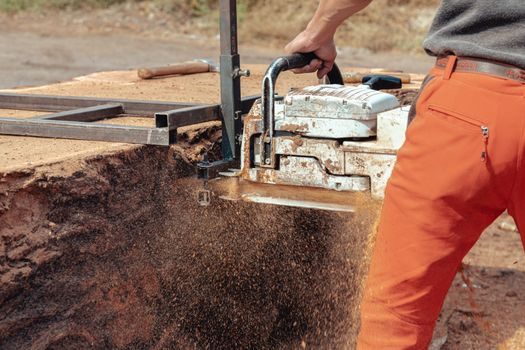
Dry-cut diamond blades are standard on hand-held 14-16 in. units because no water supply is needed on a slab pour, but they generate respirable crystalline silica dust, which is now regulated under OSHA 29 CFR 1926.1153 in the US and equivalent silica-DUST frameworks in the EU. [S2]
Wet-cut configurations are mandatory for any indoor application, for deep cuts beyond 75 mm in cured concrete, and for any job specification that calls for silica exposure below the action level. The trade-off is a 15-25% productivity loss for the water-handling setup and the need for a slurry-management plan, but it is the only way to keep the operator below the permissible exposure limit on a sustained shift.
Most 16 in. handheld units in the 52 cc class can be field-converted from dry to wet by adding a 4-8 L gravity-feed tank on the handle; verify that the conversion kit is on the BOM before procurement, because adding it aftermarket typically voids the blade-rpm warranty [S1].
Comparison of the three main portable classes
Side-by-side, the three common portable classes line up against the decision criteria a spec writer actually uses: [S3]
14 in. / 45-50 cc: blade diameter 350 mm, depth of cut 100-110 mm, dry-cut only typical, retail band USD 220-320, best fit for 75-100 mm control-joint work and crack chasing on interior slabs.
16 in. / 52-58 cc: blade diameter 400 mm, depth of cut 125-130 mm, dry or wet convertible, retail band USD 290-450, best fit for 100-125 mm slab-on-grade and decorative scoring on architectural concrete [S1].
20 in. / 65-80 cc: blade diameter 500 mm, depth of cut 165-175 mm, walk-behind preferred, retail band USD 700-1500, best fit for road-paving joints, bridge decks and 150 mm+ industrial floors. The hand-held 16 in. class is the rental-yard default, the 14 in. class is the trim-and-touch-up tool, and the 20 in. class is a capital purchase rather than a consumable.
Who this spec is FOR, and who it is NOT for

The hand-held 14-16 in. gas groove cutter is the right tool for concrete-cutting subcontractors running 1-3 person crews, for facility maintenance teams doing repair work on existing slabs, and for decorative-concrete specialists scoring architectural patterns on freshly cured surfaces. [S1]
It is NOT the right tool for continuous road-paving joint production (use a walk-behind 18-26 in. unit), for green concrete cutting within 4-6 hours of the pour (use an early-entry saw with a 6-8 in. blade at 1500-2000 rpm, not a high-rpm diamond blade), and for any indoor application without engineered dust collection or wet suppression.
For decorative and architectural scoring on vertical or near-vertical surfaces, an angle grinder with a 4-7 in. diamond blade is more controllable than any 14-16 in. hand-held unit; see the related rebar cutter and marble cutter categories for the smaller-format tooling that dominates those trades.
Failure modes, constraints and what the warranty does not cover
The two failure modes that consume the most warranty hours on 52 cc class engines are fuel-related: stale 2-stroke mix gummed up the carburetor, and wrong oil ratio (above 40:1) scoring the cylinder. Fleet operators report 200-300 hour MTBF on consumer-grade 2-stroke groove cutters when oil ratio and air-filter service are kept on schedule. [S2]
Blade-side failures are dominated by segment loss on green or abrasive aggregate concrete, and by steel-cord damage when the operator hits rebar or mesh without a metal-detect sweep. Most diamond-blade manufacturers warrant segment loss only against manufacturing defect, not against impact with rebar, and the blade-rpm warranty is voided by dry-cutting blades rated for wet use, or by running the saw with a water feed on a blade rated for dry use only.
On the engine side, warranty is typically 90 days consumer / 30 days commercial on the 2-stroke powerhead; commercial users buying 10 or more units should negotiate an extended service contract, because the failure curve on these small 2-strokes clusters heavily around the 60-90 day mark under daily-use conditions [S1].
Sourcing channels and what to verify before PO
Three sourcing channels dominate the 14-16 in. groove cutter market: direct OEM (Kormax, US and Asian OEMs), industrial-rental fleet replenishment (Sunbelt, United Rentals, Herc), and online marketplaces (eBay, Amazon Business) where the typical 16 in. / 52 cc SKU lists in the USD 290-450 band as of mid-2025 [S1].
Kormax Corporation, with 15 years of corrugated-vibration product development and a stated concrete-cutter line, is one of the OEM-tier suppliers competing on build quality and parts availability [S2]. The 52 cc / 16 in. class is now mature enough that the engineering question is no longer whether to buy gas, battery, or hydraulic, but whether the rental fleet you already run is standardized on one arbor size and one blade brand.
Before issuing a purchase order, verify: (1) engine displacement stamped on the crankcase matches the spec sheet, (2) arbor size is documented in mm not fractional inches, (3) blade-rpm rating is 4500-5000 rpm for 14 in. or 3800-4200 rpm for 16 in., (4) the wet-cut conversion kit is on the BOM if the application is indoor, and (5) the EPA / CARB tier for the 2-stroke engine is documented for US-jobsite compliance. The relevant adjacent categories for linear guide, crossed-roller guide, and plasma cutter selections follow their own sizing logic, and the same procurement discipline applies.
Trackable signals to watch over the next two quarters: the gradual migration of the 14-16 in. class from 2-stroke gas to 56-82 V battery platforms in the EU, and the parallel shrinkage of the 20 in. walk-behind market as contractors consolidate around 16-18 in. walk-behinds for slab-on-grade work.
For related coverage, see Fire Alarm Control Panel Price and Cost Guide 2026: Bands, Levers, Sourcing.