Mining-grade laser screeds are defined by three non-negotiable specs: a placement head at least 2.5 m wide, a hydraulic vibratory system matched to slab thickness, and a laser or 3D grade reference accurate enough for floor flatness (FF) and floor levelness (FL) numbers that heavy mining equipment will live on [S1].
Auswide's published scope lists agriculture, sporting, civil, and warehousing pours as a single service line, but its equipment class also covers industrial and mining shed slabs where flatness drives forklift, LHD, and truck-traffic reliability [S1]. Pro Screed Inc. in Georgia rents laser screeds for commercial concrete work, confirming that contractor-side rental is the dominant access model in North America [S2].
What "Mining-Grade" Means in a Laser Screed Spec Sheet
A screed that lives on a mine site has to survive abrasive fines, wash-down water, and shift-long vibration cycles, so the head, auger, and vibrator run on hydraulics rated for continuous duty rather than the intermittent duty seen on light commercial units [S1].
Three spec lines separate a mining-suitable screed from a warehouse unit: head width 2.5–6.0 m for full bay coverage in one pass, auger and plow ploughing volume scaled to slab depth of 150–300 mm, and a laser receiver mast tall enough to see the rotating plane above rebar chairs and mesh [S1]. Pro Screed's rental fleet is built around the same continuous-pour productivity logic, with operators quoted by the square metre for commercial slabs that scale up to industrial size [S2].
Selection Criteria: Head Type, Drive, Control and Power
Buyers should grade candidate screeds on four criteria: placement head (boom vs. roller screed), prime mover (4-wheel vs. track), control reference (single-laser vs. 3D GPS/UTS), and power package (diesel engine kW vs. electric/genset) [S1].
A four-wheel ride-on screed with a 3–4 m boom, a 2D laser receiver on a vertical mast, and a 30–50 kW diesel is the workhorse for mine workshop pours, because it covers 800–1200 m² per shift on 150–200 mm slabs without a separate generator [S1][S2]. A track-mounted, 6 m boom unit with 3D GPS/UTS referencing earns its premium on pour areas above 2000 m² per shift, where set-up, re-mobilisation, and labour dominate the cost per m² [S1].
Who the Mining-Class Screed is For — and Who Should Rent
Mining procurement should buy a heavy-class ride-on or 3D GPS screed only when annual in-house slab volume exceeds roughly 25,000–40,000 m², because below that band the rental option beats depreciation, transport, and operator standby cost [S2].
Contractors and one-off mine civil projects should rent, since Pro Screed's Georgia operation explicitly sells laser-screed rental as a service line, not just sales-plus-installation [S2]. The break-even logic mirrors the power trowel supplier landscape in 2026: specialised finishing equipment earns ownership only above a sustained-volume threshold, otherwise the rental + operator package wins on total cost per square metre.
Option Comparison: Boom vs. Roller vs. 3D Truss Screeds
The three formats mining buyers compare — boom screed, roller screed, and 3D truss screed — score differently on coverage per pass, FF/FL ceiling, slab depth band, and capital cost per m² of annual output [S1][S2].
Boom screeds (2.5–4 m head) hit the best coverage-to-cost ratio on slabs 150–200 mm thick in the 500–1500 m²-per-shift band and can hold FF 35 / FL 25 with a 2D laser reference on a flat pad [S1]. Roller screeds are preferred on stiff, low-slump mine mixes and on slopes because the auger pre-spreads and the tube consolidates without a vibrating pan, but they trail boom units on raw throughput. 3D GPS/UTS truss screeds reach FF 50 / FL 35 on industrial floors and are the only format that handles complex fall patterns for drainage on wash-down slabs [S1].
Use Cases on a Mine Site: Workshops, ROM Pads, Wash Bays
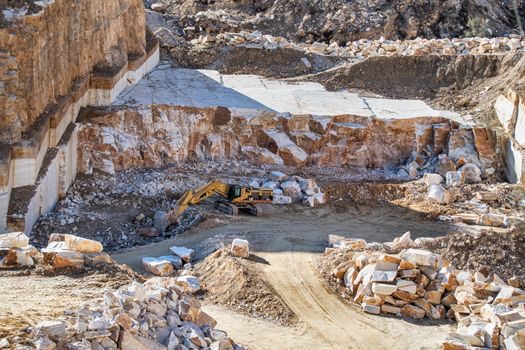
The three highest-value pours on a mine site — heavy-vehicle workshops, run-of-mine (ROM) ore-handling pads, and truck-wash slabs — each push a different spec lever on the same machine class [S1].
Workshop floors under LHDs and underground loaders need FF 35 / FL 25 minimum and slab thickness 200–300 mm, which the boom-screed format covers with standard laser control [S1]. ROM pads and ore-stockpile slabs take a roller screed because low-slump, abrasion-resistant mixes with 25–40 mm aggregate are easier to consolidate with an auger-and-tube than a vibrating pan. Truck-wash and chemical-bunded slabs need 3D-modelled falls to drainage, so the 3D GPS/UTS truss unit is the right tool even though its hourly cost is the highest of the three formats [S1].
Limitations, Failure Modes and Maintenance Traps
The two recurring failure modes in mining-service screeds are laser-receiver loss-of-lock on long, sun-exposed pours and hydraulic-oil contamination from abrasive fines ingested through the radiator and tank breathers [S1].
A 2D laser reference drifts when the rotating plane is broken by rebar stacks, mesh, or personnel crossing the beam, and the operator's only recovery is a manual re-grade, so a second receiver head is a cheap insurance policy for any pour over 800 m² [S1]. Hydraulic contamination is the dominant mid-life failure, because the same dust that loads the air filter loads the hydraulic tank, accelerating seal and pump wear; a remote-mounted, pressurised breather plus a 250-hour hydraulic filter change is the standard fix [S1][S2]. Specifying these items in the purchase contract is as important as head width, which is the same discipline buyers apply to pallet rack frame, beam, deck, and aisle trade-offs in 2026 specs.
Sourcing Levers, Standards and a Verifiable Next Signal

Public tender language for mining-spec screeds in 2026 typically cites ACI 117 (tolerance), ACI 302.1R (floor construction), and the manufacturer's published FF/FL envelope, and the screening criterion is usually "FF 35 / FL 25 minimum on 200 mm slab", not head width [S1].
Buyers should also reference the laser screed reference page on spec bands and operating principles alongside the laser level control principles when writing technical specifications, because the receiver-mast geometry and the rotating-laser wavelength drive field accuracy more than the chassis choice does. The next verifiable procurement signal to track is the 2026 release of OEM 3D GPS/UTS option pricing, which is currently the only cost line that varies 2–3× between competing machine formats, and which the same rental-fleet operators — Auswide in Australia and Pro Screed in the US — will publish as their option-book quotes firm up over Q3 [S1][S2].
For component-level specifications, see mining dump truck.