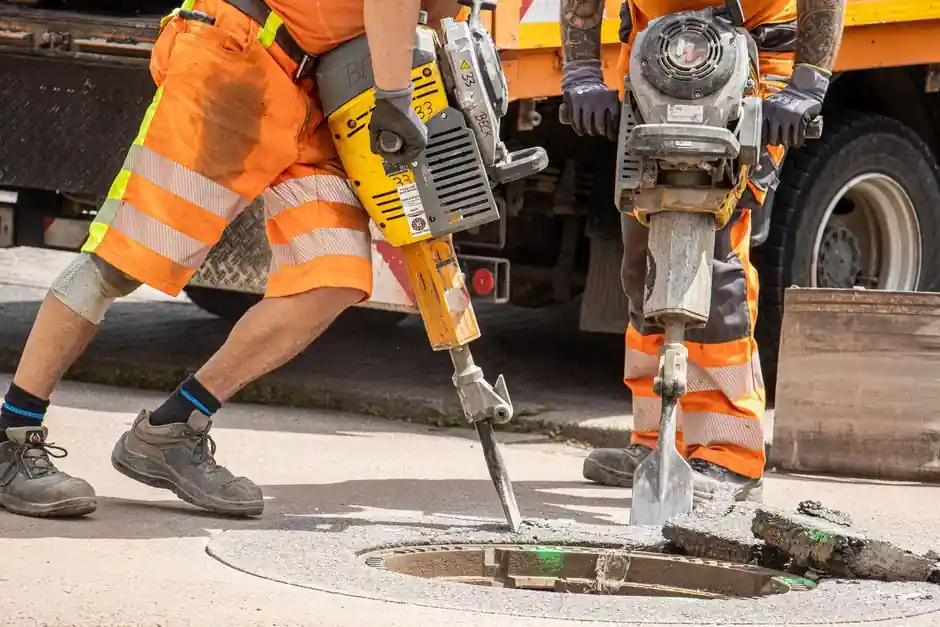
A concrete groove cutter is most operator-friendly when its declared A(8) is below 2.5 m/s², cutting equipment is maintained in balance, and worn blades are replaced before handle vibration rises.
Operator comfort depends on vibration magnitude, frequency, exposure duration, machine balance, and cutting-tool condition, not on power output alone.
What Vibration Limit Means for Groove-Cutter Operators
Under Directive 2002/44/EC, an A(8) below 2.5 m/s² places daily exposure below the action level, while A(8) from 2.5 to 5.0 m/s² requires risk assessment and control measures; exposure must not exceed 5.0 m/s² [S2].
A(8) normalizes vibration exposure to an 8-hour working day, so the same tool can produce different daily exposure values depending on duration and repetition [S2]. A low instantaneous reading is therefore not enough. Procurement should require the machine's declared equivalent vibration value, the test configuration, and the operating conditions attached to that declaration.
Comfort also depends on frequency content and handle design, not acceleration alone. The concrete groove cutter should provide a secure grip, controlled rear handle, and predictable feedback during start-up, cut entry, and blade engagement.
Blade Wear Can Raise Handle Vibration and Cut Time
The study title indicates that concrete-bit wear increases handle vibration and drilling time [S1]. That delay also increases the operator's vibration exposure per productive cut and reduces throughput.
For groove cutters, the equivalent control is a blade-inspection interval tied to visible edge damage, loss of diamond exposure, glazing, or increasing kickback. A written replacement rule is more useful than a fixed calendar interval because concrete abrasive quality and operating hours vary by job.
Low-Vibration Power Tools Compared by Daily Exposure
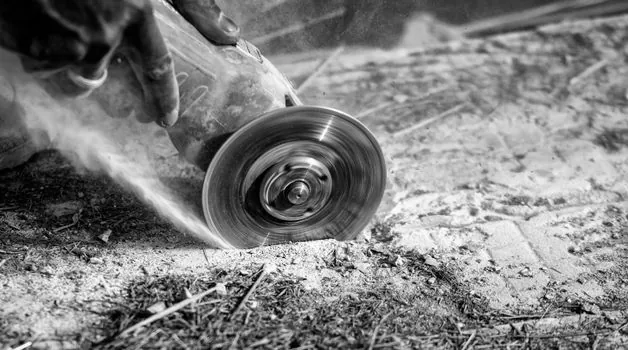
Low-vibration equipment with A(8) below 2.5 m/s² is the preferred band for routine use, while tools between 2.5 and 5.0 m/s² require exposure controls and those above 5.0 m/s² require reduced work time or a lower-vibration alternative [S2].
This comparison also shows why an A(8) specification is stronger than a comfort claim. It links the machine to an exposure metric, a daily basis, and defined regulatory actions [S2].
Where Groove Cutters Fit in Concrete Work
Low-vibration methods for concrete and rock demolition include splitting with hydraulic rock and concrete splitters and crushing by gripping with a concrete pulverizer [S4].
They fit expansion-joint, control-joint, trench, and utility-slot work where a narrow cut is required. They are less suitable when the task needs broad material removal, because multiple passes can raise exposure time and worn blades can increase vibration [S1].
A rebar cutter or demolition hammer may better match heavy reinforcement removal or bulk concrete breakout. Groove cutting is the better fit for a defined linear cut where control, kerf accuracy, and repeated shallow passes matter.
Maintenance and Operating Controls That Reduce Exposure
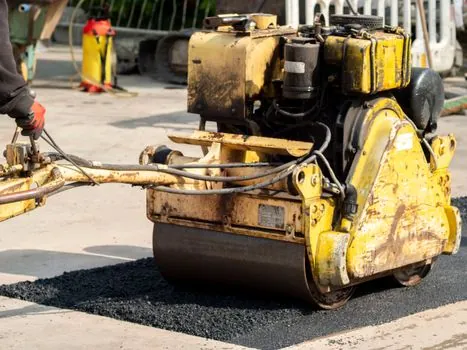
Maintaining cutting equipment and rotating elements is essential because wear can unbalance the assembly, while reducing operating time lowers daily A(8) exposure [S2]. A practical inspection should check blade damage, arbor condition, guard alignment, handle fasteners, and abnormal noise.
Operators should start each cut without the blade engaged, maintain full machine control during entry, and stop if vibration rises sharply. Cutting depth per pass should remain within the machine's rated capability, and a cutting machine should never be judged solely by maximum horsepower.
Training matters because the average vibration in a breaker-operator training example was about 9 m/s², reaching the exposure action value after approximately 35 minutes of trigger time [S7]. A task plan should therefore state trigger duration, cut length, pause frequency, and the method for rotating operators when exposure approaches the action level.
What Procurement and Site Teams Should Verify
Require three documents before accepting a concrete groove cutter: the manufacturer's declared hand-arm vibration value, the applicable test and operating conditions, and the maintenance schedule for diamond blades, spindle components, guards, and handles [S2].
For a concrete cut, verify blade diameter, arbor diameter, permitted depth per pass, and the machine's rated power before trial.
On site, record the machine serial number, blade condition, cut depth, operator, and vibration-related complaints. Replace the blade when wear indicators appear, not when the operator has already lost confidence in the cut. The resulting maintenance record provides more value than a generic promise of a comfortable handle because it connects tool condition, exposure, and productivity to traceable data.
The next trackable signal is the gap between declared A(8) and site exposure, together with drilling or cutting time per metre; if vibration rises while cut time falls, suspect binding, imbalance, or incorrect blade selection before increasing operator hours.