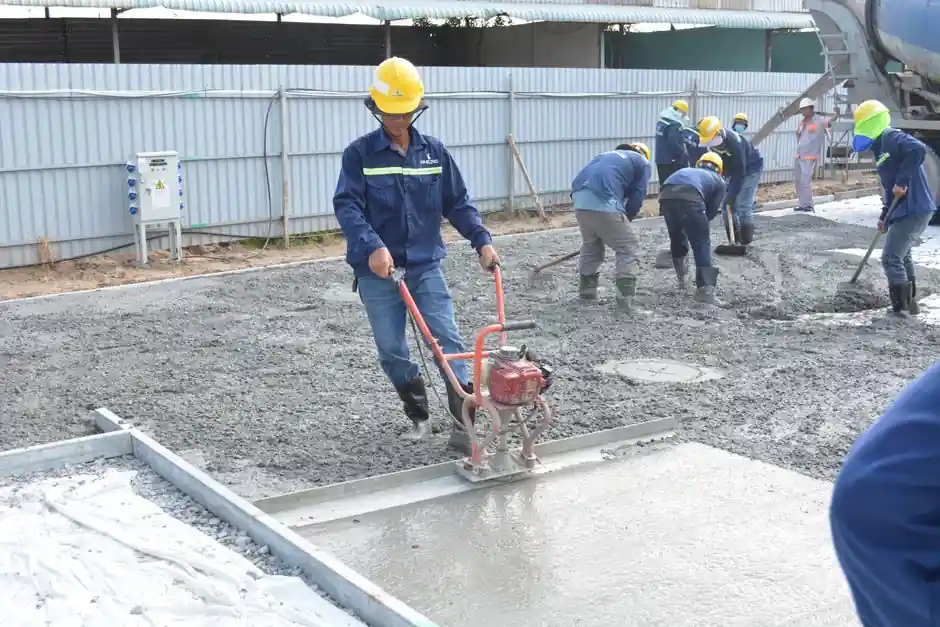
A concrete pump truck minimum charge commonly ranges from $400 to $1,500 in 2026, depending on pump type, while some operators charge $15–$40 per cubic yard pumped [S1][S5].
The price covers an operated pumping service rather than bare equipment: 2026 Florida rates are $150–$250 per hour for a line pump and $200–$300+ per hour for a boom pump, with typical minimums covering the first 2–4 hours [S1].
Minimum Charges and Volume Pricing
A minimum charge is the controlling price for small pours because mobilization, setup, pipeline or boom deployment, and cleanup must be paid even if the pump handles only a few cubic yards [S1]. Florida operators describe those minimums as typically covering the first 2–4 hours, with small jobs under 20 cubic yards commonly landing at $600–$1,000 [S1]. The broader 2026 equipment table places line-pump and trailer-pump minimums at $400–$600, boom-pump minimums at $800–$1,000, and specialty-pump minimums at $1,000–$1,500 [S5].
Per-cubic-yard pricing behaves differently. Published Florida guidance gives $15–$40 per cubic yard pumped, with lower unit rates becoming possible on large-volume pours [S1]. One 2026 quote structure combines $225 per hour with $4.00 per cubic yard, a four-hour minimum, and a separate $40 primer charge [S2]. Since 1 cubic yard equals 0.7646 cubic metres, a quoted $15–$40 per cubic yard converts to approximately $19.62–$52.32 per cubic metre before applying any minimum charge.
Line Pump Versus Boom Pump Pricing
For straightforward ground-level work below about 100 cubic yards, a line pump is usually the lowest-cost option because its smaller equipment and simpler deployment cost less than a truck-mounted boom [S1]. Its published Florida hourly range is $150–$250, and its 2026 minimum charge is $400–$600 [S1][S5]. The equipment reference for a concrete pump truck should therefore include both the daily call rate and the minimum duration.
A boom pump costs more because its articulated boom reaches over walls, fences, houses, and elevated work while reducing pipeline repositioning [S1][S2]. Its Florida rate is $200–$300+ per hour, while the wider 2026 range is $120–$300 across pump categories [S1][S5]. The Atlanta rental comparison is $650–$1,150 per shift for a line pump with operator and $1,050–$1,950 per shift for a boom pump with operator [S2].
How Volume Changes the Effective Rate

Small pours carry the highest effective unit price because the minimum is divided across very little concrete. The 2026 size breakdown places 1–5 cubic-yard pours at $80–$120 per cubic yard, or roughly $104.64–$156.94 per cubic metre, while pours above 30 cubic yards fall to $40–$70 per cubic yard, or approximately $52.31–$91.54 per cubic metre [S5].
Mid-size work occupies the middle band. Pours of 6–15 cubic yards are listed at $60–$100 per cubic yard, and pours of 16–30 cubic yards at $50–$80 per cubic yard [S5]. Those figures convert to $78.47–$130.79 and $65.40–$104.64 per cubic metre respectively. A published Florida range for a 40-cubic-yard driveway pour is $800–$1,500, while an 80–150-cubic-yard foundation or house slab ranges from $1,200–$2,500 [S1].
The concrete mixer truck supplying the concrete is separate from the pumping service. The buyer must reconcile delivered volume, pump minimum, pumping time, and any per-cubic-yard charge rather than treating the mixer price as a complete placement cost.
Cost Drivers Beyond the Minimum
Reach and site access determine whether a line pump is technically suitable. Atlanta guidance notes that dragging 200–400 feet of line repeatedly can make the lower base rate more expensive after standby and re-handling labor are included [S2]. Longer lines also affect pumping time and labor. The general equipment reference for a truck-mounted concrete pump distinguishes pumping capacity, boom reach, and the site envelope needed to deploy the outriggers and position the truck.
Other billable drivers include travel, standby, after-hours work, extra hose, primer, setup, and cleanup [S2][S5]. A $40 per-bag primer charge appears in one 2026 boom-pump example, while primer and cleanup were separate $50 and $175 entries in an older pumped-placement comparison [S2][S4 (2019-01)]. Concrete placement rate also matters: a boom pump can move more than 100 cubic yards per hour, so labor savings can offset its higher base rate on a large commercial pour [S1].
Total cost of ownership for a contractor buying equipment instead of hiring an operated pump is driven by purchase price, financing, operating cost, utilization, and the volume needed to spread fixed costs. A South African buying analysis frames the break-even volume around the number of cubic metres needed to justify owning a mobile concrete pump truck, but the quoted data do not support importing its commercial conclusion directly into North American pricing [S6].
Choosing the Correct Pumping Basis

Use an hourly-plus-yardage model when placement time is uncertain, because a line pump or boom pump can be charged for the operator, equipment, wear, consumables, and travel. A fixed-price daily call is easier to compare for a planned slab pour, but the quote must state the included hours, yardage limit, and standby treatment. The Atlanta planning bands include $3,000–$5,500 per week for an operated line pump and $5,000–$9,000 per week for an operated boom pump [S2].
Boom pumps are the defensible choice for multi-story decks, restricted access, and long-reach placements; line pumps suit driveways, slabs on grade, footings, and other work with practical truck staging [S1][S5]. Specialty pumps carry $250–$300 hourly rates and $1,000–$1,500 minimums, making them suitable for high-strength or custom mixes rather than routine flatwork [S5].
For a comparable quote, request the pump type, minimum charge, included duration, hourly rate, cubic-yard or cubic-metre rate, primer charge, travel terms, and expected output. Then compare the expected total against the installed cost of moving 1 cubic yard, which is 0.7646 cubic metres, and track whether the quoted minimum or the volume-based rate governs the final invoice [S1][S2][S5].