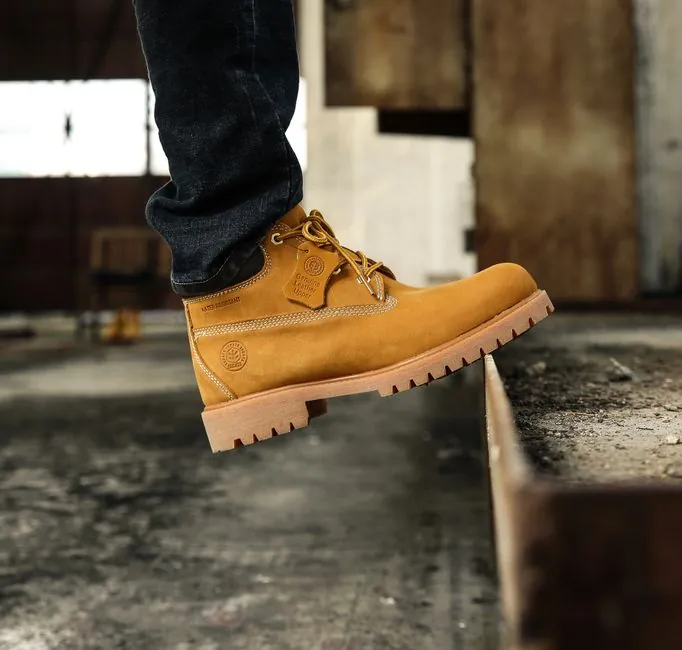
Safety shoes for permit-required confined spaces must satisfy an impact and compression rating of I-75/C-75 (75 ft-lbf / 2500 lbf) under ASTM F2413, or the equivalent S1P/S3 class under EN ISO 20345:2022, and must also pass the SD-100 static dissipative or conductive test when flammable vapors are credible [S5][S7].
OSHA 29 CFR 1910.146 defines a permit-required confined space as large enough for bodily entry, with limited egress, and not designed for continuous occupancy, which covers vessels, tanks, silos, vaults, pits, and hoppers [S1]. Footwear selection inside that rule is driven by the entry permit's hazard inventory, not by a generic catalog SKU.
Start With the Permit, Not the Boot
OSHA 1910.146(c)(4) requires the employer to identify and evaluate all hazards before entry, and 1910.146(d)(3) lists personal protective equipment among the items an entry permit must specify [S1]. The City of Dubuque confined-space program codifies that as: "Safety shoes are required for all Confined Space entries. Safety shoes must meet ANSI requirements," with additional foot protection layered in by space [S9].
UC Irvine's EHS confined-space page lists the same baseline, with "safety glasses/goggles, closed-toed shoes, gloves, proper work clothes (no shorts)" as the minimum PPE set, and adds harness, tripod, hard hat, and respirator when the pre-entry assessment warrants it [S4]. The shoe, in other words, is one of the variables written into the permit, not a generic issue item.
Toe Cap, Midsole, Outsole: The Three Spec Lines That Actually Matter
For most permit spaces, three protective layers must be verified on the boot's data sheet, not inferred from its appearance. The toe cap carries the impact/compression rating (ASTM F2413 I/75 C/75 minimum, or EN ISO 20345:2022 SB through S5), the midsole carries penetration resistance (P or PS plates, tested against 4.5 mm steel nails at 1100 N for the metallic version), and the outsole carries slip resistance and chemical resistance (SR plus FO fuel/oil, or HRO contact-heat 300 C/60 s where hot surfaces are present) [S5][S6][S7].
Confined-space entries add a fourth line item: a Scuff Cap (SC) over the toe for environments where workers kneel, crawl, or work with the boot braced against the structure, since the toe-cap finish takes disproportionate abrasion in those postures [S5]. Hazwoper guidance is consistent: steel-toe caps suit heavy impact, composite-toe caps (carbon fiber, kevlar) suit cold climates and electrical work because they are non-metallic and non-conductive, and metatarsal guards extend protection over the upper foot for mining, warehouses, and heavy manufacturing [S3].
EN ISO 20345:2022 vs. ASTM F2413-17: The Crosswalk Buyers Use

European buyers default to EN ISO 20345:2022 classes S1 through S5; North American buyers default to ASTM F2413-17 with the I-75/C-75 impact/compression mark plus optional Mt-75 metatarsal and Cd-1000 conductive ratings [S5][S7]. Both frameworks require the same three protection layers (toe, penetration, slip), and both treat chemical-resistant and fuel-resistant outsoles (FO or CR) as additive classifications layered on top of the safety class.
For a permit-required confined space the practical crosswalk reads: S1P with SR+FO and SC maps to ASTM F2413 I-75/C-75 with puncture-resistant midsole, slip-resistant outsole, and scuff toe; S3S with SR+FO+WR+SC maps to F2413 I-75/C-75 with puncture resistance, water-resistant upper, and a marked scuff cap [S5]. The codes are not identical (EN ISO 20345:2022 uses "S" suffix, ASTM F2413-17 uses a single letter per hazard), so the permit reviewer should be told which framework the boot is certified to, not just the model name.
Slip, Chemical, and Electrical: The Three Often-Skipped Hazards
Confined spaces are routinely wet, oily, or both, so slip resistance (EN ISO 20345:2022 SR, superseding the older SRA/SRB/SRC triad) is the first non-toe specification buyers should write into the permit. The second is fuel/oil resistance (FO), which protects the outsole from swelling and losing grip after a shift in hydrocarbons [S5]. The third is electrical behavior: SD-100 static dissipative (1×10^6 to 1×10^8 ohm) for environments where static spark could ignite a vapor, or CD-1000 conductive (< 1×10^5 ohm) for explosive atmospheres, per ASTM F2413-17 [S7].
A wet permit-required space (sewer, stormwater vault, clarifier) adds water resistance (EN ISO 20345:2022 WR) and often chemical-resistant uppers, since the same boot will see diluted acids, fuels, and biological fluids across a shift. Hazwoper's application guide for waterproof and insulated boots applies most directly to outdoor utility and wastewater entries, where trench foot and frostbite are credible outcomes if the upper wets through [S3].
Sizing, Fit, and Crawl-Posture Comfort
SPI's fit guidance is unusual in stating the fit envelope numerically: choose boots 15 to 21 cm high, try them on at midday when the foot is most swollen, and confirm roughly 1 cm of space beyond the longest toe, with the heel locked and no slip on lift [S2]. For confined-space work the ankle-height rule matters more than for general construction because a low-cut shoe admits slurry and debris from above when the worker kneels or crawls, while an over-the-ankle boot keeps the lace line above most splash zones.
A 21 cm pull-on is often wrong for vessel interiors with vertical hatches: the boot rim can catch on the nozzle. Lace-up boots in the 15 to 18 cm range with a snug ankle lock and a defined heel seat are the usual working solution. Composite-toe construction drops roughly 200 to 400 g per boot versus steel, which compounds over a shift when the entrant is climbing through a 600 mm manway, a real consideration for respiratory SCBA-loaded entries where the worker is already carrying 8 to 12 kg of harness and bottle [S3].
Inspection, Replacement, and Permit-Writeable Criteria
ASTM F2413-17 compliant boots carry a permanent mark on the boot (manufacturer, certification date, and the protection codes) that an entry supervisor can verify in 10 seconds against the permit. Boots with cracked outsoles, exposed midsole, separated toe-cap bond, or failed slip tests should be tagged out of service, because a wet steel deck in a vessel is unforgiving of even partial outsole wear. For high-turnover programs, write the replacement trigger into the permit: "replace when outsole tread depth falls below X mm or when chemical attack is visible," rather than leaving it to the wearer's discretion. [S2]
The "X mm" is application-specific; cite the boot maker's own replacement tread-depth value (often 3 to 4 mm for safety footwear) rather than an invented number, and document it in the written confined-space program alongside the other 1910.146(d)(3) PPE items [S1][S9]. A second trackable signal for safety managers: the next entry permit review should cross-reference the boot specification against the space's gas test results, since a flammable-vapor reading above 10% LEL on a four-gas monitor should immediately move the boot specification from SD to CD, regardless of what the original permit said.
Spec-level background on the components involved: safety shoes, fire safety, and machine safety.
Background reading: Dust Detector Selection for Laboratories: Spec Lines, Sensor Types, and Compliance.