
Selecting respiratory protection for laboratories is driven by a documented hazard assessment, the OSHA-assigned protection factor (APF) for the chosen respirator class, and the chemistry of the cartridge or filter, rather than a default disposable N95.
NIOSH classifies all workplace respirators into two families, air-purifying respirators (APRs) and atmosphere-supplying respirators (ASRs), and approves five specific configurations within them for protection against chemical, biological, radiological, and nuclear agents [S1]. OSHA 29 CFR 1910.134 requires employers to select NIOSH-certified devices from those families, match them to quantified exposure data, and operate them inside a written respiratory protection program with fit testing and medical evaluation [S1][S2].
Hazard Assessment Comes First: Contaminant Form and IDLH Drive the Respirator Class
Selection must start with the physical state of the hazard, particulate versus gas or vapor, because filters address particulates while cartridges address gases and vapors, and combination cartridges are required when both classes coexist in the same workspace [S3]. For laboratory work the contaminant inventory typically spans organic solvent vapors, acid mists, formaldehyde, biological aerosols, and powders, so a single cartridge type rarely covers the full chemical list. Identified Immediately Dangerous to Life or Health (IDLH) atmospheres force the specification to an ASR (supplied-air or self-contained breathing apparatus), because APRs cannot be used in oxygen-deficient or unknown atmospheres [S1][S6]. Continuous-flow supplied-air respirators and SCBAs are the two ASR architectures most often specified in academic and research chemistry environments when an IDLH is possible.
Once the hazard is characterized, the assigned protection factor (APF) from OSHA Table 1 of 29 CFR 1910.134 becomes the selection math: the measured or modeled airborne concentration is divided by the APF, and the resulting ratio must remain below the occupational exposure limit (OEL) for the contaminant. Half-face elastomeric APRs carry an APF of 10, full-face elastomeric APRs 50, PAPRs without hoods 25, PAPRs with hoods 1,000, continuous-flow supplied-air 1,000, pressure-demand SCBA 10,000 [S2]. That single number often pushes a chemist off an N95 (APF 10) onto a full-face or PAPR once solvent vapor breakthrough is added to particulates.
APR Sub-types and Where Each Fits in Lab Work
Within APRs, NIOSH recognizes four sub-families that labs actually purchase: filtering facepieces (the disposable FFRs, including N95, N99, P100, R95 series), elastomeric quarter-face, elastomeric half-face, and elastomeric full-face respirators, plus powered air-purifying respirators (PAPRs) [S1]. For nuisance dust and biological sample handling a N95 FFR is the typical minimum; for solvent-heavy benches an elastomeric half-face with combination P100 plus organic vapor cartridge is the workhorse. Elastomeric full-face respirators add eye protection against splash and increase APF to 50, a useful step when acid mists are present.
Powered air-purifying respirators (PAPRs) move air through a filter/cartridge by a battery-powered blower, lowering breathing resistance and providing a cooling effect during long hood work. PAPRs are specified for bearded users who cannot pass a tight-fit qualitative or quantitative fit test, because loose-fitting PAPR hoods do not require face-seal leakage testing, although their APF drops to 25 without a hood or 1,000 with a hood [S2]. Selection criteria published by OSHA list the 42 CFR Part 84 (commonly called "N-prefix") series, with P100 high-efficiency filters capturing a minimum 99.97% of airborne particulates, as the laboratory default when both particulates and oil aerosols may occur (the P rating is oil-resistant; R is somewhat oil-resistant; N is not oil-resistant) [S2][S3].
Cartridge Chemistry: Matching the Contaminant, Not the Brand</h3
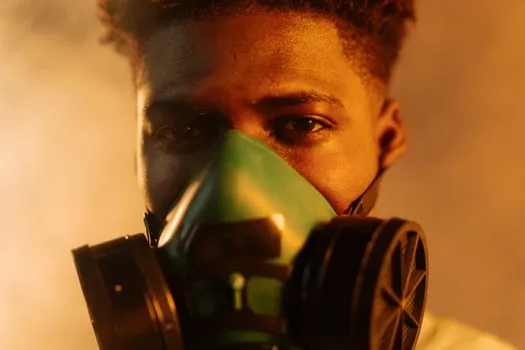
For gas and vapor hazards, cartridge selection is driven by NIOSH-approved color codes and the contaminant chemistry, with the most common laboratory pairings being black organic vapor (OV) for solvents, white acid gas for mineral acids, green ammonia, and yellow OV plus acid gas for mixed benches. Mercury vapor requires a specific mercury vapor cartridge (orange, often paired with a P100 prefilter) and a maximum use time limit typically capped at 50 hours cumulative or one workweek, whichever is shorter, per NIOSH approval limitations. [S1]
Formaldehyde is a textbook trap: standard OV cartridges do not adequately adsorb formaldehyde, so a formaldehyde-specific cartridge (often labeled "formaldehyde/organic vapor") is required for histology, anatomy, and pathology labs. For laboratories using glutaraldehyde, the same formaldehyde-rated cartridge is the conservative choice. Combination cartridges (P100 plus OV, P100 plus acid gas) are routinely specified in undergraduate organic teaching labs where a spill could generate a transient organic vapor cloud above the OEL, an approach that OSHA and lab EHS programs treat as defensible for routine, low-volume operations but never as a substitute for the engineering control of a functioning chemical hood.
ASRs, IDLH, and Oxygen-Deficient Atmospheres
Atmosphere-supplying respirators are mandatory in IDLH conditions and are built around a clean air source rather than air cleaning. NIOSH groups ASRs into supplied-air respirators (SARs), self-contained breathing apparatus (SCBA) in open-circuit and closed-circuit variants, and combination SAR/SCBA units; closed-circuit SCBAs are the devices used in mining escape, while open-circuit SCBAs dominate fire service and HAZMAT entry [S1]. A SAR can be configured as continuous-flow (APF 1,000), demand (APF 10), or pressure-demand (APF 50); pressure-demand SARs are the minimum suitable for IDLH when paired with an escape SCBA.
SCBAs carry an APF of 10,000 in pressure-demand mode and impose a service life of 30 to 60 minutes per cylinder at heavy work rates, an operational constraint that drives lab emergency planning. A working lab respirator program generally uses SCBAs only for short-duration entries, such as a confined-space rescue of a co-worker from a cryogenic dewar or an inert-gas-purged glovebox, and relies on SAR hose lines plus posted escape SCBAs for routine cylinder changeout work.
Fit Testing, Medical Evaluation, and the Written Program

Selection is not complete once the device is named. OSHA 29 CFR 1910.134 requires qualitative fit testing (QLFT) for half-face APRs using saccharin, isoamyl acetate, or Bitrex challenge aerosols, or quantitative fit testing (QNFT) using a PortaCount or similar instrument that reports a fit factor (FF) of at least 100 for half-face and 500 for full-face tight-fitting respirators, before the user wears the device in a hazardous atmosphere [S1][S2]. The OSHA respirator medical evaluation questionnaire (Appendix C of 1910.134) is a required pre-screen, and a physician or other licensed health-care professional must sign off before fit testing.
Ongoing program elements include annual fit testing, periodic cartridge change-out scheduling driven by either manufacturer service life data or an objective breakthrough indicator, and recordkeeping of training, fit test results, and medical clearances. For PAPR users who cannot be quantitatively fit tested because they are bearded or have facial scarring, the program must document that the chosen PAPR is a loose-fitting hood model and that the hood has been correctly sized. Recent lab-program guidance re-emphasizes that "selection procedures must match cartridge/canister chemistry and assigned protection factor to the specific chemical hazard, not a generic hierarchy," a useful guardrail for EHS managers [S7].
Selection Criteria Comparison: Lab Respirator Options Side by Side
Comparing the four most commonly specified lab configurations against three decision criteria clarifies the trade-offs. Filtering facepiece respirators (e.g. N95 / P100) deliver APF 10, cost typically under US$2 per unit, and are appropriate only for particulate hazards with no gas or vapor component. Elastomeric half-face APRs with combination cartridges raise APF to 10, cost US$15-40 for the reusable facepiece plus US$5-15 per cartridge pair, and cover both particulates and gases. Elastomeric full-face APRs add eye protection and raise APF to 50 at US$30-80 for the facepiece, the most common step when splash and vapor coexist. PAPRs with hoods reach APF 1,000 at US$500-1,500 for the belt-mounted blower plus US$30-100 per hood, and are the practical ceiling for routine chemistry labs that do not face IDLH. [S4]
A second axis worth tracking: cleanroom and pharmaceutical labs often require sterile, individually packaged respirators with low particle shedding and 99.99% or better filtration, while chemistry and analytical labs prioritize solvent resistance. Procurement should keep the model, lot number, and NIOSH approval number (TC-84A-xxxx) on file for every issued unit, because counterfeit or expired respirators remain a documented failure mode across the industry [S1][S3].
Where Standard Respirator Selection Falls Short in the Lab
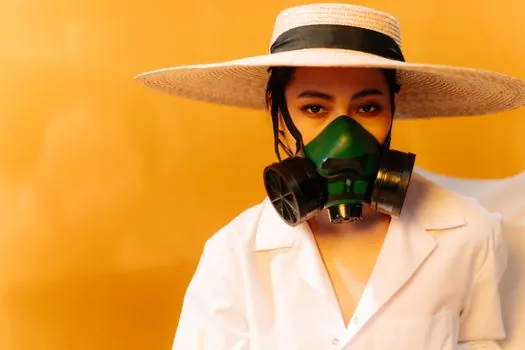
Three failure patterns recur in lab respiratory protection programs. First, N95 FFRs are routinely over-specified as a universal default even when solvent vapor is present, which 3M and OSHA both flag as inadequate, because the N95 only filters particulates, not gases or vapors [S3]. Second, organic vapor cartridges are routinely under-specified where formaldehyde or mercury is present, because standard OV chemistry does not capture either compound at a useful service life, requiring dedicated cartridges with shorter, documented change-out schedules. Third, the bearded-user population in research labs often defaults to PAPRs without checking that the chosen unit is the loose-fitting hood variant; tight-fitting PAPR facepieces still require fit testing and an APF downgrade to 25.
A practical selection checklist that closes most of these gaps: (1) list every chemical, physical state, and approximate air concentration; (2) identify any IDLH or oxygen-deficient possibility that forces an ASR; (3) compute required APF as (concentration / OEL) with a safety margin; (4) match the cartridge color code and chemistry to each contaminant family; (5) confirm fit-test pass for tight-fitting models, and select a loose-fitting PAPR hood for users who cannot pass; (6) document change-out schedule and program training [S1][S2][S7].
Standards, Approvals, and Lab-Specific Compliance Anchors
The U.S. compliance backbone is OSHA 29 CFR 1910.134 (Respiratory Protection), which references the NIOSH respirator approval program at 42 CFR Part 84 for the certification of all air-purifying and atmosphere-supplying devices used in U.S. workplaces [S1][S2]. NIOSH maintains the certified equipment list, and the TC-approval number on every NIOSH-approved respirator must be checked against that list at procurement. For laboratories working with biological agents, the CDC/NIH Biosafety in Microbiological and Biomedical Laboratories (BMBL) and the NIH Guidelines for Research Involving Recombinant or Synthetic Nucleic Acid Molecules govern the minimum respiratory protection for each biosafety level; BSL-3 work typically requires a PAPR with HEPA filtration, while BSL-4 requires a positive-pressure supplied-air suit [S1].
Academic EHS offices, such as the laboratory safety manuals at major research universities, treat NIOSH approval as the floor and add a written standard operating procedure, a cartridge change-out log, a fit-test record, and a medical clearance file for every enrolled user [S5]. When laboratories work with particulates that fall under OSHA's Respirable Crystalline Silica standard (29 CFR 1926.1153 for construction or general industry equivalents), the standard imposes additional medical surveillance and objective data on objective data exposure assessment that drive the respirator APF higher than the chemical-hazard math alone.
Procurement should treat any respirator without a visible NIOSH approval label and TC number as non-compliant, and should periodically audit issued stock for damaged valves, expired cartridges, and degraded elastomer. The intersection of respirator selection and broader lab safety architecture is detailed in our reference entry on the respirator classification and APF taxonomy, and complementary engineering controls that reduce dependence on respiratory PPE are reviewed in our pressure transmitter calibration for hazardous-area labs and gas detection controller selection for lab gas rooms guides.
Trackable signals to monitor over the next two quarters: NIOSH updates to the certified equipment list for elastomeric half-face and PAPR models, OSHA interpretations on laboratory-specific fit-testing waivers, and any new CDC/NIH BMBL guidance for emerging respiratory hazards. Standard respirator choice for routine lab work is not going to move; the program-level audit and cartridge chemistry decisions are where the action is.
Background reading: Dust Detector Selection for Laboratories: Spec Lines, Sensor Types, and Compliance.