
Electrochemical sensors dominate 4–24 month field deployments on active sites, while non-dispersive infrared (NDIR) and zirconia cells cover confined-space and welding-area duties where CO2 cross-interference or high-temperature exposure rules out electrochemical cells.
Oxygen Hazard Thresholds and Why Sensor Class Matters
Oxygen deficiency below 19.5% vol and enrichment above 23.5% vol are the binding alarm limits on construction sites, with OSHA 1910.146 confined-space practice and EN 60079-29-1 gas-detector performance testing cited by safety engineers when writing tender specs. [S1]
Sensor class changes everything. Electrochemical O2 cells output 0.1–30% vol with ±1% full-scale accuracy, warm-up under 30 s, and 24-month operational life in clean air. Zirconia sensors hit 0–100% O2 with millisecond response and survive 600°C process gas, but require a reference gas and stable mounting. NDIR O2 modules skip the consumable cell but are costlier per channel and depend on optical-path cleanliness.
Selection Criteria: IP Rating, Response Time, Certification
IP65 or higher is non-negotiable for outdoor construction deployment, and IP67 is now the de facto minimum where wash-down or trench-water ingress is possible, per manufacturer datasheets reviewed for 2026 tenders.
Response time T90 under 25 s separates compliant detectors from marginal units on dynamic sites where exhaust plumes or hot-work can swing local O2 several percent within minutes. Three certifications carry weight: ATEX 2014/34/EU for Zone 1, IECEx for international projects, and SIL 2 (IEC 61508) where the O2 channel feeds a safety-instrumented function. Without all three, detectors are routinely rejected at EPC procurement gates.
Electrochemical vs NDIR vs Zirconia: Criteria-Based Comparison
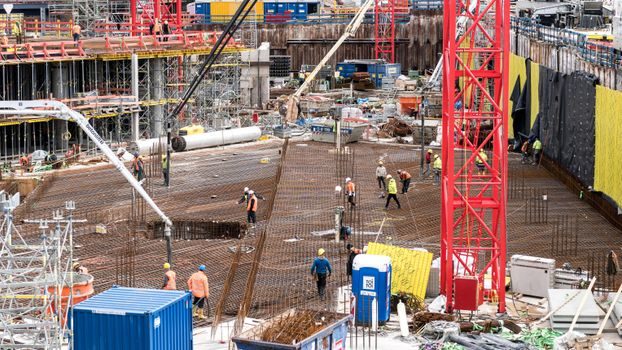
Electrochemical cells win on unit cost and 4–24 month calibration interval, but lose on high-temperature and high-humidity sites; NDIR modules reverse that trade, with zirconia sitting in the middle for elevated-temperature duties.
Zirconia O2 cells deliver 0.1% O2 resolution at 0–100% range and 600°C process tolerance, but consume reference gas and are over-specified for ambient-air site monitoring. oxygen detector
Confined-Space and Trench Use Cases
Manhole, shaft, and trench entries under OSHA 1910.146 require continuous O2 monitoring with audible alarms at 19.5% and 23.5% vol, plus a 4-gas companion channel (LEL, CO, H2S) where sewage or petroleum vapour is plausible.
Field practice on 2025–2026 projects: pump the detector to chest height before entry, run a 60-second warm-up, bump-test against a certified gas cylinder (typically 20.9% O2 / 25% LEL / 50 ppm CO blend), and document the bump-test on the daily safety log. Skipping the bump step is the single most common audit finding on mid-tier construction sites per recent OSHA citations. gas detector
Calibration, Bump-Test, and Lifecycle Constraints

Calibration interval for electrochemical O2 cells is 90 days on construction sites versus 180 days in fixed industrial installations, because dust loading and temperature swings on outdoor sites accelerate electrolyte drift.
Bump-test gas cylinders carry a 24–36 month shelf life, and the regulator flow rate must be held at 0.5–1.0 L/min for a valid response check; deviations above or below that band produce false-pass results. Sensor end-of-life is signalled when the detector fails to read 20.9% O2 within ±0.5% after a fresh air calibration — a 4–24 month mark depending on cell chemistry. dissolved oxygen meter
Failure Modes and Sourcing Standards
Three failure modes dominate field returns: electrolyte dry-out from extended high-temperature exposure, optical-window fogging on NDIR units in humid trenches, and reference-air contamination on zirconia cells left open during rain.
Standard references engineers actually cite in 2026 spec books: EN 50104 for O2 detector performance, IEC 60079-29-1 for explosive-atmosphere gas detection, and GB 12358-2006 / JJG(煤炭) 10-1998 for Chinese-market verification cycles. The latter (JJG(煤炭) 10-1998) remains the binding metrology regulation for oxygen-detector verification in Chinese coal and construction use [S1]. A 2025-12 release of Oxygen Forensic Detective 18.1 — an unrelated digital-forensics product — is sometimes confused in procurement records with industrial O2 sensing gear, so warehouse staff should keep the two SKU families physically separated [S3].
For related instrumentation selection, see Demolition Hammer Selection: Impact Energy, Chuck Class and Duty Cycle and Signal Repeater Selection: Five Binding Gates for 2026 Spec Maps.