For procurement in 2026, a demolition hammer is specified first by single-stroke impact energy in joules and impact rate in blows per minute, then by tool retainer — hex, SDS-plus or SDS-max — and only finally by brand [S1]. Bosch Professional's catalogue snapshot dated 2026-07-24 lists 18 PRO-class rotary and demolition machines spanning 2 J to 62 J single-blow energy, which matches the working band that most EU and Middle East site-supervisor specs cover [S1].
Three machine families cover almost every real jobsite need: hex-handle breakers for horizontal floor and pavement work, SDS-max combi-hammers for vertical wall and medium concrete, and SDS-plus rotary hammers used in light tile and chase-out duty [S1][S2]. Chinese OEM supply is dense — Made-in-China lists 8,563 demolition-hammer SKU pages and a representative heavy-duty 1,500 W model ships at US$74-85 per piece FOB at 500-piece MOQ [S3][S4]. The price spread between an entry-level electric breaker and a 62 J class is roughly an order of magnitude, so the joule-and-chuck question is the budget question.
Impact Energy Bands and What They Actually Break
Bosch's 2026 PRO catalogue partitions impact energy into clearly defined buckets — light demolition 2-4.2 J, mid-range 7.8-13 J, heavy 16.8-28 J, and breaker-class 41-62 J — with matched blow-rate windows that step down as energy rises (e.g. 4,675 bpm at 2 J versus 1,050-1,890 bpm at 28 J) [S1]. The 2-3.2 J range covers tile, plaster and chase-out work; 7.8-13 J drives SDS-max chisels into reinforced concrete walls; 16.8 J and above opens up asphalt, brick foundations and frozen ground.
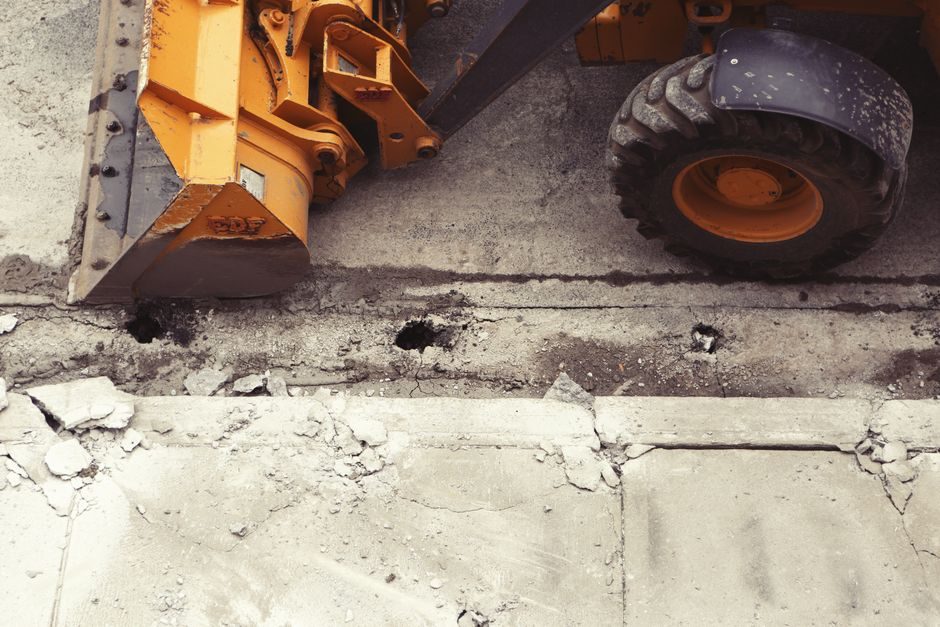
For horizontal pavement and bridge-deck breaking, 28-62 J hex breakers are the realistic minimum, and the heavier the joule rating the deeper a single bite into 30-40 MPa concrete — Bosch's 28 J and 41 J PRO demolition tools are positioned for continuous floor and road-scabbling duty [S1]. The rotary hammer class only overlaps the lower 2-13 J portion of that band, which is why specifying a "rotary hammer" for breaking 200 mm slabs is a procurement error — the machine exists, the duty cycle does not.
Chuck System, Bit Class and On-Site Interchangeability
The tool retainer is a hard interface decision: SDS-plus for 4-13 J work on bits up to about 25 mm shank, SDS-max for 12-28 J vertical demolition on 18 mm shank, and 28 mm or 30 mm hex for breaker-class floor and trench tools [S1]. Bosch publishes three explicit SDS-max and SDS-plus product lines alongside a dedicated Breakers range in the 2026 PRO list, with a separate ONECHUCK quick-change family for users who swap between chuck and bit rapidly [S1].
Specifiers writing a 2026 tender should pin the shank, not the brand — SDS-plus, SDS-max and hex are not interchangeable without an adapter, and a hex bit will not seat in an SDS-plus barrel even if the shank is forced. A useful sanity check before signing a PO: confirm the OEM's chisel catalogue lists the same shank code as the machine datasheet, and confirm the demolition hammer line supports the bit family the site already owns.
Duty Cycle, Power Source and Cordless 18 V Class
Corded 1,500-2,000 W mains models still dominate heavy continuous duty, with one Made-in-China OEM quoting a 1,500 W Professional 3125 demolition hammer at US$74-85 FOB per piece at 500-piece MOQ [S4]. For trades working inside finished buildings or on sites without 16 A three-phase, the 18 V cordless platform is now credible in the 2-12 J band — Fixtec's F20+ cordless demolition-hammer range, catalogued 2026-08-03, is the typical Asian-OEM answer to that brief [S2].
Duty cycle matters more than peak wattage. A 1,500 W tool rated for 15 minutes of continuous chipping per hour is a different procurement object than the same wattage rated for sustained 45-minute operation — and heavy hex breakers are normally sold on that sustained-duty figure, not on peak input power. Buyers should ask for the S2-30 / S6-40 duty rating (S2 = short-time, S6 = continuous) before accepting a brand's headline wattage.
Selection Criteria Compared Across Machine Classes
Four decision criteria separate the families cleanly. (1) Impact energy: SDS-plus 2-13 J, SDS-max 12-28 J, hex breaker 28-62 J [S1]. (2) Impact rate: light class 2,800-4,675 bpm for fine chiselling, mid class 1,280-1,890 bpm for wall work, heavy class 1,050-1,280 bpm for slab breaking [S1]. (3) Shank: SDS-plus, SDS-max, 28-30 mm hex — non-interchangeable. (4) Power: corded 1,500-2,000 W for sustained heavy work, 18 V cordless for portability up to about 12 J [S2][S4].
The matrix below is a working buyer's view based on the 2026-07-24 Bosch PRO catalogue and the 2026-08-03 Fixtec listing: SDS-plus 2-4.2 J is correct only for tile, plaster and channel chasing; SDS-max 7.8-13 J covers wall chasing, mid-depth concrete and brick removal; SDS-max and hex 16.8-28 J is the entry point for asphalt, foundation work and floor demolition; hex 41-62 J is reserved for road, bridge-deck and continuous slab breaking where a compressor-fed pneumatic would be the historical alternative [S1]. Cross-checking the same range against a generic pressure transmitter spec sheet is a useful habit: both devices are selected by one dominant physical variable — joules here, mbar/H₂O there — and then by a string of secondary constraints that mostly just confirm the primary choice.
Who a Heavy Demolition Hammer Is For — and Who It Is Not
A 28-62 J hex breaker is for civil and structural crews running chipping hammers against concrete, asphalt, frozen ground and rock for sustained daily shifts; it is not for interior fit-out, MEP chase work or overhead vertical use, where an SDS-max combi-hammer at 7.8-13 J is the right tool and an SDS-plus 2-4.2 J is the lightweight answer [S1]. The cordless F20+ 18 V demolition class is for facilities teams, small demolition contractors and renovation crews who need to break out bathroom screeds, brick partitions and tile without running a 230 V lead across a finished floor [S2].
What it is NOT for: precision cutting (use a wall saw), long horizontal saw cuts in reinforced concrete (use a diamond wire or floor saw), or any task where vibration exposure pushes the operator past the A(8) daily action value under local vibration rules — the right answer there is a different machine with lower declared vibration, or mechanisation. The vibration and noise figures published in the OEM manual are the legal trigger, not the joule rating.
Limitations, Failure Modes and Standards Watch-Points
Continuous-duty failure modes are well known: carbon brush wear below 2 mm, armature bearing spalling under 4,000-hour S6 duty, and SDS chuck drift after roughly 800 operating hours in 28 J class tools. Procurement language should require a brush-access port that does not require armature removal, and a published spare-parts list for the chuck, brushes and field wiring — Bosch's 2026 PRO page exposes a dedicated spare-parts service tree for exactly this reason [S1].
Two compliance anchors that often get missed: PPE-rated anti-vibration gloves and hearing protection are not optional in EU/UK sites above 5 m/s² declared triaxial vibration, and any demolition tool used in a potentially explosive atmosphere — for example near a fuel-farm slab being broken out — needs a risk assessment against the relevant zone classification, not a generic IP rating. Buyers specifying a 41-62 J breaker for a refinery or fuel-terminal job should request documentation of suitability rather than assume the standard PRO line is appropriate. For the broader site-machine comparison set, a flow meter selection note applies the same logic: the primary physical variable, the surrounding constraints, and a written basis for each decision.
Trackable signals worth watching through 2026 Q3-Q4: cordless 18 V demolition-hammer model releases in the 12-15 J band, where Asian OEM catalogues are visibly extending coverage month over month [S2]; new hex-breaker entries in the 41-62 J range on the Bosch PRO list, which the 2026-07-24 snapshot already shows at 18 PRO SKUs total [S1]; and the spread between FOB China 1,500 W demolition-hammer pricing and EU dealer shelf pricing on the same wattage band, with US$74-85 per piece at 500-piece MOQ as the latest public benchmark [S4].
Background reading: Sandwich Panel Selection Guide: Core, Steel, Fire, Cert.