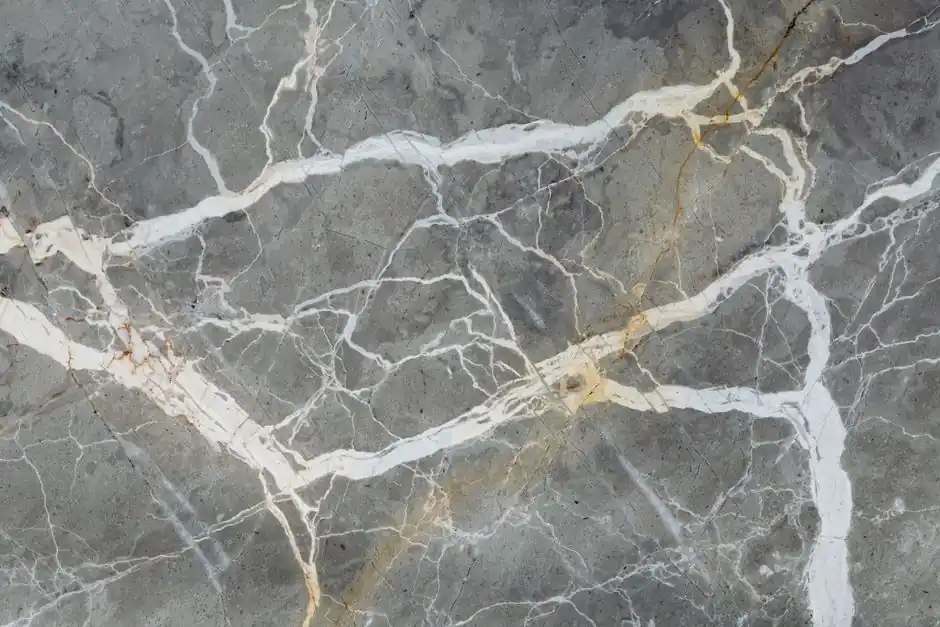
Vein-cut stone is sawn parallel to natural veins or bedding, producing long linear bands; cross-cut stone is sawn across those layers, producing cloud-like, mottled, or floral patterns [S1][S2].
The choice is an orientation decision for the same stone block, not a change in mineral composition: travertine, marble, limestone, onyx, and some quartzite or sandstone can express distinctly different faces depending on cut direction [S1][S2].
Cut Direction and Vein Pattern
Vein-cut, also called longitudinal or along-the-vein cutting, follows the stone’s sedimentary layers and exposes them as elongated striations, parallel lines, and directional movement [S2][S3]. This face generally reads as ordered and architectural, and the pattern can reinforce a wall’s horizontal axis or a floor’s direction of travel [S3][S5].
Cross-cut, also called transverse cutting, intersects the stone's layers and produces a more cloud-like, organic appearance [S1][S2][S3]. Cross-cut faces generally place more emphasis on texture and depth than on a single directional line [S4].
Terminology is not completely uniform across the stone supply chain, so the cut direction must be confirmed against the actual block, slab, tile, finish, and sample rather than inferred from a trade label alone [S1][S3].
Selection Criteria by Material
Travertine is the clearest comparison because its sedimentary structure is pronounced and its pores can appear differently according to cut orientation. Vein-cut travertine reveals elongated, linear lines, while cross-cut travertine displays a softer, cloud-like pattern [S2][S3].
Marble also changes character without changing its geological identity. Vein-cut marble emphasizes linear movement and continuity, making it suitable for corridors, large wall panels, and expansive floors; cross-cut marble emphasizes layered, organic variation for surfaces needing a softer and more expressive appearance [S4]. Some cross-cut marble and quartzite can expose foliation or metamorphic lineation, while vein-cut sedimentary stones such as travertine, limestone, sandstone, dolomite, and onyx display their layering more directly [S1].
Granite and other comparatively homogeneous stones are generally not classified by this distinction because they do not exhibit a pronounced vein or bedding plane suitable for the comparison [S2].
Pattern, Scale, and Application
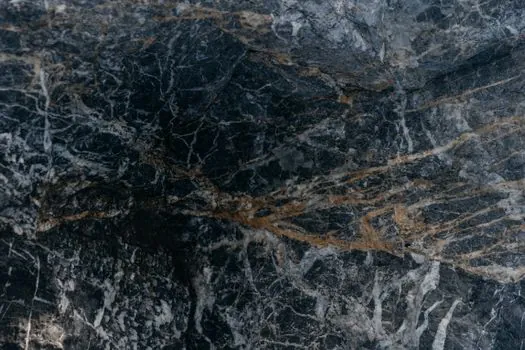
Cross-cut stones have a more uniform appearance while displaying organic patterning that provides visual movement [S1]. Its cloud-like movement can remain visible across large areas without imposing one dominant direction [S1][S2].
Vein-cut travertine has a linear, directional pattern that follows the stone's natural sedimentary layers and creates a sense of structure, order, and architectural clarity in modern, minimalist, and contemporary design projects [S3].
Fabrication and Performance Considerations
Cross-cutting can expose formation cavities and pores that become more visible in the finished surface, particularly in porous sedimentary stone [S5]. It can also require more filling, honing, or surface preparation depending on the grade, pore distribution, finish, and intended contact condition; actual slab samples must establish suitability rather than cut label alone [S1][S3].
That observation is not a universal strength rating, so project specifications should require approval of the actual slab layout, edge conditions, cutouts, and finish rather than inferring performance from orientation.
For a broader technical review of building stone, evaluate finish, thickness, movement, anchorage, drainage, and intended location together with the cut direction. Pattern selection determines appearance, but it does not replace slab-by-slab fabrication review or the project’s structural and installation requirements.
Comparative Decision Matrix
On pattern character, vein-cut stone rates highest for continuous linear bands and directional flow, while cross-cut stone rates highest for cloudy, mottled, floral, or ring-like variation [S1][S2]. On spatial application, vein-cut is stronger for long corridors, large wall panels, façade grids, and floors requiring alignment; cross-cut is stronger for countertops, vanities, shower installations, and feature walls seeking a softer or less directional field [S1][S3][S4].
Cross-cutting can expose pores and cavities, so filling or finishing review may be needed [S6]. On visual scale, vein-cut benefits from large-format installation to preserve continuous movement, whereas cross-cut can disguise seams and distribute variation across a field [S1][S3].
Use vein-cut when the drawing depends on repeated horizontal or vertical direction, book-matching, symmetry, or a strong graphic pattern. Use cross-cut when the drawing depends on soft variation, cloud-like movement, visual continuity across irregular pieces, or coordination with other materials. Do not choose by pattern alone: compare physical samples, finish, grade, dimensions, and installation method for the selected stone [S3].
Approval and Procurement Controls
Specify the orientation, product type, finish, thickness, fabrication method, and application together rather than writing only “vein cut” or “cross cut.” Require the supplier to identify how the finished face was produced, and approve full-size or project-specific samples where natural variation could affect the intended rhythm [S1][S3].
For travertine, distinguish filled and unfilled pore requirements at procurement because pore presentation is part of the finish and visual decision, not merely a technical note [S6]. For marble, confirm the selected face against the actual block because the same stone can shift from restrained and architectural to organic and layered solely through orientation [S4].
Stone cost and fabrication planning should also account for cut orientation, thickness, and finish rather than pricing every face as an equivalent [S1]. For projects where abrasion resistance governs a busy lobby, use the separate decision framework in Set Stone Abrasion Resistance for Busy Lobbies.
A traceable specification record should include the stone variety, quarry or supplier reference, cut direction, finish, thickness, dimensions, pore treatment for travertine, approved sample, and intended installation orientation. The next verifiable checkpoint is fabrication review of the actual slabs against that record before cuts are released.