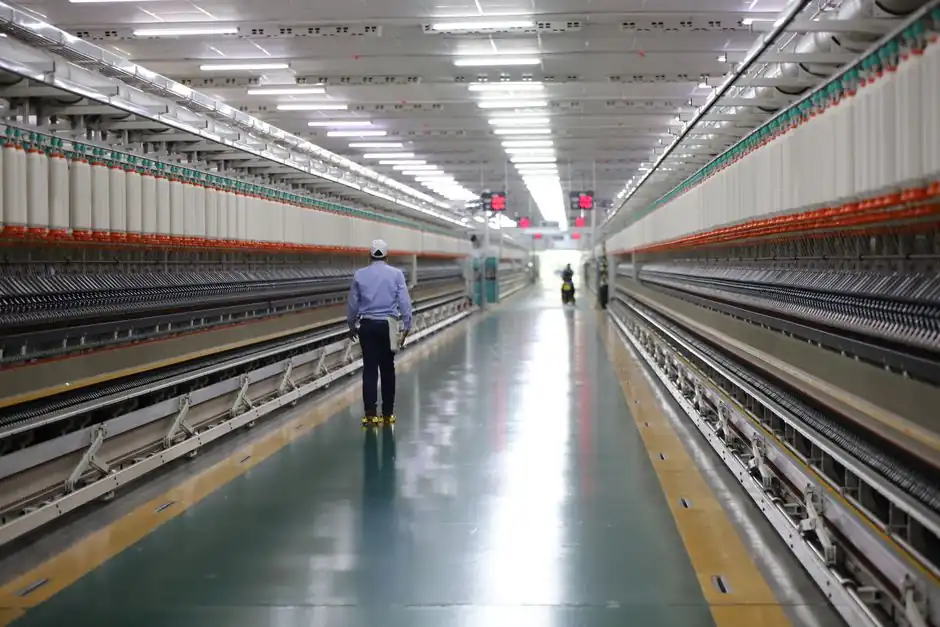
Crossed roller guides are precision linear bearings with flat cages that deliver high load rating, long service life, and high stiffness through cylindrical line contact, typically specified for stroke lengths under 1 meter [S1]. In a textile mill, these traits map directly onto loom-shuttle drives, let-off motions, take-up rollers, and stenter-chain carriages, all of which operate over short travels with high reversing frequency and continuous exposure to fiber lint.
Unlike recirculating-roller linear guide systems, crossed roller designs have no recirculation path, so there are no pulsations at load-zone entry or exit, and the gap between static and dynamic friction stays narrow [S2]. That low breakaway-to-running friction ratio is what keeps a loom cam follower or a winder traverse from stuttering at every direction change.
Why Textile Short-Stroke Axes Favor Crossed Roller Geometry
Crossed roller bearings in the SX series correspond to ISO dimension series 18 with a very small section height, support axial forces in both directions plus radial loads and tilting moments, and are usually supplied with normal clearance, clearance-free, or preloaded conditions [S3]. That combined-load envelope matters on a loom: a take-up roller sees axial pull from the cloth wind, radial load from the fabric tension, and a moment from any misalignment in the cloth path, often simultaneously.
For textile humidity, Schaeffler also offers a corrosion-resistant variant of the crossed roller bearing, which fits the steamy sizing-frame and dye-house environments where standard 52100 bearing steel would pit [S3]. The same humidity logic applies to crossed roller way guides: IKO lists stainless-steel versions of the CRW type in multiple sizes for superior corrosion resistance [S4]. When fiber dust combines with condensate, pitting is the dominant failure mode, not fatigue.
Selection Inputs Buyers Should Lock Down First
Selection starts with the application, not the catalog page: define equipment type and bearing position, then radial, axial, and moment load, plus speed, duty cycle, mounting space, rigidity target, preload or clearance, starting torque, environment, and required inspection documents before requesting a quote [S5]. On a textile line, the bearing position changes the calculation: a stenter-chain bearing runs near-continuous at low speed with heavy thermal cycling, while a rapier-loom gripper head runs intermittent and high-acceleration.
Buyers should state radial load, axial load, and moment load where values are available, and if not, provide the machine function, expected workpiece weight, offset distance, motion pattern, and duty cycle so engineering reviewers can size the basic dynamic load rating [S5]. For a creel traverse or a doffing carriage, the offset distance from the carriage to the yarn package center is the moment-load lever that engineers most often miss.
Cage and Construction Variants Worth Comparing
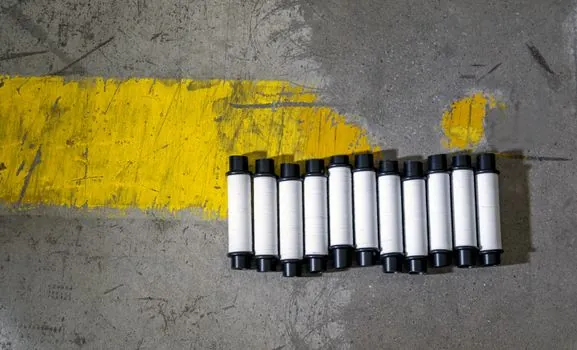
Crossed roller bearings SX use plastic spacers between rollers instead of a conventional pressed cage, which lowers mass and avoids cage-induced brinelling at high acceleration [S3]. IKO's Crossed Roller Way Guides (CRW, CRWM) use a roller cage between two linear ways with V-shaped surfaces acting as track grooves, so the cylindrical rollers are alternately crossed and the structure handles loads in any direction with accurate, smooth motion [S4]. The standard CRW has four ways and two roller cages; the CRWM module version merges the two inner ways into a single component, which simplifies bedding-plate machining in a loom slide.
Where cage creep is a risk, IKO's Anti-Creep Cage Crossed Roller Way Guides (CRWG) add a rack-and-pinion mechanism that locks the cage to the carriage stroke, with a CRWG-H heavy-duty raceway variant for extreme loads and stainless-steel options for corrosive zones; both CRWG and CRWG-H are rated for vertical-axis use, which a winder lift or a doffer hoist may require [S4]. For limited-stroke packaged solutions, the CRWU and CRWUG units integrate the ways and cage into a single bolt-down module, removing a layer of installer error on a retrofit loom slide.
Load, Stiffness, and Accuracy Trade-Offs
Crossed roller slides are factory-preloaded to remove internal clearance, which also minimizes linear-guide deflection under load within the catalog load capacity, but the installation surface still has to hold parallelism and flatness, because crossed roller slides do not forgive a warped bed the way a profile-rail linear guide can [S2]. On a knitting machine or a winder, a 0.05 mm bed flatness error across 500 mm of stroke can double the running friction and halve the fatigue life.
Crossed roller slides also maintain extremely smooth motion because the omission of roller recirculation eliminates the entry/exit pulsations of recirculating-roller linear guide types, making them the leading option for short-stroke µm or nm positioning tasks and for axes with frequent stops and starts on very short strokes [S2]. That same trait is what keeps a yarn-tension sensor head from vibrating the tension reading at high loom rpm.
Where Crossed Roller Guides Are the Wrong Choice
If the axis stroke exceeds roughly 1 meter, or if the duty cycle demands a recirculating element to keep cage-stress low over long travels, a crossed roller guide is the wrong product class, and a profile-rail linear guide or a roller bearing based recirculating system will outlast it [S1]. High-speed continuous rotation at thousands of rpm is also outside the design envelope of most crossed roller ways, which target indexing and short-stroke reciprocation.
Contaminated, unlubricated cotton-lint environments will chew a standard crossed roller guide unless the bearing arrangement includes effective sealing; crossed roller bearing arrangements rely on seals fitted in the adjacent construction, and the seal groove profile is a Schaeffler-defined geometry, not a generic O-ring pocket [S3]. For dirty, hot, and humid areas, plan a labyrinth seal plus a felt wiper, and confirm the lubrication interval against the mill's wash-down schedule.
Field-Proven Sourcing and Specification Discipline
Buyers should confirm whether a standard series fits or whether a custom review is needed, and if a replacement is being quoted, send the existing part number, photos, and machine position so the supplier does not assume the wrong internal clearance or preload class [S5]. Inspection reports, certificates, and traceability paperwork are non-negotiable on modern weaving machines, where a single false-twist spindle downtime can cost more than a year's bearing budget.
For textile-mill procurement, the practical checklist is: (1) ISO 18 series crossed roller bearing for rotary table or tensioner shaft, in SX stainless variant if humidity exceeds 80 percent RH; (2) CRW or CRWM crossed roller way in stainless steel for loom slides under 1 meter stroke; (3) CRWG or CRWUG where the axis is vertical or where cage creep has been observed; (4) matched seal kit rated for fiber-lint exposure; (5) verified mill flatness of 0.03–0.05 mm across the mounting footprint before bolt-up. For projects that pair the linear-motion retrofit with a drivetrain upgrade, see how disc coupling selection for wind turbine drivetrains frames torque and misalignment on adjacent rotating equipment.
For component-level specifications, see crossed roller guide.