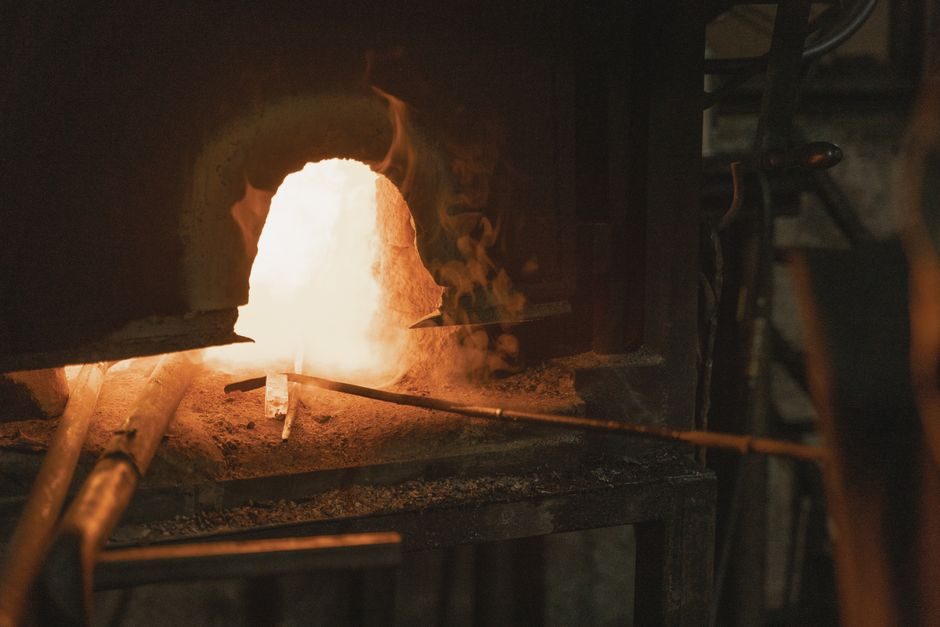
In foundry and non-ferrous melting practice, the "crucible furnace" and the "line-frequency induction furnace" belong to two different equipment families — the first is almost always a coreless (crucible-type) induction furnace, the second is the channel-type mains-frequency holder, and the comparison between them is a duty-based decision, not a head-to-head [S4][S5].
The terminological drift is the first spec trap: Chinese customs tariff subheading 8514.90.90.00 groups parts for both resistance-heated and induction industrial furnaces, and HS classification for a "non-ferrous crucible energy-saving line-frequency induction aluminium melting furnace" lands in that family — confirming that the crucible variant sits inside the induction umbrella, not alongside it [S1]. For buyers writing RFQs, the 50/60 Hz mains-frequency coil is the common thread, but the refractory geometry is what determines the operating envelope.
Equipment Definitions and the Two Sub-Families
A coreless crucible induction furnace uses a water-cooled copper solenoid wound around a refractory-lined crucible; mains-frequency (50/60 Hz) and medium-frequency (typically 1–10 kHz) variants exist, with mains-frequency dominant for large-tonnage iron and steel melts because the deeper skin depth at 50/60 Hz couples to a larger bath [S4][S5].
A line-frequency induction furnace in the strict sense usually refers to a channel-type (Rinnenofen) design where a molten-metal loop passes through an inductor channel; it is operated continuously, not batch-wise, and is the workhorse of holding and casting for cast iron, copper and aluminium alloys [S4]. IAS Induction's MetalLine range, for example, markets both coreless and channel products as one induction-melting portfolio, illustrating the shared physics but split duty profile [S4].
Duty Profile: Batch Melting vs Continuous Holding
Coreless crucible furnaces are sized for cold-charge melting, alloying, and intermittent tap — electromagnetic stirring intensity is set per heat, so the bath homogenisation is high but the thermal cycle is repeated on every batch [S4]. Channel (line-frequency) furnaces, by contrast, are operated filled and held near pour temperature; their inductor channels are preheated and primed before commissioning, and the unit is rarely drained, which makes them efficient for steady-state casting lines and for foundries feeding holding furnace flows into automatic moulding [S4].
The Steel in Translation review (2019) of induction crucible furnaces identifies the heavy refractory wall and the single-layer tubular copper inductor as the chief loss mechanisms — both are inherent to the coreless geometry and are the principal targets when up-rating an existing installation. For 2026 retrofit decisions, the practical question is therefore not which of the two is "better" but which duty window the line runs in, a frame also surfaced in the holding-furnace selection literature for foundries — see the 5 engineering gates for 2026 holding-furnace spec.
Selection Criteria, Compared
Four criteria separate the two at the RFQ stage: (1) batch vs continuous duty, (2) holdover loss per hour, (3) lining life in heats or weeks, and (4) electromagnetic-stirring control range. Coreless units win on flexibility and alloy-change speed; channel units win on kWh-per-tonne at temperature and on refractory life measured in months rather than tens of heats [S4].
A second-tier criterion is electrical impact: mains-frequency channel furnaces draw directly from the three-phase supply at 50/60 Hz with high inrush on start-up, while large coreless mains-frequency furnaces typically require power-factor-correction capacitor banks and produce significant harmonic content on the supply — the same reason IEC 61000-3-12 harmonic-emission planning is a routine item on European 2026 spec sheets for new induction-furnace installations feeding casting lines. For a 2026 sourcing frame, the holding-furnace cost breakdown in capacity, refractory and burner drivers reaches the same conclusion from the burner/holding side: refractory and continuous-duty losses dominate the lifecycle cost.
Refractory, Coil and Lining: Where the Specs Break
For coreless crucible induction furnaces the liner is sintered (or cold-cured) refractory, rammed around a crucible former; a US patent (US4351058A) describes the dry-ramming mix with sintering agent plus cold-curing binder and non-sintering granular fill, sealed with patching compound at coil exit — confirming the layered construction is the default and the patching compound is a service item [S5]. The 2023 International Journal of Metalcasting study on medium-frequency coreless induction furnaces further shows that coil failure in the bottom 1–6 turns is driven by carbon deposition and silicon-steel charge contamination, not by electrical stress alone, and recommends keeping silicon-steel charge separate from new linings as standard practice [S3].
For channel furnaces the inductor throat is the limiting element: the molten metal in the channel must remain liquid at all times or the channel freezes, so holding units are designed for low power-density continuous operation, and the 2019 review calls out heavy-walled coreless liners and single-layer tubular copper inductors as the two main efficiency bottlenecks that newer designs try to address with multi-strand or rectangular-section copper. IAS Induction markets adjustable electromagnetic bath-movement on the coreless side as a feature, while the channel side is sold on electrical efficiency at temperature [S4].
Standards, Tariff Codes and Compliance Footprint
For 2026 imports into China, a "non-ferrous crucible energy-saving line-frequency induction aluminium melting furnace" classifies under 8514.90.90.00 (parts of industrial resistance-heated furnaces and induction furnaces) with the CIQ code pathway tied to electrical-product safety and pressure-vessel rules if a sealed melt chamber is present [S1]. This is a customs-track fact, not a design standard, but it tells procurement teams that the import paperwork and CCC routing are identical for both sub-families [S1][S2].
On the safety side, ATEX category 2 / IEC 60079-xx zoning is typically applied around the melt deck where molten metal and hydraulic actuators coexist; the inductor itself is sealed and water-cooled, so the hazard zone is generally the ladle transfer path, not the coil enclosure. Buyers writing 2026 RFQs should pin the zone classification on the layout drawing rather than on the furnace nameplate, and should keep HART, Foundation Fieldbus and PROFIBUS PA off the same digital fieldbus segment when retrofitting instruments into existing molding line controls — they are not electrically interchangeable.
Use Cases and a Sourcing Decision Rule
Use a coreless crucible furnace when the workflow is melt-pour-pause-melt, alloy changes are frequent, charge size is variable, and bath homogenisation matters more than kWh-per-tonne at holding. Use a line-frequency channel furnace when the line runs 8+ hours of continuous pour from a fixed alloy, when a single holding furnace feeds an automatic molding line at steady rate, and when channel-thaw risk can be managed by a preheated start procedure [S4].
Trackable signals for the next 12 months: revised IEC 60079-0/-11 cold-start language for large induction coils, and any update to IEC 61000-3-12 harmonic-emission limits that affects how channel furnaces are PF-corrected in EU foundries.